April 12th is not only the day that Yuri Gagarin undertook the first Manned flight into space … it’s also the birthday of the great Russian explorer Nikolay Mikhailovich Prezhevalsky.
The town of Karakol lies at the eastern end of Lake Issyk Kul. Its name in Kyrgyz means “Black Hand” – and although that may have connotations to Englishmen of a certain age, it probably refers to the early Russian settlers and the effect of working the soil in the region. Before Independence the town was named after this great explorers of Central Asia. He actually spent far more time “discovering” other parts of Central Asia than wandering around Kyrgyzstan – but had the misfortune to contract a fatal disease and die here. More…
Last week one of our staff walked into my office and told me that I had a visitor from the Tatar Choir “Berdemlek”. I said that it was OK, I knew who it was and what it was about.
Sure enough, it was one of the members of the choir who had brought me an invitation to a concert on Sunday in honour of the 125th anniversary of the famous Tatar poet Gabdulla Tuqay. She had been to see a few weeks ago along with the Choir’s Director to tell me about the concert and ask for sponsorship. I have known them for several years, the choir used to meet for practices in the music school behind our office and over the years we’ve occasionally offered support for some of their activities. It is difficult to find sponsorship for cultural activities at the best of time, but in the current climate many firms have plenty of calls on their meager budget for charity and sponsorship. We are no different in that respect, but as we have a long standing relationship with the choir, I was happy to agree again this time. More…
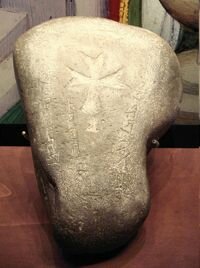
Nestorian tombstone with inscriptions in Uighur, found in Issyk Kul, dated 1312.
Kyrgyzstan is a secular state, although the majority of the Kyrgyz would classify themselves as Muslim. Over the centuries, however, Kyrgyzstan’s position on the Great Silk Road meant that it was exposed to a wide variety of religious ideas and traditions. Indeed, at least one author has claimed that the Great Silk Road could just as easily been called the Road of Ideas.
One of those religious traditions was that of Nestorianism, named after Nestorius who was installed as the Archbishop of Constantinople on April 10th, in 428. More…
A photograph uploaded to my Facebook page brought me an intrigued email … “was that a Research Machines 380Z?” For those who don’t know – the 380Z was one of the early microcomputers designed specifically for the educational market in the UK. It was a little bigger than a desktop computer is these days, but packed a lot less power. It was an 8-bit machine based on the Z80 microprocessor. The standard model came with just 16Kb of internal memory, and had two 5¼ inch floppy disk drives. It cost an arm and a leg. We had one of them which we used to teach Computer Studies. More…
So, April 7th has come and gone. An important date, an important anniversary, in the history of Kyrgyzstan. I did think about writing a postcard yesterday to mark the anniversary but, instead, I chose to write on a neutral topic and see how the day developed.
In the last few weeks, since before the 24th March anniversary of the original Tulip Revolution, a lot of attention has been concentrated on the impending anniversary. The controversy on whether the day should also be declared a public holiday was eventually answered earlier in the week when the Ministry of Labour issued a statement that, as they had received no instructions to the contrary, it was to be a normal working day. So that issued was settled, at least for this year. More…
About two weeks ago, I wrote a postcard about ski orienteering, and the Kyrgyz team attending the sport’s World Championships in Sweden. In the recent Asian Games in Almaty, they did much better, the men’s relay team taking 4th place. Unfortunately, the team didn’t do so well, in Sweden but they did manage to gain valuable international experience.
Ski Orienteering is just one form of the wider sport of Orienteering. I also wrote another postcard last year about an orienteering event which I attended in Karagachova Rosha, one of Bishkek’s parks. More…
April 6th, 2011 Author ian Sections: Tourism
One of the few songs that I can sing all the way through is a folk song which was popular in my youth, ”Where have all the flowers gone?” It helps that the words are repetitive and like a round, so they are easy to remember. More…
Vehicle registration numbers can convey a lot of information about the vehicle, and sometimes about the owner.
In France, for example, the last two digits tell you in which Department the vehicle is registered – at least it did until 2009 when the system was changed. When I used to accompany school trips to France the teacher in charge used to give everyone instructions to be on the lookout for a particular number … she “collected” the numbers and was trying to see the all in sequence, from 01 to 96. She was stuck on the number 20 for a long time because that was allocated to Corsica, and she thought she might have to arrange a special trip there because there were so few Corsican vehicles on the mainland. However, she proved lucky and so was able to progress onwards … More…
I am sure that most people in the world have heard about the “Seven Wonders of the Ancient World“, although not everyone could name them all. In fact, most of them no longer exist with only The Great Pyramid at Giza still surviving.
There has been some controversy over the fact that the list misses out a number of “wonders”, mostly from other parts of the world not known to the ancient scholars of the first and second centuries BC who originally comprised the lists. A competition was held to select the “New Seven New Wonders of the World” and the winners announced in July 2007.
The same people who organized that competition are currently running a similar one: The Seven wonders of the Natural World. Many people, myself included, like making lists such as these and in his book. “Kyrgyzstan – the Word about Motherland”, Kanibek Imanaliev suggests that the Kyrgyz have seven “objects of worship”, (the word used in the Russian version translates as “sacred objects, or relics”, but I have chosen to use the term “icons” instead). He maintains that, without these, it is impossible to fully understand the life of the Kyrgyz people. Certainly, they each play an important role.
More…
These days, news travels far and wide. This fact was brought home to me last week by a letter which arrived addressed to the hotel.
There was no addressee on the envelope, just two UK stamps, an “air mail” sticker, and a printed label displaying the hotel address, (with Bishkek misspelt). Inside were three small pieces of paper held together by a paperclip.
Two were identical. They were about the size of half a sheet of A5 paper, and reminded me of the postcards that you would see in the local shop or postoffice on a small noticeboard. Indeed that’s probably what the were because the third piece of paper, the smallest, bore the legend:
Could you display these small posters for us please?
We would be very grateful indeed.
With thanks and best wishes,
PAWS IN NEED reg charity 1110537
More…