So, who was Gabdulla Tuqay?
Last week one of our staff walked into my office and told me that I had a visitor from the Tatar Choir “Berdemlek”. I said that it was OK, I knew who it was and what it was about.
Sure enough, it was one of the members of the choir who had brought me an invitation to a concert on Sunday in honour of the 125th anniversary of the famous Tatar poet Gabdulla Tuqay. She had been to see a few weeks ago along with the Choir’s Director to tell me about the concert and ask for sponsorship. I have known them for several years, the choir used to meet for practices in the music school behind our office and over the years we’ve occasionally offered support for some of their activities. It is difficult to find sponsorship for cultural activities at the best of time, but in the current climate many firms have plenty of calls on their meager budget for charity and sponsorship. We are no different in that respect, but as we have a long standing relationship with the choir, I was happy to agree again this time.
The Tartars are a Turkish people from the Volga region in Russia – where they have their own Autonomous Republic, centered around the capital: Kazan. Although they are descended from the Mongol Golden Horde, most resemble Russians rather than the other Turkic peoples. The Tsar began encouraging the Tartars to begin settling in Central Asia in the middle of the 19th century as farmers, traders and clerical workers. In 1944 another trance were deported here by the Soviet authorities from the Crimea. A large number have emigrated to either the Crimea or Russia since Independence and there are now just over 50,000 in Kyrgyzstan.
Despite the fact that they represent a particular ethnic group, the events put on by the various Tartar societies in Kyrgyzstan tend to attract a wide variety of support and attendance from several of Kyrgyzstan’s various ethnic communities.
This concert, however, looked as if it was going to be more concentrated Tartar affair. Because the question of raising sponsorship was proving to be difficult, they had cut back on their plans for holding a major festival, however they still had an ensemble from Kazan and another local Tatar ensemble, “ Duslik” participating in the event.
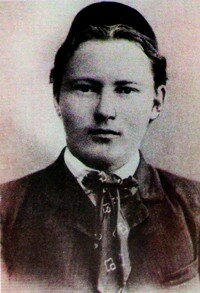
So, that raised a question: Who on earth was Gabdulla Tuquay?
Born into the family of a local mullah on April 26th, 1886, Gabdullah was a poet, a critic and a publisher of Tartar classic literature. He had a difficult childhood, growing up in a number of different families – something I could identify with as I spent the first two years of my life passed between relatives and eventually ending up in a children’s home whilst my mother recovered from TB. Gabdullah wasn’t so luck as many of the people who helped to raise him died early.
His father, for example, died when he was only five months old, and his grandfather shortly afterwards and so he grew up in the household of an old woman in the village until eventually accepted into the family of his stepfather. When he was six, his mother also died and he moved in with his grandfather’s family.
Times were tough, however, and he was taken to the capital, Kazan, in the hope of finding someone who would adopt or foster the boy. He spent two years in the city with a tanner and his wife, but when they both died he returned to his grandfather once more, who found him some more foster parents in a nearby village where he began to attend the local madrassah. His home changed once more when he was adopted by a merchant who sent him to a Russian school where he started to learn about Russian literature and became inspired to be a poet.
Once more death intervened and the Gabdullah moved into the madrassah and studied diligently. By the time he was 16, however, he had grown critical of, and lost interest in, his religious studies, gave up shaving his hair, he drank beer and even smoked, but his interest in poetry was developing.
As well as his interest in Russian literature, especially Pushkin, he started collecting folklore songs and epics. He was exposed to a wide variety of influences, including Arabic, Persian and Turkish poetry. He gained an interest in the Old Tartar language, which included a mix of Arabic, Persian and Turkish words. Meeting with different poets he also learned about poems written in the Oriental tradition.
He was beginning to get his poems published and he participated in the publication of several magazines, which often featured his poems, articles and translations. A political and socially aware activist, as time passed, he was outraged at the exploitation that he saw around him and over the years moved closer to the left of the political spectrum. Some of his work fit the satirical tradition, poking fun at the religious teachers of his youth. This didn’t exactly enamor him to the authorities, and although he was the subject of investigations and interrogations, he managed to escape the worst excesses of any repression. Despite his interest in Russian literature, he was was a staunch nationalist and was even accused of being anti-Russian.
He continued to develop a wide variety of interests including linguistics, children’s literature and drama.
He suffered from ill health, having an eye condition known as “walleye”, which led to his being rejected from service in the Imperial Army. Eventually he was contracted tuberculosis and died from the disease on April 15th, 1913, at the age of just 27.
He’s a national hero amongst the Tatars and his poem I, Tugan tel, (“Oh My Mother Tongue!“), is the unofficial hymn of the Tatar language. He is often compared to Shakespeare and Lord Byron. During the Soviet period, the main emphasis was on his social poems, but in recent times it is on his works on Tartar traditional customs.
This year marks the 125th anniversary of his birth and in Tartarstan 2011 has been declared The Year Gabdulla Tuqay.
Hence the concert.
.
I was warned that I was going to be asked to give a speech – here’s what I said … or, at least, what I planned to say:
A couple of weeks ago, two ladies from the Tatar Union “Berdemlek” came to visit me in my office and told me that they wanted to hold a concert in honour of the 125th anniversary of Gabdullah Taqay.
To be honest, I asked: “Who?”
They explained to me that he was a classic of Tartar literature, a poet, who sadly died very young.
So I went and searched the internet and found some information about him, his life and work. And, I have to agree with Mark Zaretsky, who wrote:
Поэта жизнь, короткая такая,
Была смертельный бой, великий труд.
The poet’s life, so short,
There was a deadly fight, great work.
As I read some of his poems, I found this verse which I would like to share with you:
Изгнать вражду пора пришла.
Друзья, — разделены тела,
Но души мы, не помня зла,
Объединим навеки.
Banish enmity, its time has passed.
Friends – separated bodies,
But in our hearts, forgetting evil,
United forever.
All that is left for me now is to say, Thank you for inviting me and introducing me to this poet, and also to wish you a successful celebration.
I had a little problem because one of the other speakers before me used a similar quote from Gabdullah’s poems so I had to own up and miss that bit out.
.
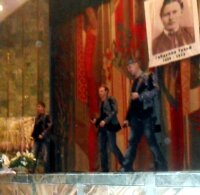
The auditorium was packed. Most of the seats were already taken by the time that I arrived, and people were, literally, standing in the aisles. Fortunately, I had a seat allocated to me … in the front row.
The concert was in two parts. The first was an eclectic mix of national songs and folk music, (including some gutteral songs which might have been hard on the ear if I was hearing them for the first time but, fortunately, I had come across this form of “folk music” before and so was prepared for what to expect), recitals of various poems, some traditional dance, a re-enactment of a folk tale, and a short talk on the life and work of the poet.
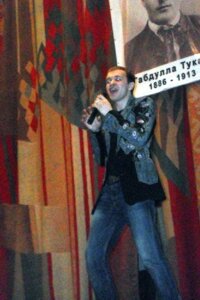
The second half consisted of a performance by a trio of young singers from Kazan, who had been sent with the help of the Ministry of Culture from Kazan: Marat, Artur and Aidar. If the concert began with the ensemble Duslik in traditional costume, some of the later acts were performed in more traditional suits and dresses. The three young men, however, sported jeans, black T-shirts and blue embroidered jackets.
I confess that the term “boy band” popped into my head because they had an extremely wide repertoire. Most of the songs were, I think, traditional Tartar songs, but set to a wide variety of musical genres. They encouraged audience participation and as well as clapping many of the audience joined in singing the lyrics.
To be honest, I didn’t understand much of what was going on because everything was in Tatar. However, the music was good. There were two songs in Russian, but only two. The woman next to me kept leaning over to tell me the theme of the each number which helped a little. One of the performers, Marat, even said that in all their travels, they were pleased to be in a place where so many people spoke their native language, Tartar. I think, however, that had there been any Kyrgyz present, then they would probably have understood a bit more, because Tartar is, like Kyrgyz, a Turkic language.
The audience was extremely mixed. As well as pensioners, there were several young people, and a few children, and two young schoolgirls recited poems. Even the pensioners were relishing the performance, with their feet tapping and on a couple of occasions some people stood up and were, (once again, literally), dancing in the aisles.
They had brought with them some specially prepared CDs, with a cover displaying a portrait of the poet. When I asked where I could get one, however, I was told that they had all sold out.
.
Once the concert was over, I was invited back to the “post concert” celebration at the home of the Vice President of Berdemlek. There we were treated to some traditional Tartar cuisine and the singing continued. After the traditional toasts, the accordionist moved around the table and people took turns to sing. The group even managed to pick up a song written by one of the local people which they asked if they could include in their repertoire.
.
For them, it was a flying visit. Marat said that they have performed in many places in the countries of the former Soviet, often entertaining members of the Tartar diaspora, but this was their first time in Kyrgyzstan. Judging by the reaction, I think they will be back. If they do come back, then I will certainly be looking for a ticket, and this time, I’ll be sure to get to the front of the queue to buy a CD.
.






 Bishkek