Marking time
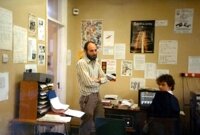
A photograph uploaded to my Facebook page brought me an intrigued email … “was that a Research Machines 380Z?” For those who don’t know – the 380Z was one of the early microcomputers designed specifically for the educational market in the UK. It was a little bigger than a desktop computer is these days, but packed a lot less power. It was an 8-bit machine based on the Z80 microprocessor. The standard model came with just 16Kb of internal memory, and had two 5¼ inch floppy disk drives. It cost an arm and a leg. We had one of them which we used to teach Computer Studies.
Then, one day during the February half term, the Headteacher at the school where I was teaching came in and said that he had just seen a report that Acorn Computers were going to run a special offer for schools, who could buy a BBC computer for just two hundred pounds and he wanted to buy two of them – but he wasn’t sure where he could find the money.
In the end, he found the money to buy eight and put me in charge of the computing department with the specific task of developing a “Computer Awareness” course which would be taken by all students. “The aim should not be to teach computing,” he told me, “but the use of computers across the curriculum.”
That was just over twenty years ago. I am still amazed whenever I think about those heady days, and what we managed to achieve … especially with the resources we had available.
It could all have gone wrong, of course. In many ways it was a gamble. Although there were many people who could see a bright future for computers and predicted how they would soon pervade every aspect of human life, there were also a fair number of critics who saw them as just another fad.
As a teacher of computers and computing, one of the topics that I, personally, found most interesting was the history of computing. It is full of rapid leaps and bounds, but also the occasional blind alley. The classic of course was Charles Babbage’s Analytical Engine which, had it ever been completed, was supposed to have catapulted the Victorians into a new age of steam driven computers. The management at, what is now, one of the biggest manufacturers of computers thought there was really only a market for a handful of computers. For every example of Apple, Google or Facebook that has made its founders into millionaires, there are plenty of examples that have floundered. And, not just in the dotcom boom and crash.
As it happens, however, the self-confessed “illiterate” in all matters relating to computers turned out to be a visionary and in those twenty years things have changed tremendously.
About ten years before that, I had bought my first electronic calculator. It had just four functions – that’s right: add, subtract, multiply and divide. A week later, (literally, just one week later), one of my friends went out and bought a calculator for himself, which cost him half of the price I had paid and, as well as having the same four functions, it also a percentage button … and a memory. I was furious. On the other hand it was a good lesson which I have never forgotten.
As the former British Prime Minister once said, “A week is a long time in politics!”
.
This week, of course, has seen the anniversary of the revolution which took place on April 7th last year, and the events to commemorate the event have in many ways dominated the news. The controversy on whether the day should also be declared a public holiday was eventually answered earlier in the week when the Ministry of Labour issued a statement that, as they had received no instructions to the contrary, it was to be a normal working day. So that issued was settled, at least for this year. The Prime Minister, however, said at a rally that April 7 should become a holiday … but, “Not now, when pain of losses is still hurtful.” He cited the situation in France where “Bastille Day” is not only a national holiday but in many respects is considered the country’s National Day. However, it was established as a holiday only many years after the events which resulted in its “liberation from tyranny”.
There had already been a number of meetings and conferences dedicated to the day, and the lessons to be drawn from the lead up to the events, the happenings on April 7th and their aftermath. The President went on a tour to Talas, where, on April 6th, it could be said that the revolution began in earnest with the storming of government buildings. Exhibitions have been held, a film dedicated to the events a year ago and a book about them has been published.
On the day itself the centre piece was a minutes silence at three o’clock. A special memorial was unveiled at at a ceremony and service at At Beyit on the southern outskirts of Bishkek, (a memorial to the fathers of the nation who were massacred at Chong Tash in 1937 and the cemetery in which many of those killed last year were laid to rest), during the morning; another service was held near the forum accompanied by the planting of trees, followed by a march to the central Ala Too Square; A requiem service was held in the main Ala Too Square with flowers laid at the fence of the White House; requiem prayers were said in villages throughout the Batken oblast; a football tournament was held in Cholpon Ata in Issyk Kul … amongst a host of other activities.
The parliament suspended its sitting for two days so that the deputies could spend time with the people commemorating the anniversary.
That, at least, brought a respite in the argument between two of the deputies which ended in fisticuffs and blood and the hospitalization of one of them at the end of last week. There were reports that a reconciliation had been reached between them and that it wouldn’t affect relationships within the ruling coalition.
That’s not the only controversy. Last week the General Prosecutor was dismissed by the President and this week he made an appearance before the parliament. In it he made a number of allegations about the conduct of several members of the government, from the President downwards, and the bodies of law enforcement. The parliament has decided to investigate these allegations.
Amongst the allegations were accusations about phone tapping. During the previous regime special equipment was installed at all of the mobile operators which enable the authorities to eavesdrop on all telephone conversations. Apparently, so it is claimed, the system was widely used and some say that Maxim is still able to use it to listen to phone calls between deputies, even though he safely ensconced in the UK. The security services eventually responded to the allegations by issuing a statement that the system is only used under a court order.
There were also claims about the recurring issues, such as the Megacom scandal. It is still as clear as mud what’s happened, what’s happening and what will happen. The arrangements for the fuel supply for the Manas airbase is still under consideration, but at least fuel is now arriving from Russia. At one point there was no fuel in the country’s storage tanks, but farmers now have some to at least start work on the Spring planting season.
Generally, energy seems to have been one of the themes for the week. Somehow, Kyrgyzstan has paid all its debts to its neighbours for Gas supply, and there have been announcements of proposed new projects in Hydro-electric plants. We’ll have to see, however, if they actually materialize.
One reason why they might not is the insecurity felt by potential investors. For example, one Chinese potential investor was quoted in a report as saying something like, “we want to invest, but we are afraid”. I thought he was going to go on and talk about the security of his investment, or social and political instability, (both of which are issues constantly being raised by, and with, the IBC), but instead he went on to comment on the attitude of the tax and other authorities who, he said, seem to make problems as soon as his countrymen crossed the border. It seems to me that there is a problem here, and it doesn’t just affect the Chinese, although they are probably affected more, simply be the fact that there are so many of them here. There are some stories of this sort of thing appearing, and not just from the Chinese. As an example, there was a report posted on one of the local websites of a Filipino businessman who faced all sorts of problems including arrest and incarceration for tax violations, even though, he said, the tax authorities had never told him what they were.
Anyone who wants to work as a “sole trader” can buy a “patent”, (a special permit which allows them to engage in economic activity without having to worry about tax and reports), but a foreigner has to pay five times more than a local citizen for the same document. The additional cost often makes it uneconomic. This may well help to protect local entrepreneurs but it also risks pushing the foreigner into the shadow economy. It also seems to go counter to the Constitution’s provisions against discrimination and the guarantee of equal treatment under the law.
The question of ownership rights is perhaps most prominent in the Megacom case, where it is not clear who owns what but it raised its head again with the decision to privatize once more about half of the “assets” nationalized following the revolution.
The debate about whether or not to join Russia, Kazakhstan and Belarus in the Customs Union continues. The government have said that a decision will be made later in the year and there is a lot of comment in the press about the relative merits and demerits of the case.
There have, thankfully, been other things during the week that have allowed us to think of issues not associated with politics. For example, the weather has improved and Spring finally seems to have arrived. The temperature is up in the mid-twenties and looks like staying there for some time. The trees and shrubs are sprouting and some of the bulbs have started to make an appearance. I just hope that I am not tempting fate by mentioning the fact.
There have been inspections and presentations concerning earthquake preparedness, which was just as well because we had another small one, (3.5), down south during the week.
The parliament are looking at measures to improve the rights of the Disabled and finally looking at amending the Family Code, but it’s not clear if that will actually mean that the adoptions by Americans and other foreign nationalities which were suspended before the revolution will be able to proceed.
It has been announced that there will be a pensions increase as from May, but it will be regressive. Those on the lowest pension of just 1000 a month, will receive an additional 600 som a month for those receiving over 10,000 som will get just 100 som extra. The measure will cost like a billion som in the course of a year and it is not clear where that is going to come from.
Finally, I have had a piece of bad news … Victor, the oldest of the cats, (he’s twelve and a half), has been diagnosed with Cancer. Tatiana wants to take him to another vet and get a second opinion, but I pointed out that this was already the second opinion, so I don’t see much point. Better to try and make him comfortable and hope that it’s a mistake. At the moment, he is basically OK, but goes into a fit about once a day. It’s funny that we don’t really think of cats getting Cancer.
.
Although it is a “long time”, and a lot can happen in the course of a week, this week hasn’t been too bad, apart from the commemorations of last year’s event nothing really dramatic has occurred. It’s been more like a case of “marking time”. Let’s hope it stays that way.






 Bishkek
Thanks for the Postcard. It was 1981, 30 years ago, when I had my first BBC Micro! None of us are getting any younger! I still have data on the 5″ disks and nothing to open them with now!!
On the investment front I have just done a grammar check on the Minister of Economy speech, presumably to you and other ‘foreign’ investors and it was pretty good in my view with a very simple approach to taxation
‘In the Kyrgyz Republic there are free economic zones. They are convenient places for the development of production capacities. These zones provide a wide range of benefits such as; exemption from all taxes, fees and payments for the entire period of activity. The only fee is a fee for providing tax relief amounting to 1-2% of revenue from sales of goods and services.’
I am very glad that you have a peaceful spell and Spring has arrived. Sorry to hear of Victors cancer but I think he has already had a very long life and am sure he gave much pleasure to you all.
Hope life treats you well and please convey my hugs and thoughts to your lovely ladies.
Yes, 30 years ago, not 20 (!) … I suppose I am showing by lack of numeracy skills despite having been a maths teacher … either I am getting out of practice – or I am just getting old.
The Free Economic Zones do provide the advantages that he states – but there are problems with them – especially the fact that they constantly seem to be under threat.
Your good wishes will be passed on to the “lovely ladies” when they next appear for work on Monday.
I am so sorry to hear about Victor’s illness! Hope it is not too painful for him…