Djoormat Bokonbaev
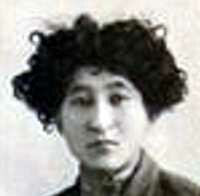
As I sat in the taxi heading South out of the city centre, I saw another one of those billboards announcing 100 Jill - 100 years – it’s another anniversary, a jubilee … and once again there seems to have been little publicity. This one, however, struck me as particularly odd.
I know that this year has been declared as the year of Kurmandjan Datka, the Queen of the Alai, who was born in 1811, so it is to commemorate her bi-centennial, but the poster said 100 years and referred to Djoomart Bokonbaev, who was a famous poet and playwright and is sometimes referred to as the Kyrgyz Pushkin.
What was confusing, however, is that he was born on 16th May, 1910, in the village of Mazar-Sai, which is in the Toktogul region, so his centenary was last year, not this one. Although I hadn’t seen that particular poster before, I doubt that it has been there for more than a year.
Anyway, For the record:
Bokonbaev’s parents died when he was 14 and so he went to an children’s home, where he stayed until he was sixteen.
He then studied in the pedagogical technical school and within two years was a head of department working on the newspaper Kyzyk Kyrgyzstan, (“Red Kyrgyzstan”). Between 1933 and 1935 he studied journalism in Moscow (in a communist party university) and when he returned to Frunze (Bishkek) he became the editor of the youth newspaper “Leninchil Djash”. Later he also served as editor of the art, literary and political magazine “Soviet Kyrgyzstan“, (which later changed its name to “Ala Too“).
His first poem, “The poor men that have received the land“, was published in an Osh regional newspaper in 1927 – just a year after leaving the children’s home. It was the first of many to be published. A collection was published in 1933 and during his life he published about 20 different volumes.
The themes he explored included the changing lives of the Kyrgyz people in the new Soviet society … celebrating the new life of the Kirghiz people under the conditions of socialist construction … and the inclusion of workers and miners into Kyrgyz literature was his particular innovation, for example writing about workers on various construction sites in poems such as Kyzyl Kyia; Suluktu; and Turksib. He also utilised historical themes in works such as Poverty and The Desert of Life. During the Second World War, his work displayed a patriotic fervour: Moscow Fortress, The Spirit of the Great Lenin, My Heart Is a Red Banner, Above the Lake. Although his poems were “politically correct”- within the system in which he grew up - they are considered to have combined propaganda with a deep lyricism.
He was also a playwright – his first play was a musical drama entitled “Altyn Kyz“, or “Golden Girl”, in 1937 – which was followed by a drama “Kargasha“. Collaborating with Malikovym and Turusbekov, he co-authored the librettos for the operas “Toktogul” and “Aichurek” – based on themes from the Manas epic – which are sometimes performed in the Opera Theater in Bishkek.
After the German invasion of the Soviet Union in 1941, he joined the Red Army as a volunteer – but was killed as the result of a car accident in the village of Chon Sary Oi, in Issyk Kul, on 1st July, 1944.
There was a bust of him in the central reservation of Prospect Erkindik, just down from Moskovskaya … but it was stolen – for the srcap metal value – in 2003. The thieves were caught within days of the event, and the bust was recovered – but it is still undergoing reconstruction.
One of the main streets in central Bishkek is named after him, (indeed there are several in different towns and villages throughout the country), as is the rayon administrative centre of the Ton district in the Issyk Kul oblast, a collective farm in the Toktogul district, as well as several schools and libraries throughout the republic.
.


 Bishkek