Which direction for orienteering?
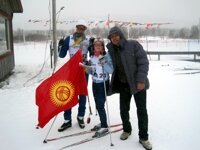
About two weeks ago, I wrote a postcard about ski orienteering, and the Kyrgyz team attending the sport’s World Championships in Sweden. In the recent Asian Games in Almaty, they did much better, the men’s relay team taking 4th place. Unfortunately, the team didn’t do so well, in Sweden but they did manage to gain valuable international experience.
Ski Orienteering is just one form of the wider sport of Orienteering. I also wrote another postcard last year about an orienteering event which I attended in Karagachova Rosha, one of Bishkek’s parks.
Orienteering first appeared in Soviet times when Kyrgyz athletes took places in the top five in All Union competitions. Some factories even had their own teams and specialist clubs. Orientation was also a part of military training, because every soldier must be able to navigate around a map.
With the collapse of the USSR, however, many of the specialists left Kyrgyzstan and development of the sport ground to a halt. Following independence in 1991, alpine downhill skiing and snowboarding gained in popularity but cross-country skiing and orientation remained at an elementary level.
In 2008, a Kyrgyz team took part in the Russian Hiking Championship and, on their return, it was decided to try and revive the sport of orienteering in Kyrgyzstan. Long term plans were set in motion to develop a variety of orienteering trails and competitions were organized, both hiking and cycle orienteering. The Tourist Sport Union also began working with both disabled persons and socially vulnerable groups in the population.
Then, in 2010, the federation received an invitation from the Kazakh Orienteering Federation to participate in the Asian Games in the Ski orienteering competition. The Kazakhs offered both organizational and technical support, and naturally, the Kyrgyz side seized the opportunity.
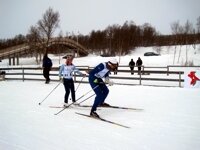
A search for suitable competitors to include in the team began. In the end, the squad comprised of representatives from the federations of mountaineering, rock climbing and ice climbing, snowboarding and water sports, as well as from the Tourist Sports Union itself. One of them in the men’s relay team had only two months experience on skis. Unlike many of the teams they were to be competing against, the Kyrgyz squad was basically prepared from scratch.
There was also an issue concerning the recruitment of trainers, not just competitors. At the moment there are about a dozen people in Kyrgyzstan who are qualified in “mountain tourism”, which includes the vital skills of topography and orientation. Some, however, are engaged in commercial activities, (for example, working in travel agencies), so although they are happy to act as judges in competitions, they are not actively involved in training schemes.
A training programme initially began in the September, but was hampered by the lack of snow which only arrived in December. In January, after just one month’s training, the federation sent a team to the Kazakh Championships which proved to be good preparations for the Asian Games.
There was a lot to learn. For example, there over 80 different kinds of lubricants used by competitors – the choice of which one to use will depend on the temperature and the type of snow. The coach, Ilshat Dautov admits that mistakes were made, but “the only people who make no mistakes are those who don’t try anything.”
As well as taking part in international competitions, there is a lot of work to be done within the country, if the sport is to develop and take off. Competitions are planned for both Spring and Autumn, including one organized together with the Mountain Bike Federation.
.
Developing ski orienteering, in particular, in Kyrgyzstan is not so simple. If Britain is known for changeable weather, then the situation in much of Kyrgyzstan is similar; the climate is often unpredictable – snow falls one day, but the next has already melted away. On the other hand, in some areas, such as around Naryn and Karakol, snow may lie for a long time. In order to raise awareness and develop the sport in these areas, however, there is a need to organize clubs and routes.
Then there is a question about equipment, which doesn’t come in cheap. Fortunately, some donation from federations abroad and some private sponsors some equipment has been provided, at least some second-hand, and it is planned to distribute it to clubs and schools.
.


 Bishkek