Vehicle registration plates
Vehicle registration numbers can convey a lot of information about the vehicle, and sometimes about the owner.
In France, for example, the last two digits tell you in which Department the vehicle is registered – at least it did until 2009 when the system was changed. When I used to accompany school trips to France the teacher in charge used to give everyone instructions to be on the lookout for a particular number … she “collected” the numbers and was trying to see the all in sequence, from 01 to 96. She was stuck on the number 20 for a long time because that was allocated to Corsica, and she thought she might have to arrange a special trip there because there were so few Corsican vehicles on the mainland. However, she proved lucky and so was able to progress onwards …
I used to do a similar exercise in Britain, where the numbers didn’t really hold any significance – that was all in the letters – starting with the number 1, and trying to get all the way to 999 … but I never got passed about 160.
Another game we used to play, especially on long journeys was to take the three digits of a number plate and try to make the third from the first two … so, for example, with 134, 1+3=4, or with 255, √25=5, or with 329, 3²=9 and with 136, 1×3!= 1x(1x2x3)=1×6=6, (you can tell I was a Maths teacher, can’t you!). Sometimes, the calculation resulted in a number which was more than just one digit, so you could repeat the process with the result until you eventually got to the desired result. For example: 629 → 6²=36 →3+6=9. Sometimes, on a journey we would hold a competition to see who could provide a solution first. I still try it sometimes on my long drive up to Naryn using Kyrgyzstan’s 4 digit registration numbers, but I don’t really have anyone to compete with which, sort of, takes the fun out of the game.
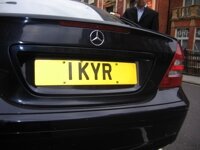
In the UK there is, or was, a letter that told you when the vehicle was first registered, which was a great boost for the industry every August, when the new letter was issued, as people vied to buy brand new cars with the all important status symbol. Another sales gimmick used in the industry was the sale of personalised plates, (like “JON 1 E” which used to belong to the actor Jon Pertwee, and 1 KYR which was the official car of the Kyrgyz Ambassador), and some could command astronomical figures.
.
.
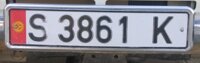
Vehicles in Kyrgyzstan are registered to a particular owner. When a vehicle is transferred to a new owner – the number plate is changed. Although the system seems to be constantly revised, there is a system to the way number plates are allocated … and it is possible to tell something about the owner of the vehicle from the number.
- Vehicles owned by a Kyrgyz citizen have a number plate which has a white background, with a Kyrgyz flag on the left hand side. The registration number usually takes the form of two letters separated by a four digit number, such as B1234A. Some recently registered vehicles have three letters such as: B1234AB
-
If, on the other hand, the two letters are together, then this means that the vehicle is registered to an organization (commercial or government administration) …
-
If the letters ar KG, then the vehicle is registered to the national government - there was some discussion to stop registrations as, it was claimed, the system was being abused.
-
The letters used to precede the numbers (for example: KG01) but in 2006 the system was changed so that the digits now come before the letters (such as: 01KG).
- Two digit numbers are registered to members of the Presidential administration and the heads and State Secretaries of various central (Republican) bodies,
- three digit numbers are designated to the Prime Minister’s Office, the Ministries, State Committees, and other administrative bodies of the government. There are also a few numbers allocated to the Heads of some companies, such as Kyrgyz Railways, the Electricity Generating company” Power Plants”, Kyrgyz Gas, … and so on.
- Basically the lower the number, the more important the person it is assigned to.
- 01KG is registered to the President. The president’s vehicles have no number on the front and a plate with the number displayed on the rear.
- 001KG is registered to the Prime Minister
-
The letters used to precede the numbers (for example: KG01) but in 2006 the system was changed so that the digits now come before the letters (such as: 01KG).
-
In other cases the letters will denote where the oblast where the organization is based and the vehicle is registered: AA (Batken), BA (Bishkek), DA (Djalal Abad), IK (Issyk Kul(, NA (Naryn), OA (Osh), SA (Chui) or TA (Talas).
- The Governors of the oblasts use numbers such as NA0001 – for the governor of Naryn Oblast.
- A vehicle with a registration BB, then this denotes a vehicle registered to the Ministry of Justice – or the Procurators’, (prosecutor’s) Office.
-
If the letters ar KG, then the vehicle is registered to the national government - there was some discussion to stop registrations as, it was claimed, the system was being abused.
- The first letters denote where the vehicle was registered:
|
Letter |
Oblast |
|
A |
Batken |
|
B and E |
Bishkek |
|
D |
Djalal Adbad |
|
I |
Issyk Kul |
|
N |
Naryn |
|
O and Z |
Osh |
|
S |
Chui |
|
T |
Talas |
(There are still some vehicles with the first letter H. This is the letter “N” in the Cyrillic alphabet – and when the change to the new format was introduced – in Naryn they continued to use the Cyrillic alphabet for a short time).
- Members of the police (Militsia) and the traffic police (GAI) often have numbers starting with 15 or 16.
- Recently registered vehicles may record the department or ministry to which the vehicle is registered, for eample: MVD = the Ministry of Internal Affairs.
-
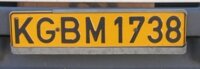
Vehicles owned by foreigners are usually given a Yellow plate – with four letters followed by four numbers – e.g. KSBM1234.
-
Diplomatic and International organizations (such as the World Bank or IMF) are granted Red number plates – the letter D indicates that it is registered to an embassy or consulate, whilst a T indicates a Technical registration for an international organization. The number plate also includes the date when the accreditation expires.
- Sometimes the registration is temporary, for example, if it is registered to someone for the period of their stay in the country – then the date when the visa expires (and hence the registration expires) may be displayed.
- There is one vehicle in Bishkek with the red number plate “PROTOCOL”. (I do not know to whom it is registered, but I often see it near the White House.)
- Vehicles registered to the United Nations are given a Blue number plate.
- Black number plates – with white numbers – are usually registered to a military establishment.
- A tractor has a T following the number
Some cars still sport an old soviet-style number plate using the Cyrillic alphabet – but, in theory, they should all have been re-registered and have received a new number plate in the Latin alphabet.
Trailers also are designated a number plate – they do NOT display the number of the vehicle towing them, as they would in the UK.
Large vehicles and buses are obliged to display their registration number in large letters on the back of the vehicle.
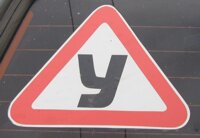
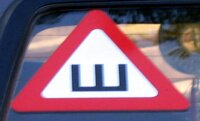
Back in Britain, vehicles being driven by “Learner Drivers” should display a sign with a letter “L”, but here they should display one with a Cyrillic letter: “Y” or “|_|_|” in a ‘red warning triangle’.
.
.
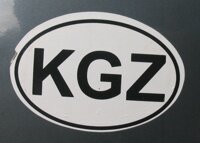
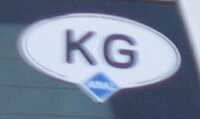
The international plate denoting that a vehicle is registered in Kyrgyzstan is technically KGZ – although you can sometimes see variations: KS, KG and KGS.

.
.
.




 Bishkek