Paws in Need
These days, news travels far and wide. This fact was brought home to me last week by a letter which arrived addressed to the hotel.
There was no addressee on the envelope, just two UK stamps, an “air mail” sticker, and a printed label displaying the hotel address, (with Bishkek misspelt). Inside were three small pieces of paper held together by a paperclip.
Two were identical. They were about the size of half a sheet of A5 paper, and reminded me of the postcards that you would see in the local shop or postoffice on a small noticeboard. Indeed that’s probably what the were because the third piece of paper, the smallest, bore the legend:
Could you display these small posters for us please?
We would be very grateful indeed.
With thanks and best wishes,
PAWS IN NEED reg charity 1110537
It seems likely that the news item a couple of weeks ago about the local authorities announcing that they intended to shoot stray dogs in the capital had been seen by members of the charity and they had decided to do something about it. I know that the story got quite wide publicity around the globe, probably as a result of the estimate that as many as 10000 animals could be targeted, (literally).
There are mixed feelings, locally, about the strays. Whilst some people feel pity for the poor animals, other are all in favour of the measure. Trust the British to feel sympathy for our “dumb friends”, but there are some grounds for concern.
According to the news reports there are a large number of them roaming the streets of Bishkek, and residents of some of the Microdistricts, (the residential districts, or suburbs, on the outskirts of town), are reported to be scared by them.
Most of the ones I see in the city center, (where I spend most of my time because that’s where I live, have my office and the hotel), are in ones and twos. There is one pack which often I sometimes see which consists of about five animals which run together and make an amuzing sight because they are different breeds and sizes. On the whole they are wary of people, and although they may yap at passers by, they turn tail and run more than they threaten anyone. The solo dogs are more “aggressive”, standing their ground more and barking loudly, but they too turn tail and run at the first sign that someone is paying attention to them.
A bigger problem seems to be the domestic animals that are often kept as guard dogs. They can bark well into the night disturbing sleep. We had one living near to the hotel when it opened and we installed additional double glazing to help deaden the noise. Fortunately, it is no longer a problem.
I do know one lady who lives in a village outside Bishkek, who was bitten by such a dog who had managed to get out of the yard and into the street, but it wasn’t a stray animal.
One of the real concerns is that there is Rabies in the country. Back in the UK, we are fortunately free of this disease, but we are aware of the potential threat posed by it. I once got bitten by a dog in France, in a village on the outskirts of Paris. Once again, it was a household pet. I can tell you that I spent a few anxious nights worrying about it. If it had been a stray dog, the doctor said, then he might have considered a course of treatment but, because it was a pet, it was unlikely to have been infected and it would be possible to arrange for it to be kept under observation.
We sometimes get asked by tourists for advice about Rabies and, for the record, here is what we tell them:
Rabies is an acute viral infection of the nervous system. Once symptoms develop in humans the disease is usually fatal however, if someone is bitten, then it is possible to get “post-exposure” treatment which – if given early enough – usually prevents the disease developing. Symptoms include delirium and painful muscle spasms in the throat.
Rabies can be contracted through a bite from an infected animal. There is a vaccine treatment against the disease and the CDC advices that travellers who might be exposed to wild or domestic animals through your work or recreation consider vaccination. The British Foreign and Commonwealth Office, on the other hand says:
“Rabies vaccination before travel is only recommended for those who may be exposed to an unusual risk of infection or who are undertaking long journeys in remote areas where medical treatment may not be immediately available.”
In any case, vaccination does not remove the need for urgent medical treatment in the case of a bite from an infected animal.
To avoid Rabies it is advised that you should: Avoid contact with animals: wild, stray or apparently tame. In any case, do not allow an animal to lick you; Cover all breaks in your skin (cuts, grazes, abrasions) with a sticky plaster or dressing.
If you are bitten: Wash the wound immediately using soap, (or detergent) and rinse with clean water; Disinfect the wound, for example with alcohol or some other strong disinfectant; Consult a doctor – or hospital. Explain that you have been bitten by animal that might be rabid; Make a note of the details of the incident – time, place, a description of the animal – including if it was wild, stray or domestic; Inform the local police; Inform the nearest consul or embassy and Consult your doctor immediately on your return home.
You should also ensure that your insurance policy covers emergency repatriation under these circumstances.
There is reportedly rabies in mountain areas, and most hospitals carry stocks of vaccine. Although we have never heard of a tourist contacting this disease, we do know of one case, some years ago, where a tourist was bitten by a dog and had to undergo a course of treatment. In 2003 there were about 50 cases of rabid animals, mostly dogs, reported in the republic, and in 2004 a number of people died from Rabies following dog bites. The incubation period can be as long as one year and clinical signs or symptoms include breathing complications, and the fear of water and light. Rabies is also found in neighbouring countries including China so you should be careful about contact with animals.
I have come across this policy of shooting stray dogs before, in Naryn. At that time there had been a number of cases of dogs worrying sheep and the authorities had issued an order that dogs worrying sheep were to be shot, and a bounty was paid for them. Although there weren’t any sheep in the town, stray dogs were duly shot on sight. Now, it so happened that one of our staff had a dog which he brought to work the guesthouse, and it wandered out through the gate, which happened to be open, into the street where a marksman found it and dispatched it.
Cats are not in such danger. At the moment I have three cats, and two of them arrived as strays. In fact we have had quite a large number of strays arrive over the years, but have been lucky enough to find homes for most of them. To be honest, I suspect that these two in particular were really domestic pets that had been abandoned, because they were remarkably tame and used to human company. Garfield, (the ginger one, very imaginatively named), for example, sat patiently inside the corridor outside the office and when someone opened the door he just marched in, found the saucer of where some cat food was laid out for one of the others, and started scoffing. He’s now settled down, (they both have), and is considered part of the team in the office. They even have their own Job Description.
.
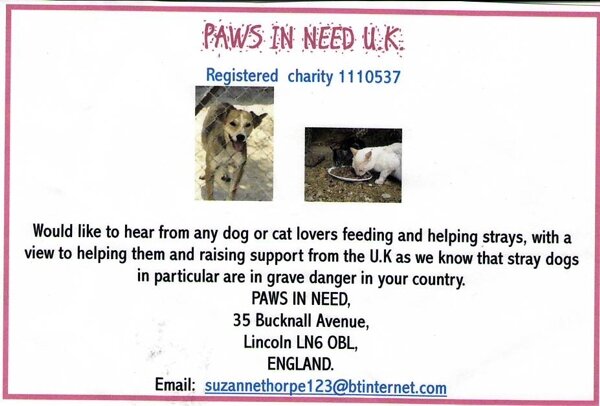
Anyway, I decided to do a piece of “due diligence” and find out a little about this charity.
I searched in Google for “Paws in Need” and came up with quite a few links to sites reporting on various activities, mainly in the US, concerning animals in distress. “Paws in Need” seems to be a catchy title, maybe because of the abreciation, “PIN”. I didn’t come across this organization, however, so I went to the Charity Commissioner’s website and typed into the search box the registration number. Up came a page of information about the charity.
Everything seemed to fit and looked in order, (except that the website listed there didn’t seem to be working).
The stated aim of the charity is to “provide neutering, vetinary help, and food for stray dogs and cats and also assist small groups helping them.” They further say that they seek to, “prevent and relieve the suffering and distress to dogs and cats who are in need of care and attention by reason of sickness or because they are stray, have been abandoned, neglected or maltreated.”
It’s a small charity, raising less than ten thousand pounds annually, so it doesn’t need to submit annual accounts, although they do submit an Annual Return/Update to the commissioners and have done so ever since they were established back in 2005. According to the information on the page, they support groups in Cyprus, Greece, Malta, Portugal and Spain. It seems as if they are intending to expand their efforts to Kyrgyzstan.
Well, I am not sure what help they are proposing that they can offer, but we have passed the information onto a family that we know who do look after some stray dogs and they promised to get in touch with the charity.
.








 Bishkek