Nestorius and the Church of the East
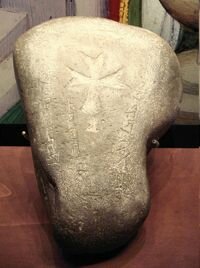
Nestorian tombstone with inscriptions in Uighur, found in Issyk Kul, dated 1312.
Kyrgyzstan is a secular state, although the majority of the Kyrgyz would classify themselves as Muslim. Over the centuries, however, Kyrgyzstan’s position on the Great Silk Road meant that it was exposed to a wide variety of religious ideas and traditions. Indeed, at least one author has claimed that the Great Silk Road could just as easily been called the Road of Ideas.
One of those religious traditions was that of Nestorianism, named after Nestorius who was installed as the Archbishop of Constantinople on April 10th, in 428.
Nestorius was born in 386 AD in Germanicia, a villiage in the Roman province of Syria, but which is now part of modern Turkey. He was a renowned scholar and progressed through the ranks of the church to this senior position. However, he ran foul of church authorities for his view about the divine and human natures of Jesus. Nestorius took the view that he “could not imagine God as a little boy”, or growing old He rejected of the long-used title of Theotokos (“Mother of God”) for the Virgin Mary, in favour of Christotokos, (“Bearer of Christ”), and this brought him into conflict with other prominent churchmen of the time who accused him of heresy.
He attended the First Council of Ephesus in order to defend himself. Ephesus was, of course, a site with special reverence for the Virgin Mary and still claims to have the house where she lived out the last days of her life. The Council was presided over by one of Nestorius’ chief opponents and so, perhaps, it is little wonder that he lost the debate. The Council found against him and formally condemned him for heresy and removed from his see on 22nd June, 431.
Nestorius retired to a monastery, where he asserted his orthodoxy for the rest of his life.
His fate, however, was not universally welcomed. Some seventeen bishops supported him, only to also be removed from their posts. Despite this, there was a faction which remained loyal to him and his teachings, many of whom migrated to Persia where the church had already declared its “independence” in a bid to counter charges of “foreign interference”, especially after the Roman Empire adopted Christianity as an official relilgion.
Effectively, a new, independent “Church of the East” was established in what is referred to as the Nestorian Schism. Nestorianism then spread further East into India, Central Asia, (there was a Nestorian Bishop based in Samarkand), and China where it flourished until well into the fifteenth century. Indeed, the Nestorians were probably the first Christians to enter China.
There were Netsorians amongst the Sogdians and the nomadic Turks of the Steppes, although it is not clear what they understood by their religion. The rumours of Christians present in the Mongol court led to a belief in Prester John, a Christian King in the East who could come to the aid of the Church in the West against the Muslims.
A Nestorian monk, Rabban Sauma, travelled the Silk Road back to Europe (via Talas in Kyrgyzstan – where he met the cousin of the great Kublai Khan), who visited Jerusalem, the Vatican and even had an audience with King Edward I of England in Bordeaux.
Archaeologists have discovered several sites which have remains of Nestorian Christian churches or communities, such as near Tokmok. Bishkek, used to be known as Jul during the 6th to 12th centuries and archaeologists have discovered the remains of both Nestorian and Manichean churches in the surrounding environs.
.





 Bishkek