An interest in Skiing
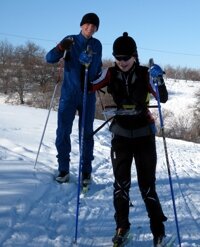
Let me say at the outset that although I am not a skier, I happen to be the proud owner of two (almost) antique pairs of wooden skis and have a profound respect for exponents of the sport.
However, that hasn’t always been the case.
When I was a kid, watching ski events on the TV bored me. They made it look so simple. What could be simpler than bending your legs at the knees, leaning forward and then pushing off with two sticks and letting gravity do the rest. OK, I thought, twisting and turning in a slalom event looked as if it might involve some skill and excitement, but I couldn’t see what all the fuss was about.
Of course, there’s a lot more to it that and the sportsmen on TV were all experienced and skilled. The fact that they fooled me by making it look so simple should be taken as a compliment.
Anyway, when a new teacher at school decided to organize a trip to Swiss slopes one Easter, even though most of my friends were ecstatic over the prospect I was far from eager to take part. So much so, that I think it was the only time that I hid a letter from about it in the bottom of my school bag and deliberately and did not give my parents. School trips like this were a rarity in those days and I was afraid that my mother would say that it was a great opportunity and that I had to go.
My first experience of skiing came many years later, when I was in my early thirties and a teacher myself. A group of sixth formers that I was teaching Computer Science to, decided that they wanted to organize a day out at a local dry-ski slope and asked me to go along. In a hasty decision, I agreed.
As it happened, I quite enjoyed the experience. It wasn’t a long slope, there was no snow around and it wasn’t particularly cold. I enjoyed a fair amount of success, bending my knees, leaning forward and pushing back on the two sticks that I held in my hands and let gravity do the rest.
Although it was fun, it was a “one off”. I wasn’t “bitten by the bug”, and, feeling that my schoolboy impression was probably pretty accurate, I never felt the urge to repeat the experience.
On my travels around the world I have visited a couple of ski resorts but never felt the urge to don a pair. On one occasion, in New Zealand, the owner of the hotel where we staying overnight even expressed his surprise, saying that we were his first ever “non-skiing guests”.
Then, in my first year here in Bishkek, a friend decided to take a week of his annual holiday in one of the local ski resorts, and he asked if I would go along with him, to keep him company. At first, I declined; pointing out that I was a total novice and had only ever once in my life put on skis. He assured me that he was also a novice, claiming that he had never skied before, so I would have the advantage on him because I had at least some experience behind me. As before, in hasty decision, I agreed.
On this occasion, however, things did not go smoothly. Although my friend quickly found that he was in his element on skis, I was having trouble. It was quite cold, much colder than I was used to, and although there was a fair amount of snow around, the slopes were uneven and seemed quite steep. My feet kept turning in on themselves so that the skis crossed, and I kept falling over. I didn’t seem to be able to get more than about five meters before I found myself twisting and turning, but not skillfully around a slalom marker flag, but rather around my waist and ending up prone on/in the snow. My ankles ached and I began to be afraid that I might break something. On the second day, I decided … enough!
I no longer thought that it was “easy-peesy” … on the contrary, that is when my admiration for anyone who can stay upright whilst standing on a pair skis was born.
I didn’t give up totally on the holiday itself, however, and instead of packing up and going home, I spent the rest of the week going for long walks in the neighbouring countryside whilst my friend and the other skiers, (a party of Russians from Omsk), sped down the slopes.
So, how come I happen to own two pairs of skis? If the truth be told, they came into my possession by accident. When I bought my apartment here in Bishkek, the previous owner packed up his belongings but didn’t exactly clear the flat. The skis were amongst the things he left behind and told me to dispose of as I saw fit. Whereas the rest was thrown away, the skis took my fancy and, even though I knew I would never use them, (and doubted if even an aficionado could make much use of them), I decided to keep them.
So, it comes as a bit of surprise, (even to me), that I have recently developed an interest in skiing. Oh, please don’t misunderstand me, I still don’t feel any urge to don a pair. It’s only as a spectator, and not even as a spectator in the cold, windblown slopes.

It just so happens that in the past I have had some dealings with the Tourist-Sport Union of the Kyrgyz Republic. This is an association that organizes a number of events for young people, orienteering competitions, and the like. One of the members of the Union is Ilshat Dautov and he also serves as the President of the Kyrgyz Ski Orienteering Federation and he recently accompanied the Kyrgyz team to the Asian Winter Games held in Kazakhstan.

Ski orienteering? Yes, that caught me by surprise as well. Apparently, Ski orienteering, (or “SkiO” as it is also known), is a winter sport, involving cross-country skiing races that require physical endurance, strength, technical skiing skills and the ability to navigate and make the best route choices while skiing at a high speed. Competitors have to navigate a dense network of ski tracks marked on a map along with information such as the quality and width of the tracks, in order to visit a number of control points, in the correct order, in the shortest possible time. They have to take hundreds of decisions about their choice of route at high speed during every race
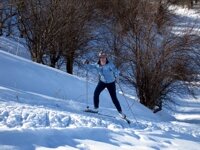
It is one of the four types of orienteering which is recognized by the sport’s governing body, the International Orienteering Federation, (IOF).
Although it was featured as an event in the Asian Winter Games, it is not yet a full Olympic sport, but the IOF have applied for it to be included in the 2018 Winter Olympics.
I suppose you could call SkiO a minority sport, both worldwide and here in Kyrgyzstan. The Kyrgyz Federation has a number of sections, mainly in the North of the country, but they are constantly looking to extend their activities. That’s partly how I got interested in their activities.
I have long said to anyone that would listen to me that, (although I would be the first to say that I am by no means an expert – after all, I can’t even ski!), I think the Naryn region has great potential for cross country skiing. During the winter there is nearly always an abundance of snow and the landscapes offer a variety of slopes of different gradients and difficulty. There are a number of small downhill runs in the immediate environs of the city but they tend to serve just the local population. Because Naryn is quite distant from the other main population centers in the country, is quite high at 2700m above sea level and would require a considerable amount of investment to develop ski bases and the associated facilities, I think it it would probably be difficult to develop downhill skiing further. On the other hand, it seems to me, these disadvantages are not necessarily as critical when it comes to developing cross country skiing and SkiO. (That is not to say that developing cross country skiing won’t require investment but, I think that it can probably be be effected more easily.)
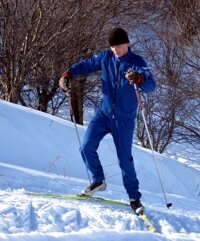
Anyway, Ilshat is now getting ready to travel to Tänndalen in the Swedish region of northwest Härjedalen, (about 600km northwest of Stockholm), where two Kyrgyz athletes, (Igor Gusev and Olga Gorodzhanina), will take part in the sport’s World Championships which are being held between March 21st and 27th. It is hoped that the Kyrgyz team will be one of 35 competing in the event.
The venue, at an altitude of approximately 800m above sea level, is situated on a rather steep area on the side of a large mountain. The area already has some permanent trails for cross-country skiing and will have extra trails specially designed for ski-orienteering added. The terrain over which competitors will race includes both undulating contours, with height differences of about 180 m., as well as flatter landscapes and encompassing both forests and marshland.
National teams can compete in a variety of events, Sprint, Middle and Long distance races as well as relays. Unfortunately, the Kyrgyz team consists of just two people, so they won’t be able to take part in the relays.
For those interested there is more information on their official website, (http://www.skiwoc2011.com/index.php?en&subj=18), where the results of individual events will also be posted.
I, for one, will be checking with interest.
.



 Bishkek