Georgian Independence Day
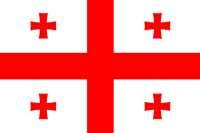
The other day I was asked when did the British celebrate their Independence Day. I replied with a simple question: “Independence from whom?, or what?”.
If you mention Independence Day, then most people will probably think of July 4th. I suppose it is an indication of American influence in the modern world that their holiday assumes such a prominent position in the global psyche. As it happens, today, (May 26th), is the Independence Day of Georgia – the former Soviet Republic, that is, not the former British colony that became the fourth State to ratify the Constitution of the United States, (only to secede from the Union to join the Confederacy, and which was the last of the ‘rebel’ states to be restored to the Union).
For some reason Georgia is quite popular amongst “progressive”, “liberal” groups here. The Georgians are not particularly numerous in the population but I often see references to the Georgian experience whether in terms of liberalising the visa regime or economic policy issues.
Interestingly, Georgia is one of the 11 nations of the world which celebrates two Independence Days: May 26th and April 9th. The reason there are two dates is a long and convulated story.
The date in May commemorates the founding of the Democratic Republic of Georgia in 1918, after the collapse of the Russian Empire following the Russian Revolution in 1917.
The April date, on the other hand, commemorates the declaration of Independence from the Soviet Union in 1991, which took place shortly before the collapse of the USSR following the abortive coup against Mikhail Gorbachev.
There have a variety of states that were based on the territory of what is now Georgia, back into antiquity. The Kingdom of Georgia flourished in the period between the tenth and twelfth centuries, but then broke up into smaller states which were enviously eyed and set upon by their Byzantium and Persia. The small Georgian nations tended to look to their Russian neighbours for support, which was sometimes forthcoming, but not always. Eventually, the two kingdoms that covered the area now known as Georgia were assimilated into the Russian Empire in 1801 and 1810 with other territories joining them over the next seventy years.
Georgia and Russia society actually had much in common in that they were both Orthodox Christian, run by an aristocracy which owned the land that was worked by serfs. Despite this, the assimilation of the territory did not go unopposed. This was partly due to high handed government by Russian military governors, but a softer approach eventually led to a successful integration into the empire. A critical moment came when the Tsar, Alexander II, freed the serfs. The conditions of the emancipation were such that it pleased neither the landlords who relied upon peasant labour, nor the serfs themselves, and Georgian national feelings grew amongst the population. The next Tsar took a much more robust approach to the preservation of his empire and even the mention of the name Georgia was forbidden in the press of the time. The decline of the aristocracy left a power vacuum which favoured the large numbers of Armenians who held civic posts and owned most of the businesses.
Socialism was becoming more influential, especially with the arrival of industrialization, and in 1905 the Marxist Social Democratic Party was the dominant political force in the country. When the First World War broke out, most Georgians were ambivalent about it, some even harbouring pro-German sentiments. The collapse of the Russian Front and the revolution at the end of the war gave the Transcaucasian peoples, (from Armenia, Azerbaijan and Georgia), their chance to declare independence, which they seized, especially as the Russian army experienced wide scale desertions. The resulting Democratic Federal Republic of Transcaucasia was short lived, facing both internal pressures as well as external ones from both the German and Ottoman Empires.
Hence, it was that the Democratic Republic of Georgia came into being on May 26th, 1918.
The new state was recognized by a number of States, including Germany, the Ottoman Empire and Britain. That other version of the Great Game, (between Britain and Germany as opposed to the one between Britain and Russia), then swung into play. All three of which seem to have had troops in the country, administered part of the territory. At one point Britain deployed some troops in the capital, Tbilisi. Britain also tried to mediate disputes between the new state and even younger neighbour Armenia.
The main political grouping were Menshevics and the new republic faced pressures from Lenin’s Bolsheviks in Moscow. In February 1921, the Soviet Red Army eventually invaded the country, citing numerous provocations, and after a short war occupied the country and forcing the government to flee into exile. Although resistance persisted until 1924 Georgia was assimilated into the Transcaucasus SFSR and eventually became a constituent republic of the USSR.
.
Throughout the period of the Soviet Union, there remained a strong nationalist sentiment in the country. Although the republic seemed to prosper, resentment towards Moscow was growing, especially after protests were savagely broken up. Change was in the air and a multi-party assembly was elected in Tbilisi which organized a referendum on independence on March 31st. There was an overwhelming majority of votes cast in favour and independence from the USSR was formally declared on April 9th.
Hence the second Independence Day.
.
For the record, the other countries which commemorate two Independence Days are: Azerbaijan, Belize, Colombia, Croatia, The Czech Republic, Ecuador, Estonia, Latvia, Lithuania, Slovenia and the Ukraine. .







 Bishkek