Every now and again I happen to say something which causes my staff to stop what they are doing and look at me with a quizzical look as if I am star of Stephen Spielberg’s classic film, E.T.
Most of them speak English well, and are used to my strange accent and turn of phrase. Even so, the odd idiom or cultural reference slips into the conversation without my really noticing it … and I end up having to explain it. For example, there was the time I said: “The answer’s simple, it’s 42. The important thing isn’t the answer, it’s knowing what the question is?” (For the record, that’s a reference to “The Hitch Hiker’s Guide to the Galaxy” by Richard Adams.) Then there were the pair of abbreviations: TGIF and OGIM, (“Thank God it’s Friday” and “Oh God, it’s Monday”). The other day, they were confused by another one: SWMBO.
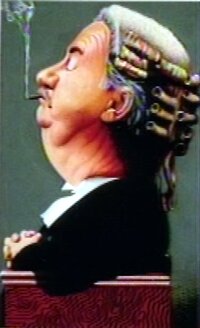
SWMBO – She Who Must Be Obeyed. More…
Bearing in mind that
- there are differences between the various versions of the epic …
- it is the world’s longest epic with over half a million lines …
- it is said to take three months, four hours a day, to recite the whole epic from start to finish …
- it took several years for the various manaschi to compile their written versions …
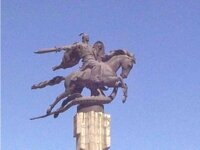
… this is the basic storyline of the Manas Epic … in brief: More…
One of the advantages of the internet is that I can now scour lots of different sources of news from around the world. Back in the UK, I rarely had the opportunity to read newspapers on weekdays because I used to leave home well before the newspaper boy would have delivered them, but I did have two of the Sunday newspapers delivered and would sit and scour the pages on Sunday morning once having finished the ironing whilst listening Alistair Cooke’s Letter from America and the Archers omnibus edition. Now every day, having checked the email, I can scan several websites and read articles from a wide variety of newspapers.
Yesterday, I came across a story about the publication of a new edition of the classic story of “The Rime of the Ancient Mariner“ by Samuel Taylor Coleridge as a graphic novel – that is, in comic book format. More…
Running a tour company, you can imagine how many visitors to Kyrgyzstan I get to meet each year. Many, of course, are clients, either on an organized tour or else guests at one of our hotels in Bishkek and Naryn. Not all of them, however.
Every now and again we come across travellers who are undertaking a bit more than a vacation trip to the mountains of Central Asia; they might be trying to follow in the footsteps of Marco Polo or other adventurers along the Great Silk Road but others are going on the journey of a lifetime – a “Round the World” trip.
Some of them are taking a year out after college, before starting work. Some just want to see as much of the world as they can. Some try to do everything on foot, using public transport wherever possible, whist others have their own transport: cycles, motor cycles or cars. Rob, for example, was an American cyclist who crossed the border from Kazakhstan just after the Tulip Revolution … and managed to spend several months in Kyrgyzstan. Another couple were travelling in a custom built “hot rod” that made people stop and stare as it whizzed by … boy, did they get the attention of the GAI, the local traffic police!
More…
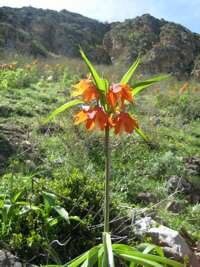
On Sunday I wrote a postcard about the Aigul flower. The reasoning behind the postcard was not just that this is the time of year when the flower blooms, but also because there is festival due to beheld in the Batken oblast, and the neighbouring oblast in Tajikistan, dedicated to two local flowers: The Aigul and the Guli Surh, lola … the red tulip.
The tulip got it’s name from the Persian word “toliban” which means turban, and reflects its resemblance to this form of headgear. The Guli Surh is sometimes known as the King of Tulips and is a rare plant – it is listed in the Red Data Book of Kyrgyzstan as an endangered species. The word Lola comes from Uzbek – Lola is the Uzbek word for tulip.
More…
There is a legend which tells of Urbo-Khan, a noble and respected Khan who lived at a place where caravans of the Silk Road crossed paths. He had an only daughter, Aigul, and she was as beautiful as a swan. Her fiancée, a very strong man called Kozulan, was famous for his fearlessness and was in charge of the Khan’s troops.
The two families were preparing for the couple’s wedding when enemies of the Khan invaded the country. Kozulan went to battle and perished in in the fighting, protecting his homeland. His warriors brought his heart to Aigul and she buried it not far from the highest mountain in the region – Aigul Tash.
She grieved so terribly for her beloved that she climbed to the top of this mountain and threw herself off it into an abyss. Where drops of her blood lay on the earth, wonderful, unknown flowers soon began to grow and blossom.
More…
This week has seen a number of notable anniversaries: the fall of Masada to the Romans, the adoption of the Union Jack as the British flag, the start of the American Civil War, the assignation of Abrham Lincoln at the end of the war, the sinking of the Titanic, the founding of the International Labour Organization, the first manned space flight by Yuri Gagarin in 1961, the disastrous Apollo 13th flight, the first shuttle launch, not to mention the birthdays of such luminaries as Leonardo da Vinci and Leonhard Euler.
It also marks the first use of the phrase “Cold War”, in 1947, to describe the continuing state of political and military tension, economic competition after the Second World War between the Communist World, (the Soviet Union and its satellite states and allies), and the powers of the Western world, (as represented by the United States and its allies). The phrase was actually coined by George Orwell two years earlier, to describe a world living under the threat of nuclear warfare where a “peace that is no peace” existed. More…
For someone interested in history, I find it interesting how some dates in the year seem to attract important anniversaries whilst others seem to be bereft of them. Take April 15th, for example, which is not only the anniversary of the sinking of the Titanic, (which struck an iceberg the night before), and the death of Abraham Lincoln, (who was shot in the Ford Theater the night before), it’s also the birthday of two of my heroes: Leonardo da Vinci, (1452) and Leonhard Euler, (1707).
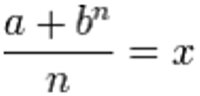
Most people will know the stories of the sinking of the Titanic and the assassination of Abraham Lincoln and have some idea of who Leonardo da Vinci was. Leonhard Euler, however, will probably be a closed book to most and I suspect that few people will have any idea of how to pronounce his name. More…
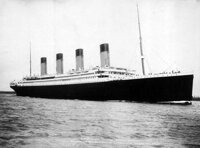
At 11:40pm on April 14th, 1912, the RMS Titanic hit an iceberg in the waters of the North Atlantic, whilst on her maiden voyage from Southampton to New York. Two hours and forty minutes later, she sank and 1517 people lost their lives. Less than a third of the people on board, (706 out of a total of 2223), survived. It was one of the worst maritime disasters in history.
The story of that night has been reconstructed several times, for example in books and films, (perhaps, most notably in “A Night to Remember” in 1958 and James Cameron’s 1997 epic, “Titanic”), but also before Boards of Enquiry on different sides of the Atlantic.
You might well wonder how I can how I can dedicate a Postcard from Bishkek, (the capital of landlocked Kyrgyzstan), to a maritime disaster. Kyrgyzstan would seem to have little connection with the world’s largest passenger carrying ship of her time, and/or icebergs. It is true, however, that there was once a hoax post on the internet about the secret construction of a massive ocean going liner in the Kyrgyz shipyards on Lake Issyk Kul, but the closest we have to an iceberg are the rapidly retreating glaciers in the Tien Shan Mountains. More…
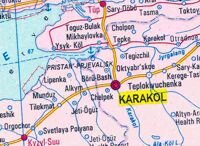
One of the cities in Kyrgyzstan which is which is often visited by tourists is Karakol, at the Eastern end of Lake Issyk Kul. It is the largest town and the administration centre of the Issyk Kul oblast. The town was founded by Russian settlers in the 1869, and the name translates as “black hand”.
In Soviet times it was called Prezhevalsk after the Russian explorer who made several journeys into Central Asia and almost reached the gates of Lhasa in Tibet, but who contracted a Typhoid and settled in the area over looking the lake to die. There is a museum dedicated to him on the site of the house that he had built, a little less than 10 kilometres from the centre of the city, on the Mikhailovka inlet. Six years after his death in 1888, a monument and small chapel were built by the side of his grave, then in 1957 the Soviet authorities constructed the present museum and gardens.
The settlement was originally named Karakol – then in 1886 received the name Prezhervalsk. Lenin gave it back its original name in 1926, only to have Stalin rename it Prezhevalsk again in 1935. Finally in 1991 it was renamed Karakol once more. More…