Nikolay Mikhailovich PREZHEVALSK

April 12th is not only the day that Yuri Gagarin undertook the first Manned flight into space … it’s also the birthday of the great Russian explorer Nikolay Mikhailovich Prezhevalsky.
The town of Karakol lies at the eastern end of Lake Issyk Kul. Its name in Kyrgyz means “Black Hand” – and although that may have connotations to Englishmen of a certain age, it probably refers to the early Russian settlers and the effect of working the soil in the region. Before Independence the town was named after this great explorers of Central Asia. He actually spent far more time “discovering” other parts of Central Asia than wandering around Kyrgyzstan – but had the misfortune to contract a fatal disease and die here.
Although an important historical figure, (he is sometimes referred to as the Russian equivalent of Livingstone), Prezhevalsky has suffered a little because his attitude and reputation as a Tsarist, a chauvinist and a colonist which did not endear him to either the Soviets or the Kyrgyz. The Soviets, unable to turn him into an ideological figure, concentrated on his tireless exploits exploring and mapping vast areas of Siberia, Tibet and Central Asia.
He was born in a small village near Smolensk, in Western Russia, in April 1839, and from an early age he had a passion for travel. His father was a sickly army officer pensioned off at the age of 32 and it was expected that young Nikolay would follow in his father’s footsteps. He left school at 18 and duly joined the army. Although he never enjoyed military life, apparently he decided, (like many young men both before and afterwards), that an army career would have given him the best chance to “hit the road” and see the world.
He was renowned for having a remarkable memory – and this helped him achieve high grades in school – especially in mathematics, a subject he intensely disliked. His friends would test his memory by opening a book at random, reading him a couple of lines … and he would then continue, faultlessly recalling the text, diagrams and all. Even after his journeys he could recall information from books that he hadn’t seen for years.
His time at school was not uneventful. On one occasion he was on the point of being expelled, but at his mothers request he received a beating instead. Throughout the rest of his life he remained opposed to the use of corporal punishment – a practice common in the army at that time.
He graduated from the military academy early – and served in Poland … where he quickly rose through the ranks and was appointed to a staff position, and was later appointed to the general staff – which was an ideal place from which to launch himself into his ambition to travel.
He managed to persuade the Russian Geographical Society and his senior officers that he would be a good explorer, and the Society agreed to sponsor an expedition to the Usuri river region in the Russian Far East of Siberia in 1867-69. Despite, at times, appalling conditions he collected many plant specimens, which he sent to the St. Petersburg Botanical Gardens, and specimens of birds. The results impressed everyone and the Society agreed to help finance future trips. His employers, (the army), were happy to give him the time he needed, on the condition that, on his return from each trip, he reported first to them before saying anything to the Society – in other words he became an Army agent – a spy.
Rising to the rank of Major General he became the most honoured of all the Tsarist explorers. He never married – in fact he sometimes known as a misogynist.
He focused on Central Asia, Launching four major expeditions in 15 years, writing four books about his experiences. In all he traveled some 32000 kilometers in Central Asia and mapped some seven million square kilometers, including several major mountain chains.
Mongolia, China and Tibet (1870-73) – crossing the Mongolian steppes and the Gobi Desert on the way to Beijing. The party of four set out and experienced numerous hardships: temperatures that ranged from -45 to +50; a desert landscape “decorated” with columns of salty dust and the bones of horses, mules and camels “scattered all over”; lack of water – on one occasion having scooped murky water from a well they discovered a “rotten dead corpse”; robbers and troublesome guides. It was on this trip that he met the Tibetan Ambassador to China who invited him to Lhasa to meet the Dalai Lama – but he was running out of money and the Tibetan winter was setting in – so he had to turn back. He spent the next two years writing up the expedition, lecturing and drumming up support for his next expedition.
Tien Shan, Lop Nor, Taklamakan desert and northern Xinjiang (1876-77) – He crossed into what is now Xingjian across the Kazakh-Chinese border and was surprised to discover that he was not the first Russian to visit these parts. In 1861 a group of “Old Believers” had traveled here in search of a “promised land” and after a couple of years struggling to farm and hunt they decided to give up and return to Siberia. Apparently only one girl survived (to become the favourite wife of the Bey of Turfan) – the others killed by rebellious tribesmen. On this trip he discovered that the salt lake of Lop, Lop Nor, as in fact some 100 miles away from where the Chinese cartographers had placed it since ancient times. His report sparked a great debate and when he returned to the region on later trips he repeated his measurements and calculations and came to the same conclusions. The mystery surrounding the “erroneous” positioning of the lake was not solved until Hedin visited the region in 1895, 1900 and again in 1928. He discovered salt flats where the Chinese had once located the lake and what appeared to be a dry river bed. He came to the conclusion that the river and lake had changed their position once – and was about to do so again. Sure enough, when he returned in 1928 the lake and river were back in their original locations. Although he planned to visit Tibet, he fell ill with a skin disease and decided to return to the nearest Russian town for treatment.
Mongolia, China, Tibet (1879-80) through inhospitable country; across mountain passes so high that there was barely enough oxygen to light a fire so that water took two hours to boil and harassed by tribesman – although by some accounts he was held in high regard, considered to be a healer, as well as a great warrior – the party eventually reached a point only 260 km from Lhasa. The Tibetan authorities refused him permission to proceed and no amount of argument or persuasion could make them change their minds – and so, with a heavy heart, he was forced to turn around and head back home. It was on this expedition that he discovered the tiny steppe land horse that now bears his name – Prezhevalsky’s Horse – now, sadly, disappeared from its old habitats and surviving only in zoos around the world. It was the world’s last species of wild horse.
Mongolia, China, Tibet, Taklamakan desert and Tien Shan (1883-85) – setting out once more for Tibet and, once more, facing harsh landscapes, (quicksands, swamps, huge mountain ranges …), inhospitable climate (with temperatures rising above 40 degrees and desert storms), and an unfriendly reception from the local population (attacked by tanguts in Tibet, cheated by the Mongols, and hostilely treated by Chinese officials). This time he was forced back because the Chinese had destroyed the bridges over the Tam Chu River and blocked border passes by boulders cutting all the routes into Tibet. He turned North again and the arriving in Kyrgyzstan over the Bedel Pass, the expedition ended at Karakol on the shores of Lake Issyk Kul. From here Prezhevalsky returned to Moscow.
As a result of the invasion of Sikkim in 1886, Britain was seen as beginning to show an interest in Tibet and this was perceived as a threat to the empire. Who was better than Prezhevalsky to lead another expedition to Lhasa In 1888 he returned to Pishpek to prepare for what was to be his grandest expedition. While hunting tiger by the Chui River he unwisely drank the water, and contracted typhus. He was dispatched to Lake Issyk Kul for rest and treatment – but it became clear that he wasn’t going to recover. He had a small house built on a promontory overlooking the lake, with a small chapel where he meditated and prayed. He wrote to the Tsar asking to be photographed in his coffin dressed in his explorer’s clothes and to be buried beside the lake.
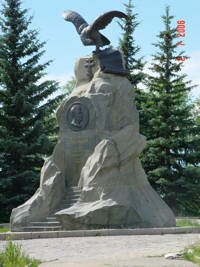
He died at the military hospital on 20 October 1888, at the age of 49, and the town was renamed in his honour. His house was preserved and has been turned into a small park and museum. In the grounds a monument was erected depicting an eagle landing atop a mountain. The bird is twice life size – with a wingspan of 2.5m – an olive branch in its beak and in its talons was placed a golden baton … but in the uprising of 1916 it disappeared.
The expedition which had been interrupted by his untimely death was resumed in the autumn of the following year under the leadership of Pevtsov. It succeeded in collecting much information and a wide variety of specimens.
The Russian Geographical Society created an award in his name: The Prezhervalsky medal. One of the explorers to receive it was the Russian explorer Pyotr Kozlov who had been on one of Prezhervalsk’s earlier expeditions and was in the party to go on the fateful final one.
To mark the twenty fifth anniversary of his death, it was announced that a museum to commemorate Prezhervalsk and his expeditions was to be established in the town. Some 1500 roubles were raised … but the museum was never built and there is no record as to what happened to the money. It was in 1957 when the present memorial complex was established. The original modest collection was added to over the years – and includes many items with personal connections to the explorer.
.




 Bishkek