One year on …
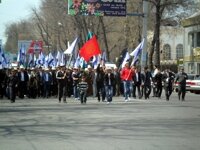
So, April 7th has come and gone. An important date, an important anniversary, in the history of Kyrgyzstan. I did think about writing a postcard yesterday to mark the anniversary but, instead, I chose to write on a neutral topic and see how the day developed.
In the last few weeks, since before the 24th March anniversary of the original Tulip Revolution, a lot of attention has been concentrated on the impending anniversary. The controversy on whether the day should also be declared a public holiday was eventually answered earlier in the week when the Ministry of Labour issued a statement that, as they had received no instructions to the contrary, it was to be a normal working day. So that issued was settled, at least for this year.
Personally, I can’t say that I am that surprised. Although the events a year ago marked an important event in the history of Kyrgyzstan, and a precursor to the “peoples’ revolutions” that have erupted throughout the Middle East and Northern Africa, the authorities might well be anxious about “celebrating” an event in which so many people died and which is the subject of much controversy.
What is emerging as the “official” account of events tends to concentrate on the “corrupt and anti-popular” regime of Kurmanbek Bakiev, and the “heroism” of the people in opposing and overthrowing it. (Eighty three of the eighty nine people killed that day have been declared “heroes of the April popular revolution” with their families receiving benefits including apartments, lump sum cash payments and various child-welfare benefits). It ignores, or plays down the fact that the protesters commandeered firearms, the death of two policeman and a a member of the armed services and the looting that followed the demonstrations.
The consequences of the day’s mayhem, death and destruction, a year ago are far from over: controversial trials into the deaths, (labelled by some critics as , a “show trial”), continue; inter ethnic violence which erupted in the months following the revolution is still not resolved, (and some seem to doubt if it ever will be); the new authorities have failed to live up to popular expectations, consisting of a shaky coalition which includes allies and members of the former regime, and do not seem to have been able to effect substantial improvements in the lives of ordinary people who have to cope with high rates of inflation, unemployment, widespread corruption and rights violations, and leading to criticism of “tribalism” being levied against various individual members of the ruling elite.
There was certainly concern about how the day might unfold. Members of the British community, for example, were warned that “feelings maybe running high, particularly in the capital, Bishkek”, and that they should “exercise extra caution in public areas and avoid all demonstrations and large gatherings at this sensitive time.”
The anniversary, however, did not go unmarked and, fortunately, they were no serious incidents to mar the commemorations.
There had already been a number of meetings and conferences dedicated to the day, and the lessons to be drawn from the lead up to the events, the happenings on April 7th and their aftermath. The President went on a tour to Talas, where, on April 6th, it could be said that the revolution began in earnest with the storming of government buildings. Exhibitions have been held, a film dedicated to the events a year ago and a book about them has been published.
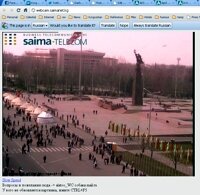
http://webcam.saimanet.kg/
On the day itself the centrepiece was a minutes silence at three o’clock. A special memorial was unveiled at at a ceremony and service at At Beyit on the southern outskirts of Bishkek, (a memorial to the fathers of the nation who were massacred at Chong Tash in 1937 and the cemetery in which many of those killed last year were laid to rest) during the morning; another service was held near the forum accompanied by the planting of trees, followed by a march to the central Ala Too Square; A requiem service was held in the main Ala Too Square with flowers laid at the fence of the White House; requiem prayers were said in villages throughout the Batken oblasat; a football tournament was held in Cholpon Ata in Issyk Kul … amongst a host of other activities.
The parliament started a two day recess to allow the deputies to be with the people as they marked the anniversary.
.
All this is not to say that one day in the future, April 7th won’t be declared as a national holiday. In fact the Prime Minister said at a rally today that April 7 should become a holiday … but, “Not now, when pain of losses is still hurtful.” He cited the situation in France where “Bastille Day” is not only a national holiday but in many respects is considered the country’s National Day. However, it was established as a holiday only many years after the events which resulted in its “liberation from tyranny”.
.




 Bishkek