Exchange rate fluctuations
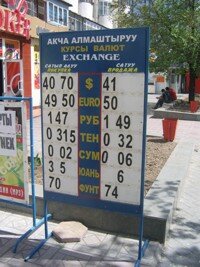
In May 1993 Kyrgyzstan became the first of the countries of the former USSR to establish its own national currency: the Som. Two years later, in May 1995, the som became fully convertible and could be freely exchanged for the currency of other countries. The National Bank of Kyrgyzstan sets exchange rates against major currencies every day.
There are three types of exchange rate in use in the Kyrgyz Republic. Two are set by the National Bank (NBKR):
- The commercial rate – set at 2:00pm every business working day, based on the volumes of trade conducted on the currency market. Usually you will see only several currencies quoted, most notably the US dollar, the Euro, the Russian Rouble and perhaps the Kazakh Tenge.
- The accounting rate – used for book-keeping purposes, and set once a week on Friday afternoons, (except for the US Dollar, which is set daily).
The third could be called the “street rate” – and is that offered by banks and exchange offices (Obmiyen buro) and these can vary from place to place and at various times throughout the day. These are usually set below the commercial rate of the NBKR.
In addition it is also important to remember that an organization can set it’s own rate of exchange – it does not have to to use the official NBKR rates, although the practice is not so common these days. So, for example, when I first came to Kyrgyzstan, (it seems so long ago now – almost sixteen years), it was common to see places quote their prices in y.e., (uslovnaya edinitsa – arbitrary unit), which everyone knew really meant US Dollars. I once hit a particular problem because but the organization set their rate at the beginning of the year converted at that set rate regardless of the NBKR rate or the street rate. Their set rate was 38 som to the dollar – even when the official rate was about 34 som.
Usually the exchange office will quote a “Buying” and a “Selling” price. There will be a difference between them – and it is on the basis of this that they earn a profit. There is no additional commission – unless the customer is trying to use their credit card for a cash withdrawal or to encash travellers’ cheques, where the additional charge usually reflects the bank charges which are incurred.
Also, unlike in places such as Uzbekistan, there is no “black market” and no “black market rate”. As a result there is no reason to exchange money anywhere at a bank or a licensed exchange office.
.
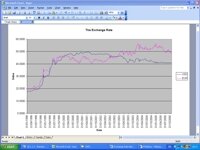
As for all currencies in the world, the exchange rate fluctuates from time to time.
When the som was first introduced, the exchange rate was set at 4 som to the US dollar; at the end of 1999 it was almost 46 to the US dollar; in 2001 about 48 to the US dollar, (it reached it’s highest value of 49.5726 in April, 2001). The value of the US dollar then gradually fell against the som and in July 2006 fell below 40 som for the first time in almost exactly six years. The decline in the value of the dollar continued unabated, reaching a nadir (to date) of 34.5416 in December 2007, when it levelled out and the average value in 2008 was about 36.5969 som to the Dollar. Effectively, the US Dollar had devalued against the som by 30%.
Since 2008, however, the dollar has staged a recover, rising to an average value of 42.9239 in 2009 and 49.9884 in 2010 and, so far this year, 47.1609.
However, the rate has shown considerable fluctuations. Since 2006, the difference between the maximum and minimum values has varied between 3.0083 Som and 4.8305 – which represented a 11 or 12% difference in the then value of the dollar! (For the record: in 2003, it was actually 6.0113 – which represented a 13-15% variation). So far, this year, the dollar rate has, perhaps been more stable in that it has varied only between 47.5265 and 45.9058, (a difference of 1.6207 som per dollar – or a variation of about 6.5%).
These fluctuations led to a decline in value had a significant effect for many people in Kyrgyzstan where prices for goods and services, (such as imported household goods or tour services), were often quoted in foreign currency. As the exchange rate for the dollar fell, so the som value of the income received also fell. As people tried to maintain their levels of earnings, this led to price increases which seemed to both outrun and fuel inflation.
The Euro currency was nominally introduced on 1st January, 1998. In fact exchange rates had already been quoted against the Euro for some time, but at the beginning of 1998, the official rate was 19.1907 Som. The value of the Euro rose until it reached parity with, and then surpassed, the US dollar in July 2002. Since the beginning of 2003, until the end of 2008, the Euro maintained a value at about, or above, 50 som. It did reach as high as 58.0544 in April 2008. A year later it broke the 60 barrier, and although it dipped below it again for a period in the summer of 2010, it recovered and has been well above this level all this year.
The relative strength and stability of the Euro against the US Dollar meant that some organisations switched their pricing policy from US Dollars into Euro. Where prices were still quoted in y.e., the unit sometimes became the Euro rather than the US Dollar. On the whole, however, the Dollar has retained its dominance as the foreign currency of choice.
For the record: although you can still come across y.e. prices, it is becoming rare.
In fact, the National Bank would like to stop all payments in foreign currency from happening within the country. It is already not possible to arrange a bank transfer within the country unless it is in Kyrgyz Som. In theory they have a point. The Som is, after all, the national currency. However, provided the accounts are properly conducted in Som, there is no reason why contracts and prices cannot be quoted in foreign currencies, or even barter.
..
Kyrgyzstan is still fundamentally a cash based society. There are attempts to develop the banking system, but it is proving to be a long and slow process. Most of the banking services are still transactions rather than providing for savings and credit facilities. Some of those transactions, of course, involve remittances from Kyrgyz citizens working abroad and sending money back home to the families – in foreign currency.
Even small fluctuations in the exchange rate can have a substantial effect on people, especially if their savings are held in foreign currency. A drop of 10 tiyin, (or 0.10 som), per dollar can mean make a difference of 100 som per 1000 dollars. That doesn’t seem like much, but earlier this year the dollar rate stood at over 48 som whereas now it stands at less than 46, representing a loss of 2000 som … or the equivalent of more than 43 dollars, at today’s rates. Add to that the effect of inflation, (currently around 20%), and the value of the foreign currency, (whether earnings, remittances or savings), measured in purchasing power is even further diminished.
As the rate continues to fluctuate, there is a natural tendency for people to watch it carefully and try to predict movements in the value of the dollar, in order to dump their foreign currency if it looks as if it might go into free fall. According to one commentator, there is a real risk that people will “actively get rid of their dollars” and that, of course, will probably drive the value even lower.
There is speculation that it’s all a “game”, played by “speculators”, (yes, the pun was intended!), manipulating the market to force down the price of currency, only to force it back up once again once they hold a sufficient stock.
Another thought is that people are cashing in their dollars, perhaps in order to meet their everyday expenses … or perhaps more substantial, one-off, expenses. The classic example I have heard is the need of several politicians for Kyrgyz Som in order to pay their election expenses, (leaflets, advertising hoardings, TV adverts, etc.).
Despite the apparent strength of the Som, so the argument goes, the economy is still in a fragile state, with the cost of raw materials, energy, and labour constantly rising. The effect of this is to potentially price Kyrgyzstan out of the market.
.
For the record: It can be difficult to find exchange rates for the som quoted outside the countries of the former USSR but, for the record, the official ISO 4217 currency code is KGS.
If you want to check the current official rate then you can find it on the National Bank website: www.nbkr.kg


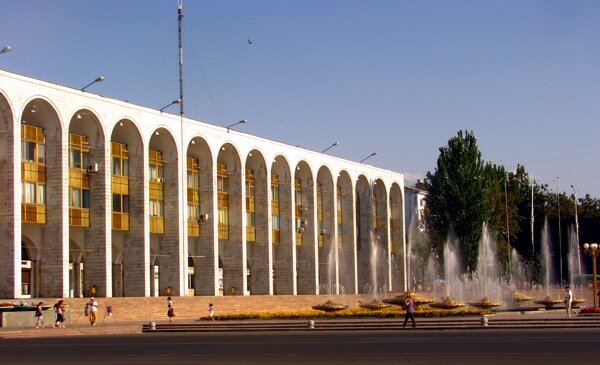
 Bishkek