Karakol
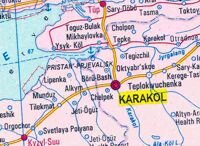
One of the cities in Kyrgyzstan which is which is often visited by tourists is Karakol, at the Eastern end of Lake Issyk Kul. It is the largest town and the administration centre of the Issyk Kul oblast. The town was founded by Russian settlers in the 1869, and the name translates as “black hand”.
In Soviet times it was called Prezhevalsk after the Russian explorer who made several journeys into Central Asia and almost reached the gates of Lhasa in Tibet, but who contracted a Typhoid and settled in the area over looking the lake to die. There is a museum dedicated to him on the site of the house that he had built, a little less than 10 kilometres from the centre of the city, on the Mikhailovka inlet. Six years after his death in 1888, a monument and small chapel were built by the side of his grave, then in 1957 the Soviet authorities constructed the present museum and gardens.
The settlement was originally named Karakol – then in 1886 received the name Prezhervalsk. Lenin gave it back its original name in 1926, only to have Stalin rename it Prezhevalsk again in 1935. Finally in 1991 it was renamed Karakol once more.
In 1869, the Turkestan Military District of the Russian Empire sent an expedition into Issyk Kul, then a distant part of the Kokand Khanate. It was commanded by Baron Alexander Kaulbars and he charged with deciding upon the site for a fort, administrate centre and associated settlement. attracted by the location at the foot of the Terskey Ala Too mountains, his party began surveying and planning the layout for what became the city of Karakol.
The garrison which was to take up residence consisted of an infantry battalion, a mountain battery and 200 Cossacks.
As with other settlements designed by military engineers at that time, the town plan was based on a rectangular grid of streets. Later regulations ensured that every house that was built had to include a garden and an avenue of trees outside. These avenues of Silver Poplars are still evident today.
Construction proceeded rapidly. Within two years of Kaulbars’ arrival in the district there were several streets already built up, and the community consisted of 80 rich farmsteads and five mills. In the streets there were over 50 benches.
Migrants from the Ukraine and Central Russia began to arrive in the 1890’s. According to some contemporary reports the settlers were middle class, not peasants or “workers”. A poor harvest had spurred them to seek new pastures and there were many stories about the rich soil and farming potential in the region of Karakol.
Karakol was to claim a number of important “firsts” in Kyrgyzstan:
- the first meteorological station in the region was established in 1881
- the first public library in what is now Kyrgyzstan was opened here
- the first hippodrome in Centre Asia was built in Karakol
Other social institutions were established – for example schools and parks. There were 2 churches, 9 mosques, and 44 factories. All of which signalled that Karakol was a thriving and prosperous market town. In 1907 the 308 shops managed a turnover of 1,191,000 roubles.
As well as a garrison town and regional centre, Karakol also served as the base camp for several expeditions: into the Tien Shan and across into China.
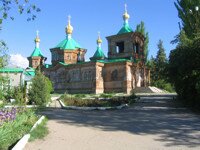 The Holy Trinity Cathedral is a fine example of a Russian Orthodox Church, which served as a dance hall under the Soviets, and a school during the Second World War. Built on the site of an earlier church, erected in 1876, the current building was constructed between 1890-5. During the construction a yurt served as a church for local population. The building consists of wooden walls on a stone foundation, and it is highly decorative. The five onion domes, which used to adorn it, were destroyed in the Soviet period. Inside are a number of icons – including some saved from Svetly Myz, and a copy of one of Saint Troitzy by Andrei Rublev (who lived in the 13th Century). It has now been returned to active service as a church and some reconstruction was begun in 1961. It is now being renovated anew.
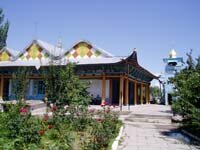
There is also a Dungan (Chinese) mosque in the town built by a Chinese architect and 20 artisans between 1907 and 1910. It was built entirely of wood, without a single nail. The Dungans first arrived in Karakol, as refugees, in 1877 and created a small community. The Bolsheviks closed the mosque from 1933 until 1943, but it was then reopened and has operated as a place of worship since then. The Mosque is set into its own territory and the distinctive decoration (it is painted in bright colours – red, green and yellow – and bears reliefs depicting various types of flora and mythical animals such as dragons and the phoenix) that give it an original character. There is a veranda by the entrance to the large central space.
There is the Regional Museum with seven rooms:
- A Russian room depicting the development of the town and early Russian settlers;
- A Kyrgyz room depicting aspects of traditional national culture
- An Arts and Music room, a fine collection of musical instruments
- A wildlife room with a variety of stuffed animals found in the region
- An Archaeology and History exhibition
- A “Kumtor” room
The war memorial to the fallen in the Second World War – The Great Patriotic War – consists of two white columns with red stars above them and a sculpture of “Mother Russia”, and bears 1300 names. In the park there is also an alley of busts of “Heroes of the Soviet Union”.
There is also a monument in Pushkin Park dedicated to 11 border guards who were killed in a clash with people crossing the border illegally in 1926. The 11m. monument comprises a bronze statue of a border guard with a dog.
Also in Pushkin Park is a memorial over the graves of soldiers of the Red Army who died in battles with the White Russians during the Civil War (in 1919). It takes the form of five stone columns.
The Sunday Animal Market attracts a large number of visitors.
With its large number of colonial style buildings (“chocolate box cottages”); shady, poplar lined streets; lively market; the oldest hippodrome in Central Asia, and overlooked by the Terksey (“Shady”) Ala-Too Mountains it can give an impression of a Nineteenth Century Russian Village.
However, Karakol is perhaps best known these days as a center for trekking with a large number of well established routes in the valleys nearby. Nearest to the city is Djety Orguz with the Seven Bulls rock formation and the Valley of Flowers. Many trekkers visit the Ak-Suu (Tepliyekluchenki), Altyn Arashan and Karakol valleys. Karakol is also the last city on the way to Enilchek and the mountains Khan Tengri and Peak Pobeda.
In the winter months, a ski-base in the nearby Karakol gorge just to the South of the city is popular with locals and visitors alike. The complex comprises a hotel, and two chalets, surrounded by woodland. There are over 20km of snow runs available, ranging in length from 400m to 3.5km, descending 800m, with inclines varying between 7% to 53%. There are slopes for both experienced skiers and beginners alike – and also opportunities for off-piste skiing. They are served by five ski-lifts (suspended rope-tag type). Snowboarding is also possible and the sledge runs are served by a specialist lift. The slopes are conditioned by a “Prinoth” snow-groomer. There is equipment for hire, and instruction is available. There are also facilities including a restaurant, billiard room, sauna conference room – and a helicopter landing pad. They also have transport available, including snowmobiles. The center is also open in summer and can offer a good base to explore some of the nearby highlights of the Tien Shan Range.


 Bishkek