Guli Surh – Lola – The Red Tulip
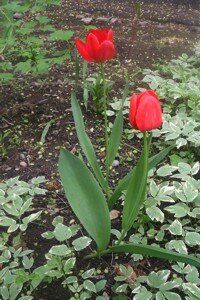
On Sunday I wrote a postcard about the Aigul flower. The reasoning behind the postcard was not just that this is the time of year when the flower blooms, but also because there is festival due to beheld in the Batken oblast, and the neighbouring oblast in Tajikistan, dedicated to two local flowers: The Aigul and the Guli Surh, lola … the red tulip.
The tulip got it’s name from the Persian word “toliban” which means turban, and reflects its resemblance to this form of headgear. The Guli Surh is sometimes known as the King of Tulips and is a rare plant – it is listed in the Red Data Book of Kyrgyzstan as an endangered species. The word Lola comes from Uzbek – Lola is the Uzbek word for tulip.
Although they are normally associated with Holland, tulips are native to Central Asia, (a region covering Turkey, Iran, Afghanistan and other parts of Central Asia – including Kyrgyzstan).
They originate from mountainous areas with temperate climates and need a period of cool dormancy, they do best in climates with long cool springs and early summers.
Nowadays, they are often grown as spring blooming annual plantings in warmer areas of the world.
It is not certain who first brought the tulip to northwest Europe, but the most widely accepted story attributes this to the ambassador of King Ferdinand I to Suleyman the Magnificent of the Ottoman Empire in 1554. In one of his letters he tells how he saw “an abundance of flowers everywhere; Narcissus, hyacinths and those which in Turkish Lale, much to our astonishment because it was almost midwinter, a season unfriendly to flowers”.
There are other suggestions, but however the flower originally arrived in Europe, its popularity soared quickly and they were greatly admired for their variations in colour. There is an account written as early as 1559 described tulips flowering in Augsburg, Bavaria, and the first major work on tulips was written in 1592. They were in such great demand that there are reports of thefts of bulbs from the gardens of the University of Leiden in the mid-1590′s. In the 1630′s there was a frenzy now known as “tulip mania” when tulip bulbs were even considered as a form of currency.
Of the approximately 150 varieties of tulip, there are some 22 different varieties of tulips which grow wild in Kyrgyzstan – eight of them are sufficiently rare as to be included in the Red Book as endangered species:
Tulipa anadroma Z.Botsch.
Tulipa greigii Regel
Tulipa kaufmanniana Regel
Tulipa kolpakowskiana Regel
Tulipa affinis Z.Botsch
Tulipa nitida Th.Hoog.
Tulipa ostrowskiana Regel
Tulipa rosea Vved.
Tulipa zenaidae Vved.
Amongst the most famous are the Greigue – sometimes called the “green tulip”, the Kauphman and the Zinaida.
There has been some speculation in tulip bulbs but a number of projects have been started to help preserve them. This includes the Chunkurchak State Biological Reserve in the Chunkurchak Gorge – just 25 kilometers from Bishkek.
The flowers bloom mainly in April and May.
This particular tulip grows in the loess-like soil in the area around the Sogd oblast of Tajikistan and the stony slopes of the foothills of the Tien Shan, (The Tashkent Alatau and the Kuramin range), and the Pamir Alai. It has been grown in the botanic gardens in Khujand since 1956. It can grow to a height of about 40 cm and sports three or four blue-grey coloured leaves, with purple-brown spots on the upper faces and wavy edges, which are packed close to each other and grow to about 12 cm long. Each plant produces a solitary flower in the form of a beaker with closely set leaves.
Although it is known as the Red Tulip, the colour can vary. There are, for example, crimson red petals with yellow lobes and red spots, and a black spot at the base. The stamen is usually yellow but can have black or, occasionally, violet shading.
Flowers begin to bloom in the middle of April and can be seen for a period of just over two weeks.
The bulb is quite small, measuring about two and a half centimetres in diameter.
There is a legend associated with the floweer. Siavash, a legendary Perisan Prince who also appears as a symbol of innocence in Persian literature and is a major character in the Persian epic poem “Shahnomeh“.
Although was a courageous warrior who dies in a battle defending his homeland. Apparently, the valley in which the battle occurred was littered with white flowers which, after his death, turned red. The valley was then renamed “Surh Lolia” which means “Valley of Siavash.”
.







 Bishkek