SWMBO
Every now and again I happen to say something which causes my staff to stop what they are doing and look at me with a quizzical look as if I am star of Stephen Spielberg’s classic film, E.T.
Most of them speak English well, and are used to my strange accent and turn of phrase. Even so, the odd idiom or cultural reference slips into the conversation without my really noticing it … and I end up having to explain it. For example, there was the time I said: “The answer’s simple, it’s 42. The important thing isn’t the answer, it’s knowing what the question is?” (For the record, that’s a reference to “The Hitch Hiker’s Guide to the Galaxy” by Richard Adams.) Then there were the pair of abbreviations: TGIF and OGIM, (“Thank God it’s Friday” and “Oh God, it’s Monday”). The other day, they were confused by another one: SWMBO.
SWMBO – She Who Must Be Obeyed.
I was using the abbreviation to describe a particularly domineering woman “who wouldn’t take No for an answer”. She had decided that we needed to plant two trees in the yard and had done some research, found a nursery and despite the fact that I had pointed out that we already had about 80 trees and shrubs in our small yard so, IMHO, (“in my humble opinion”), didn’t have space to plant two more, she ordered the plants and commandeered some of our neighbours into a team to dig holes and plant the saplings.
It may sound like a “put down”, but, in fact, it’s a term of endearment. Let me explain:
SWMBO was used by John Mortimer, a barrister, (a trial lawyer in Britain), and author who wrote the screenplays for one of my favourite TV shows: “Rumpole of the Bailey”. Actually, it seems to have been invented by H. Rider Haggard in his novel “She”, a novel written in the first person which tells of a journey to a lost kingdom in the African interior ruled over by a mysterious white queen, Ayesha, who reigns as the all-powerful “She”, or “She-who-must-be-obeyed”.
John Mortimer was born on April 21st, 1923, into the family of Clifford Mortimer, a barrister, (or trial lawyer). When he was thirteen, his father hit his head on a tree branch and lost his sight. For most people that would be a severe trial and, quite possibly, a career ending experience … but not for Clifford Mortimer who was able to maintain his practice. Indeed, the loss of his sight was never acknowledged within the family. The young John Mortimer toyed with several possible careers, (acting, writing and the law), eventually deciding to follow in his father’s footsteps after Clifford offered the following advice: “”My dear boy, have some consideration for your unfortunate wife … [the law] gets you out of the house.”
Having studied in Oxford, he was called to the Bar in 1948 and some of his experiences as a barrister provided inspiration for the seven series of “Rumpole of the Bailey” which were aired between 1977 and 1992.
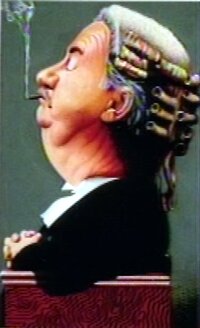
Horace Rumpole is an cigar smoking, ageing barrister, (always approaching but never actually taking retirement), who specializes in criminal cases – always defending, never prosecuting, (although there was one episode where he undertakes a “brief” for a private prosecution), and never pleads Guilty. He sees it important to try and “keep people out of prison”. On the other hand, he ’s a principled man and cannot “defend” someone who admits their guilt but can offer counsel, advising them of their legal rights and the most appropriate course of action, offering please of mitigation. His “glory hour” came early in his career, analyzing blood stains in the “Penge Bungalow Murders”. He doesn’t win all his cases, but he certainly tries his hardest, often bursting into renditions of poetry.
The cast dramatis is quite extensive with caricatures of judges, barristers, solicitors, clients, clerks, police office and others. There’s Gurthrie Featherstone, for example, the “Head of Chambers” who also sits as an MP – “either a left-wing member of a right-wing party, or a right-wing member of a left-wing party – for the life of me, I can’t now remember which.”; Claude Erskine-Browne, who longs for lucrative civil cases, and “Uncle Tom”, the oldest member of chambers who hasn’t had a case for as long as anyone can remember.
Then, of course, there is SWMBO: Hilda Rumpole, Horace’s wife who is domineering … and an ambitious social climber, but she is also loving, loyal and attentive. In fact, although she was created to act as a counterpart to give Horace as rough a time at home as he sometimes receives at the hands of supercilious judges, and in individual episodes, or scenes, can come across as cantankerous and bossy, throughout the series as a whole, she as a is portrayed quite affectionately and sympathetically. I actually have a lot of time for Hilda. For all her faults, she acts as a fine counterbalance to Horace, who sometimes seems to see things as a game.
In my time I have known several women who deserve the title SWMBO. Two of them, for example, were Deputy Head Teachers under whom I worked. Another was a colleague with whom I taught and a fourth is Tatiana, our accountant who insisted on planting the trees. All of them strong willed and domineering but, like Hilda, with a “heart of gold” and all people whose judgment I would trust so that if they said something with which I disagreed, I would take the time and effort to stop, take another look and re-examine the situation … because they might well have identified something that I had missed.





 Bishkek