The Aigul Flower
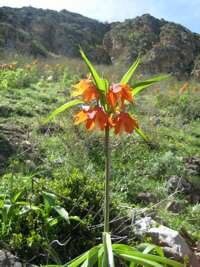
There is a legend which tells of Urbo-Khan, a noble and respected Khan who lived at a place where caravans of the Silk Road crossed paths. He had an only daughter, Aigul, and she was as beautiful as a swan. Her fiancée, a very strong man called Kozulan, was famous for his fearlessness and was in charge of the Khan’s troops.
The two families were preparing for the couple’s wedding when enemies of the Khan invaded the country. Kozulan went to battle and perished in in the fighting, protecting his homeland. His warriors brought his heart to Aigul and she buried it not far from the highest mountain in the region – Aigul Tash.
She grieved so terribly for her beloved that she climbed to the top of this mountain and threw herself off it into an abyss. Where drops of her blood lay on the earth, wonderful, unknown flowers soon began to grow and blossom.
Twenty kilometres from the town of Batken in the south of Kyrgyzstan there is a mountain named Aigul-Tash, (“Aigul’s Stone”). Every year at the end of April and the beginning of May beautiful red flowers blossom on its slopes – known as Aigul’s flower .
Where the heart of the brave worrier was buried a new mountain came into being and it was given the name Kozulan-Tash (“Kozulan’s Stone”). The two mountains look at each other and stretch their slopes towards each other, as if forming stone gates to stand in the way of foreigners.
The proper name for these flowers is Edward’s Pentilium, (“Ryabchik Eduardo“), and they grow extensively in a region around Batken in the south of the country. The only other place where they are found is in the mountains of Afghanistan.
They were described by the famous German traveller, Alexander Gumbold, although there is no evidence that he actually visited the area.
The plants grow to about a meter high, usually on the sunny slopes of the mountainside. Long green leaves along the stalk, topped by red or orange flowers. The flower is unusual in that the seeds of the flower take seven years to ripen in the soil and another seven years are needed before flowers appear on the thin stem. Flowers normally appear in late April and early May. It usually blossoms at the full moon and in the first year there is only a single bloom, then a year later two flowers blossom. After another year: three. According to local people, examples of the “lunar flower” consisting of thirty flowers on one stem have been seen.
It is said that the flower can be mistaken for an ordinary lily, or even a tulip, but it is not either.
Inside the bell of the flower there are some big drops of dew which the local people say are Aigul’s tears.
The plant’s bulbs are used in oriental medicine for treating stomach problems and liver disorders.
Although the flower is rare, and was listed in the Red Data Book of the USSR, it was not included in the original Red Book of Kyrgyzstan, (although it did make it into the 2004 edition). It is considered a “blasphemy” to pick the blooms and the story is that schoolchildren are excused lessons to patrol the vicinity where the flower grows and prevent “tourists” from picking the flowers. Even cattle are not allowed to graze in the the area in case they harm the plants.
Because it is rarely found anywhere else but in this remote part of Kyrgyzstan, the flower is the symbol of the Batken oblast and was adopted by the State Agency for Tourism as a symbol for the country.
.






 Bishkek