Kyrgyzstan is pretty hot on celebrating almost any anniversary.
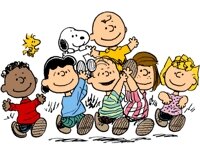
Well, today marks a sad anniversary, although it has passed without any comment … well, that’s understandable … I doubt if many people here have heard of Charlie Brown.
February 13th, 2000 saw the publication of the last ever original Peanuts cartoon strip, a specially prepared cartoon published the day after the cartoon’s creator, Charles M. Shultz, died. More…
If I am a little late with this week’s postcard, then please bear with me. The reason is simple: John, a consultant from the UK has appeared en route to a new project in Tajikistan and Afghanistan and he brought with him some jars of “Black Gold”, (Marmite), and copies of the Times, the Economist and the satirical magazine Private Eye. I have spent several hours munching on toasted Marmite sandwiches and devouring the press. All of them have websites, and the Economist has podcasts, but the papers tend to limit access to their articles, so getting my hands on an original printed copy is a real bonus. Thanks John! More…
There’s been a lot of discussion on the internet recently about internet provision in hotels and, in my role as General Director of two hotels, I have been following the discussion with interest.
The internet has become an important part of our daily lives, checking emails, and social networking sites, checking the news and following stories that are of interest, researching topics for study and work … and, of course, entertainment. I know that when we loose internet access, for whatever reason, it causes me considerable strain and anxiety. I can well understand why travelers away from home want and feel that they need access to the world wide web.
Having said that, only something like a third of our guests in Bishkek actually use the internet whislt they are with us, and in Naryn very few people ask to use it.
There are many people who seem to have come to expect that this access should be freely available and, in particular, that hotels should provide wi-fi services for free. Personally I am not sure that I see the case for this. Guests don’t expect for telephone calls or drinks in the minibar to be provided for free … or do they? If not, then why should internet access be provided, (wi-fi or otherwise), for free? More…
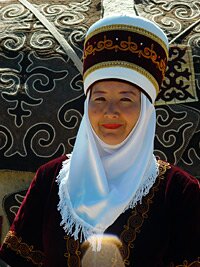
In yesterday’s post, I wrote about the importance of hats in Central Asia and concentrated on the headgear worn by men. Women also have distinctive styles of traditional headgear and I suppose that I ought to mention these as well. More…
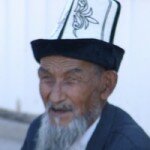
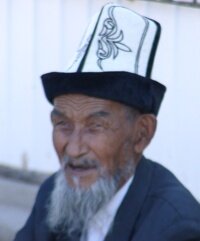
Aksakal wearing a traditional Kyrgyz Kalpak
Whenever we have a spell of cold weather, I am taken to task by my friends and colleagues about why I don’t wear a hat. It isn’t just hats, I tend not to wear a scarf or gloves. The reason is simple, I have a habit of loosing them. I put them down in a café or restaurant and then forget them when it comes time to leave. Then, later when I notice that I don’t have them, I forget where it was that I last had them.
They do, however, have a good point. We lose an awful lot of our body heat through our heads, and for me with my close cropped hair, I tend to loose more body heat this way than most.
What’s more, hats, here in Kyrgyzstan, play an important social in helping to identify exactly who you are. More…
The 2011 Asian Winter Games have come to an end.
They were held just over the border in Kazakhstan, or at least some of the 69 events in 11 different sports were held just over the border in Almaty, others were held in the Kazakh capital, Astana. More…
I’ve missed an anniversary. Surprisingly, little was made of it here, even though it was a nice round number – “It was twenty years ago …” as the Beatles sang on the title track of “Sergeant Pepper’s Lonely Hearts Club Band”, that the Supreme Soviet of the Kyrgyz Republic, then a constituent republic of the Soviet Union decided to pass a one line resolution to restore the name of the capital city to “its historic name”: Bishkek.
The historic decision was taken on 5th February 1991.
On the same day, they also passed a resolution making Noorus a Public Holiday in the republic. More…
I received an interesting email yesterday, from a Kyrgyz student studying abroad who has been set an assignment to compare the tourism strategies of two countries: New Zealand and Kyrgyzstan.
When I first read that I recalled an essay that I appeared on an examination paper that I once sat, to compare and contrast the Theology of the book of Genesis with that of the book of Hosea. I quickly passed over that question and moved onto the next … thank goodness I had a choice … five questions out of twelve … let’s hope that they are not all as frightening as that one! More…
Whilst the attention of the rest of the world has been focused on Egypt, here in Kyrgyzstan we’ve been concentrating on Turkey.
There’s a reason for that, of course … this week’s visit to the Kyrgyz Republic of Recep Tayyip Erdogan, the Prime Minister of Turkey. More…
As I review the news coming in from Egypt, reports and analysis, I see that reporters are making quite a few references to Kyrgyzstan.
I suppose that is natural, and understandable, as yet another government faces outbursts of public discontent, with calls on the President and government to resign and the resulting disorder on the streets. One report asks about the “domino effect” and what the fallout will be across the Middle East and about the implications for other Arab states and, of course, for Israel. Some articles have looked back in time to see how this particular “domino” fits in to the history of popular revolutions such as in Kyrgyzstan and more recently Tunisia.
A couple of articles have also mentioned that from February 1959 to June 1961, President Hosni Mubarak underwent training as a pilot in the Soviet Union, attending both, a training school in Moscow and another at the Kant Air Base, near Bishkek in what is now Kyrgyzstan (but was then one of the constituent republics of the Soviet Union). (In fact the airfield at Kant is, today, home to the Russian 5th Air Army’s 999th Air Base which was established in response to the American base at Manas airport.) Mubarak had qualified as a pilot in 1950 and served in the Egyptian Air Force as a fighter pilot and later flew bombers. In the Soviet Union he qualified to fly the Ilyushin Il-28 and Tupolev Tu-16 jet bomber, two of the planes which the Soviet Union was supplying to Egypt at the time. More…