A town called Bishkek

I’ve missed an anniversary. Surprisingly, little was made of it here, even though it was a nice round number – “It was twenty years ago …” as the Beatles sang on the title track of “Sergeant Pepper’s Lonely Hearts Club Band”, that the Supreme Soviet of the Kyrgyz Republic, then a constituent republic of the Soviet Union decided to pass a one line resolution to restore the name of the capital city to “its historic name”: Bishkek.
The historic decision was taken on 5th February 1991.
On the same day, they also passed a resolution making Noorus a Public Holiday in the republic.
In fact, as I understand it, Bishkek wasn’t the historic name of the settlement.
The name “Bishkek” is, actually, surrounded in mystery. For many foreigners, arriving at the cities Manas airport, the confusion starts with the airport designation code … FRU. That, at least, is relatively easy to explain: it derives from the name by which the city was known at that time when the system of codes was designed and allocated: Frunze
There have been four major settlements on the site that is now occupied by Bishkek: Jul – 6th-12th century; Pishpek – 1825-1926; Frunze – 1926-1991; Bishkek – 1991 to the present
Jul – A Sogdian city on the Great Silk Road – 6th-12th century. Although archaeological excavations have recovered artifacts, all traces of this city have now disappeared. A walled quadrangle, it occupied an area between the modern streets Orozbekova, Lenigradskaya and Kirova. A varied population included Zoroastianists, Buddhists, Nestorian and Manichean Christians. The Mongols and Tartars under Genghis Khan destroyed it.
Pishpek – one of 35 fortresses built in the region by Khokand to extend control over the Chu valley. Built in 1825, it occupied approximately 250 sq. m. It had high clay walls and two concentric perimeters and contained living quarters, a guardhouse, armoury, workshops, mosque and treasury. About 150 soldiers were garrisoned here, and hostages of the local population also lived here as a “peace pledge”.
A settlement grew up around the fortress populated mainly by Sarts, (Uzbeks). Conquered by a detachment of 600 Russians from Vernoe, (present day Almaty) in 1860 in a 7-day assault, it was abandoned, although a stronger fortress was later built by Kokand. In 1862, local Kyrgyz and Kazakh chiefs appealed for Russian aid in overthrowing Kokand domination and succeeded in destroying Pishpek once again.
Increasing numbers of Russian settlers began to arrive, mostly freed serfs, who enjoyed tax breaks, cash incentives and free wood to help build new homes. At this time the Russians administered the region from their base at Tokmok, but a flood in Tokmok 1877, led to the adoption of a plan to develop Pishpek. Army engineers planned a rectangular grid of streets, which survives to this day and was elaborated in the Soviet period.
The city occupied the area between the modern streets Jibek Jolu, Togolok-Moldo, Engels and the Alamedin River – an area of about 5 sq. km. In the first official census in 1882, there were 2135 inhabitants, mostly Sarts, Tartars, Dungans, Russians and Ukrainians – there were 6 Kyrgyz. The Dungans were probably refugees from the Uprising in Xinjiang – given subsidies by the authorities and assigned a plot of land to the West of the town rubbish dump.
By the end of the century there were over 752 houses, mostly simple thatched roofed brick shacks, two schools (for Europeans), one three-bed hospital, and a small industrial sector with flourmills and leather works.
The city elected its first mayor in 1895 – Ilya Terentev. By 1914 the city was home to some 20,000 inhabitants. There was a cinema, a newspaper, two orthodox churches, several mosques, a Russian high school for boys, a horticultural school as well as several other schools for the local population, a brewery, a distillery, flour mills and other small plants and at least one automobile. (The brewery made 10 times more money than the other 18 enterprises combined). There were over 500 shops, a weekly market and an annual fair. A new one with 14 beds had replaced the hospital, the ambulance was a sledge pulled by a camel. In the uprising of 1916 – Pishpek was left alone although neighbouring villages were raided.
After a New Year’s party on 1st January 1918, a group of Bolsheviks armed themselves and “arrested” the garrison command, releasing the prisoners held in the local jail. Over the next few months, they established control over the region, but in December they faced a counter-revolution. In the village of Belovodsk, about 30km west of Bishkek, the post office was seized by a curious group of anti-Bolsheviks who managed to take control of large parts of both Pishkek and Djambul regions. Within a week they were marching on Pishkek itself. The battle for the city lasted 8 days, but the defenders (commanded by Logvinenko – who hurried here with reinforcements from Almaty) – managed to overcome the attackers and the counter-revolution was defeated. The soldiers who died in the fight defending the revolution were buried and a memorial erected in Oak Park, near where the Russian Theatre now stands. Logvinenko became a hero and had a street named after him. (When he died in the 1930, he joined the “Martyrs” in their communal grave). This ended the counter revolution in the North of the country, but during the civil war the Bolsheviks were threatened by the Basmachi movement which even “liberated”, for a time, the Parmir district in the South.
In 1924 Pishpek became the political and administrative centre of the Kyrgyz Autonomous Region.
Frunze – The city was named in honour of M.V. Frunze, a famous Communist leader and Soviet hero who was born in the city then called Pishpek in 1885 – the son of a Moldavian doctor’s assistant. His statue stands opposite the railway station at the top of Prospect Erkindik – and there is a museum dedicated to him on Frunze Street. In the museum a small house is preserved that, so it is claimed, is the one in which he was born (although it is now thought that they preserved the wrong one!). After a tempestuous youth in Moscow, (and numerous arrests for revolutionary activity), he ended up commanding the Red Guards who occupied the Kremlin in October 1917. He was a major character in the Civil War directing the defeat of the White Army in Siberia and the campaign in the Caucasus. Frunze led the Bolshevik forces that seized Khiva and Bukhara after the uprising of 1920, and pushed the Basmachi rebels out of the Ferghana valley. He replaced Trotsky as Commissar for War, introduced compulsory universal conscription and helped shape the Red Army into a formidable force. After Lenin’s death he survived several mysterious car accidents, but in 1925 he was told he was ill and that he had to undergo a stomach operation – not by a doctor but by the Central Presidium! He died as a result of the Operation.
There is an account that the local citizens wanted to rename the city Fruzegrad, after the style of Leningrad and Stalingrad, but the idea was frowned upon in Moscow as too grand and quickly forgotten.
During WWII – Frunze developed as a major city. Several key factories, (including the Lenin works on Prospect Mira) were evacuated to the city away from the approaching German armies. Non-military enterprises, which were relocated, included clothing factories (for example, making knitwear for the army and general population alike); leather works; shoe factories (which made more than two million pairs of shoes); silk factories; pharmaceutical factories. In addition, some 18 research establishments were created. Whole populations of Russian Germans and Koreans were forcibly repatriated here. Kyrgyz soldiers fought in the Red Army and number some 7 “Heroes of the Soviet Union” among their ranks. Busts of these heroes can be found on Molodiya Gvardia (Avenue of the Young Guards).
Following the war there was a planned expansion of the city with the development of the micro regions (like suburbs) with numerous apartment blocks being built, and many public buildings. During the 1970’s and 1980’s there was again a massive building programme and many of the impressive, white marble faced government and public buildings were erected.
Bishkek – The city was renamed Bishkek in February 1991.
There are many different stories about the origin of the name “Bishkek” … but none of them has the status of an “authorative” version.
There are several versions of what the name means – but the most common version is that is from the name of an implement – a long wooden stick with a bulbous end – used by Kyrgyz women to beat milk in a churn to make koumiss (a fermented drink made from mare’s milk). There are examples of a Bishkek to be found in museums, such as the Historical Museum in Bishkek.
One such story tells how a woman forgot her “bishkek” when her family packed up and moved from their camp by the Alamedin river. As soon as she realized – people were sent back to search for it – but couldn’t find it … and so the place where they had camped was remembered as the place where she had lost her bishkek.
One legend has it that it was a Khan’s wife who forgot her bishkek and as it studded with jewels and therefore very precious, the khan was very angry and sent 40 men to search for it. Unable to find it, and afraid to return – they settled down to a life in exile and called their encampment Bishkek.
In another version, the place was named after an energetic craftsman … who was always busy, and so he earned for himself the nickname “Bishkek”, (raising the tempting comparison to of ”busybody” – someone who is always “mixing it” or “stirring”), and there place where he lived was duly named after him: Bishkek’s place. After he died, the name stuck.
A similar version involves a warrior, rather than a craftsman, (Bishkek Baatyr) who earned the earned the nickname from his exploits on the battlefield – because he appeared to be everywhere at once. According to the legend, he was buried at this spot.
Another legend involves a pun – and suggests that the name is derived from the phase “Besh bek” – or Five Men – and denotes the fact that five men fought over the land because it offered particularly good grazing for the livestock.
A different play on words is offered in another version. In this one the name is derived from the phrase “Besh Biik” or five peaks … although it is hard to identify which peaks could be referred to.
The “Atlas of the Kyrgyz SSR”, however, concludes that the name is probably derived from a ancient Sogdian word and which basically means “place below the mountains”. Although there is no record of such a place name in any ancient records … there is apparently some linguistic support for this version.
When, in February 1991, the Kyrgyz Supreme Soviet decided to rename the city of Frunze, the decree said that it was reverting “back” to the former name of Bishkek. There is, however, apparently no record of Bishkek as a place name … so why Bishkek? Maybe the intention was to revert to Pishpek … but the sound “p” is not very common in Kyrgyz (although it appears to be more natural in Kazakh) and it could simply be that the intention was return to the former name, Pishkek, with the initial letter “kyrgyzified” to the more natural “b”.


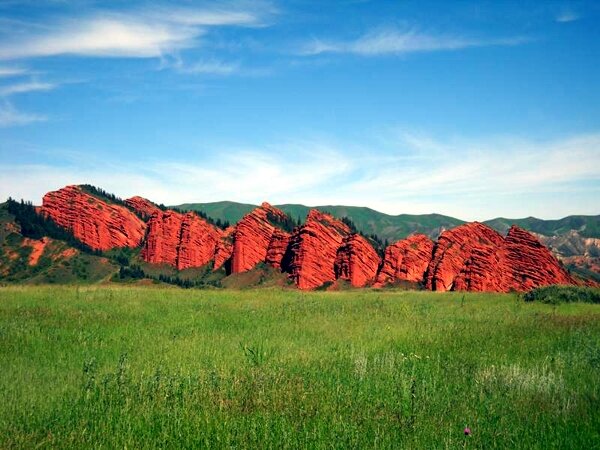

 Bishkek