Hats – are more than just headgear
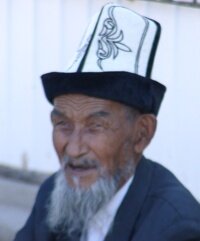
Aksakal wearing a traditional Kyrgyz Kalpak
Whenever we have a spell of cold weather, I am taken to task by my friends and colleagues about why I don’t wear a hat. It isn’t just hats, I tend not to wear a scarf or gloves. The reason is simple, I have a habit of loosing them. I put them down in a café or restaurant and then forget them when it comes time to leave. Then, later when I notice that I don’t have them, I forget where it was that I last had them.
They do, however, have a good point. We lose an awful lot of our body heat through our heads, and for me with my close cropped hair, I tend to loose more body heat this way than most.
What’s more, hats, here in Kyrgyzstan, play an important social in helping to identify exactly who you are.
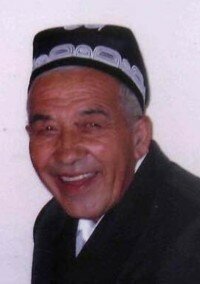
An Uzbek sporting the traditional dopilar
The Kyrgyz, for example, tend to wear felt hats, the Kalpak, whereas Uzbeks tend to wear their traditional headgear, the dopilar. It’s even said that the Kyrgyz who live in the village of Barak which is an enclave totally surrounded by Uzbek territory tend to carry two hats whenever they leave home – a Kalpak for wehen they are on Kyrgyz soil and a dopilar for when they are on Uzbek territory. I don’t know, however, if that’s true, and it certainly goes against the tendency here of wearing your hat with pride as a symbol of your nationality.
This isn’t only true here. Hats can help to identify people and the role they play: The distinctive policeman’s helmet as worn in the UK, the Gaurdsman’s Bearskin, the chef’s cap … and so on. I remember having to write an essay when I was training to be a teacher about the different roles played by a teacher in the course of a day’s work: an instructor, a policeman, a friend and confident, a surrogate parent … and so on. The topic was introduced to us as “the various hats worn by a teacher”.
I was reminded of this when I came across a clip on the internet called “Some Kyrgyz hats”, (http://www.dailymotion.com/video/xgwmcw_some-kyrgyz-hats-hd_travel).
Some Kyrgyz hats HD
Hochgeladen von FernandoAysoPalacios. – Exotische und unterhaltende Reise Videos.
The Kalpak or, as it is more properly called, the “Ak Kalpak” (=”white Kalpak”), is a hat usually made from four panels of white felt with traditional patterns stitched into them as decoration. It is worn by males of all ages – especially in rural Kyrgyzstan – and is a symbol of the nation. (One writer has even written that “what the baseball cap is to the Americans, the Kalpak is to the Kyrgyz”.)
There are different styles of kalpak. They can all be folded flat for storage or carrying when not being worn. In some cases the brim may be turned up all the way around, and in some cases there is a cut in the brim so that a two-pointed “peak” can be formed. Plain white ones are often reserved for festivals and special occasions. Ones intended for everyday use may have a black ‘velvet’ lining.
The most common form of Kalpak is thought to resemble the shape of the mountain Khan Tengri.
It is said that in some of the earliest historical records of the region, there are references to a pointed hat worn by some of the peoples that inhabited the area – similar to the Kalpak. In Turkestan/Tajikistan there are some ancient cave paintings which also seem to depict this piece of headgear.
Even if it looks a little strange to western eyes, this headgear is also a practical item of clothing – keeping the head warm in winter and protecting from the heat in the summer.
In a region where hats are an important mark of “who you are” – they mark out the wearer as specifically Kyrgyz.
The kalpak is the “holiest” of national clothing for the Kyrgyz. It has “mysteries” that many say they can feel when they wear it – this ancient style of hat seems to connect the man wearing it with the history of his fathers and the destiny of his people.
Kyrgyz respect their kalpak. According to tradition:
- You must not kill a man with a kalpak on;
- Kalpaks can’t be put on the ground;
- Kalpaks are laid next to your head at night, never by your feet.
There are also many sayings connected with the headgear, such as:
- “If you lose your kalpak you lose your head”;
- “don’t trade your kalpak or you’ll trade your mind”;
- “Wear a kalpak and you won’t get sick, it is warm in winter, cool in summer “;
A kalpak and a chapan are often given as presents at a ‘toi’, (or family celebration), either from the guests to the host, or from the host to guests of honour.
There is also the “Arakchyn”, which used to be worn under the “kalpak”.
In addition, there were other forms of headgear – but the Kalpak has assumed a role as an essential part of the Kyrgyz National costume. In winter men would often wear fur caps – especially when riding in the mountains – and there were three traditional designs: “kashkar tebetey”, “telpek” and “tebetey”.
Maybe I need to get myself a Bowler Hat.




 Bishkek