It’s not Ascot … but Hats for the ladies
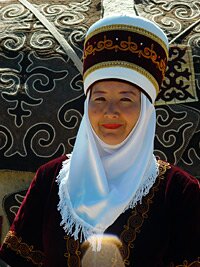
In yesterday’s post, I wrote about the importance of hats in Central Asia and concentrated on the headgear worn by men. Women also have distinctive styles of traditional headgear and I suppose that I ought to mention these as well.
Today, scarves have become the basic form of headgear preferred by women of all ages, wrapped around the head so that face appears framed in an oval of material, or – particularly in summer – tied at the back of the head exposing the neck.
However, there are several traditional forms of headgear such as the “elechek”, “shokulo” and the “kep takya”.
The “elechek” (a sort of “turban”) was often worn by older women, (“chon apa”), the matriarch of the family. (In the south it was also called “ileki” and “kalan“.) It is clearly depicted in the portrait of Kurmanjan Datka on the 50 som banknote.
It consists of a cap, coral suspension brackets, and a scarf, wrapped around the head. There may have been ornaments on it – different types of ornament would denote which tribe the woman belonged to. The size of turban was a sign of prosperity. Rich Kyrgyz women made an elechek turban from 20-30, or even 40, meters of white fabric wrapped around the head, and it could reach massive proportions.
The anthropologist Klavdiya Antipina took a series of photographs showing the complicated ritual of dressing in an elechek which John Sommer and Bibira Akmoldoeva featured in their book about her.
When the owner died the material from the elechek would be used as a shroud to wrap the body.
Today, however, instead of wrapping a long sheet of linen around the head as a turban, it is possible to buy one ready made as a cap which placed on the head like a crown, with a piece of material forming a frame for the face.
The Shokulo is a tall conical hat made from a thin layer of felt, laced with bright materials and pieces of expensive furs and with a veil to cover her face. It sometimes looked like a helmet but could measure 25 cm high – with earflaps and a triangular piece of material draping down the back and decorated with silver and golden ornaments, precious stones – and long pendants of coral, pearls and turquoise – which reflected the wealth of the brides family – and feathers of an eagle or an owl – the owl feather is to protect from “evil spirits” or “evil eyes”. Under the Shokulo would be a quilted velvet conical hat on which the felt version would be placed.
The Shokulo was also considered an important piece of the wedding attire for women.
The “kep takya” was a cap crowned by a drawstring which gathered the ends of the material together into a bunch creating a ‘dome’, densely clasping a head. Over the temple would be a hollow silver ball with a pea inside. Hanging down from this helmet were highly decorated ear flaps, (jaak), with tassels or plaits and a long flap, (kuiruk), stretched down the back. Attached to the cap may have been a number of charms which originally may have been to protect the family from evil spirits – but in time have come to be merely decorative.


 Bishkek