Did he … or didn’t he?
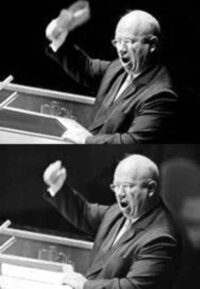
Well, did he, or didn’t he?
It may be the stuff of legend, but back in 1960 Nikita Khrushchev is supposed to have caused a bit of a stir in a session of the General Assembly of the United Nations. He was in New York on an official visit and participating in the meeting of the august body on October 12th, (or was it the 13th? – accounts vary), when he is supposed to have taken offense at the speech being made a delegate from the Philippines who charged that the Soviet Union had “swallowed up” Eastern Europe and “deprived [it] of political and civil rights”.
He had already created a stir with angry outbursts interrupting the speech of the British Prime Minister Harold Macmillan, but on this occasion he stormed to the rostrum on a point of order. Shouting and gesticulating wildly he expressed his anger and was eventually sent back to his chair, where he continued remonstrating … apparently banging the desk with his fists – and, according to some versions, took off his shoe and used it to continue his outburst by banging the desk with the heel of the shoe.
At least, that’s the commonly held belief … the trouble is that it probably never happened. The accounts are far from clear … although it appears that he did hammer the desk with his fist – so hard that he managed to break his watch. The one photograph of him brandishing his shoe shows a sandal and it appears that it may have been doctored.
Khrushchev was renowned for his passion and various outbursts … there was for example the famous “kitchen debate” with Vice President Nixon in front of the Wold’s press, that literally took place in a kitchen – albeit a show kitchen, at the American National Exhibition in Moscow in 1959, rather than a real one.
Nixon started by pointing at a dishwasher, (which was, incidentally, invented in the nineteenth century in order to cut down on breakages by servants), saying, “I want to show you this kitchen. It is like those of our houses in California,” and Khrushchev replied “We have such things.”
Well, maybe they did … but, I don’t tin there were that many of them. Even today, although we do have some dishwashers on sale in the shops here in Bishkek, they are not very common. Perhaps things would have been turned out differently if some of the labour saving modern marvels that Nixon wanted to showcase had been more available here in the Soviet Union – or even after the break up of the Union – to help people feel that life was improving.
As it is, passions are still running high here in Kyrgyzstan … and the latest bout has been directed once again at the Kumtor mine.
They have led to more protests in Karakol, the administrative center of the Issyk Kul oblast in which the mine is located. According to one report, the protest was started by a group of about 150 women complaining about credit unions and the difficulties of repaying loans given the high rates of interest and other conditions imposed by the financial institutions. At first, all was proceeding calmly. If all of that is true, then the numbers grew significantly, the emphasis shifted to the negotiated settlement with the Canadian company embodied in the memorandum that has been out for public consultation and the situation grew more violent.
The main road round the southern shore of Lake Issyk Kul was blocked, (a favourite tactic here in Kyrgyzstan – a mountainous country where there is often only one road from A to B, so it is seen as being easy to implement and gain maximum effectiveness with minimum effort). The crowd berated Kaptagaev, the governor, pushing him and tearing his tie from around his neck. The police moved in to protect him, but when he got into a car, someone apparently poured petrol over it and tried to set it alight. He was taken captive and held hostage as the protesters demanded air time for a live broadcast to air their grievances.
It seems they made several other demands like the release of other protesters and stopping the criminal case against the people accused of trying to extort three million dollars from the company; renunciation of the earlier agreements with the company and a greater share of the reformed joint venture – if not complete nationalization. At one point, it is said, they gave the government just half an hour to respond.
Maybe that’s the reason President Atambaev made comments about the difference between democracy and anarchy; about the need for demands to be realistic and how the “wrong” decision could lead to a financial crisis … which somewhat begs the question as to what constitutes a “wrong” decision. He’s made other comments about the role of the Parliament in the process … Parliament will decide – if they decide to nationalize then the government will have to comply … but it will lead to immense difficulties, (so, presumably he sees it as an example of a “wrong” decision). He also said that when parliament do make their decision then they should do so in open vote – so that everyone can see who voted for what, and they can take responsibility for their actions.
All the parliamentary parties have been meeting to discuss their responses to the memorandum. Ata Jurt has come down strongly on rejecting all the previous agreements with the company – “instructing” the government to denounce them and saying that they will demand the resignation of the government if it doesn’t do so. They are not the only ones to call for the resignation of the government.
In the meantime, there have been calls for the parliament to invite the President to address them … and explain his opinion on the affair. Although, I suppose, there would be some benefits from this, (it might well have some advantages over the “policy by megaphone” that we are seeing at the moment where everyone makes public announcements which only seem to get harder and more entrenched as time goes by), I don’t think I can see him doing it. After all, his position seems to be that Kyrgyzstan is now a Parliamentary Democracy – so, it’s for parliament to decide … and take responsibility for the consequences.
In the end … the parliament seem to have decided to delay their final decision for another week.
What was interesting in that was that, apparently, there is a deadline that the government have to keep to following the commission findings being reported … although I suspect that they can still comply with this timetable even with the delay.
.
The protests took place over several days – with some 23 arrests and 6 policeman being injured.
They also led to appeals from businessmen for the government to take steps that would allow them to get on with life and work normally; punishing those who cause the disruptions.
This appeal was brought into sharp relief when I met the owner of a small Bed and Breakfast, (which is located just outside Cholpon Ata), during the week. As is usual when two or three people in tourism get together at this time of year, talk quickly turned to the question of the season and, “How was it for you?”.
Whereas I was able to say that the it had not been too bad for us and turned out to be better than I had feared – a slow start at the beginning of the year but picking up as more and more people are undertaking journeys (even quite lengthy journeys along the Great Silk Road) at much shorter notice than they used to – he said that it had been a pretty awful year for them with far fewer guests than last year. Lots of people – but most of them were family and friends takng the opportunity to visit rather than paying guests.
I was surprised at that because I had received the impression that although there had been a few hiccups, there seemed to have been a lot of tourists up at the lake. His response was reasonable and measured: that was true in the main resorts and the center of town, but his B&B is just that little bit further away and so tends to pick up guests once the other places are full. Then came the sting in the tail – “We had lots of people from Kazakhstan pre-booked, but after the trouble about Kumtor on the southern shore, they nearly all cancelled.”
The sentiments of the appeal was, once again, was echoed by comments from the Head of State. If someone is taking hostages, he said, then we cannot rule out the use of weapons. In fact weapons were used … there were reports of stun grenades and tear gas being employed in the efforts to restore peace and calm.
.
Perhaps the strangest thing about the whole incident is that stories started flying around that the people behind it, financing it, (and everyone seems to agree that it was a planned event – not a spontaneous outpouring of righteous indignation), were former President Roza Otunbaeva, former Prime Minister Omurbek Babanov and even Emilbek Kaptagaev, the governor who was berated, pushed, stripped of his tie, trapped in a car and held hostage. Needless to say, there have been denials but it looks to me, even taking a very cynical approach of politicians, like a blunderbuss approach, a clear attempt to muddy the waters by pointing the finger of blame at all and sundry in order to deflect attention from where it might reveal something.
.
Although I have a lot of time looking at just one issue, life goes on and other things have been happening.
The weather has taken a turn for the worse. The Ministry of Emergency situations even spent money warning everybody that there was going to be a deterioration in the weather – rain and snow were expected – especially in the mountain regions – and urging everyone to exercise care and caution. They were right! Snow fell causing havoc on the the main Bishkek-Osh road over the Too Ashu Pass causing the road became slippery, heavy machinery could hardly descend down on the Bishkek side making difficulties for other road users.
The Bishkek heating plants, which provides most of the city’s hot water and central heating, has announced that the heating system has been serviced over the summer, fuel stockpiled, (although we will still have to purchase some 500 million cubic meters of gas), and 12 boilers will be ready for November 1st with another 15 coming on line by 1st December. The system will be turned on on November 10th – unless the temperature falls to less than 8 degrees for three days in a row.
An explosion in Djalal Abad got everyone worried about a possible terrorist outrage in which four people were injured. Fortunately, it turned out to be a more prosaic event – a gas cylinder exploded.
Here in Bishkek we had a fire which managed to burn out some ten shops and approached a gas station. Fortunately, it was extinguished before it reached the petrol tanks. If it had reached the petrol station, I hate to think of the scale of the explosion that it might have created. As it was only block away from my office and so I am extremely grateful for the efforts of the fire fighters … who are apparently facing more and more fires as the years pass.
There were some confusing statistics published during the week.On Thursday we learned that GDP had grown by over 9% in the the first nine months of the year … but the next day another government department told us that by the end of the year, “real economic growth” for 2013 was expected to be just 6.9%. On Thursday we were told that inflation for the period January to September stood at just 1.6% and that this low figure was due mainly to the fact that food prices have fallen … but not many people have noticed this and on Friday one deputy complained that people could not afford the prices in the markets. Another pointed out that in the Batken oblast, where there is a fuel shortage which has resulted in rocketing prices and this, in turn, has led to a 20%-30% increase in food price. Incidentally, the cost of non-food items in the index have risen by almost 4%, particularly for alcohol and tobacco products.
There was, however, a piece of good news: according to press reports, it seems that Kyrgyz honey has been recognized as “the best in the world”. That’s not simply an empty boast on the part of the Kyrgyz Press, there is something behind it. Honey from At Bashy was awarded the gold medal at the Apimonda Congress of beekeepers in Kiev. The congress was apparently attended by 12,000 delegates … which seems a surprisingly high number. Kyrgyzstan produces some 5000 tons a year but this represents less than a tenth of what it could produce – It is produced in all regions of Kyrgyzstan and is a popular foodstuff and there is a lot of rivalry between the regions as to which produces the best honey. IMHO, (in my humble opinion), the arguments are irrelevant – they are all good … although I have to admit that they do vary in consistency and flavour depending on the location of the hives and the flowers in the district.
Now, perhaps that is something for people to get passionate about, and bang the lectern with their shoes for emphasis!
_______________________________________
Postcard from Bishkek: the weekly postcard that I send out as an email also gets posted on the website ianbek.kg each week – and there are other postcards which don’t get sent out. This week, for example, there has been the following postcards:
- Wish list - Some places in Kyrgyzstan that I still haven’t visited but would like to - 06/10/13
- Aesculus hippocastanum - A reminder of my youth … Conker trees in a Bishkek park – 07/10/13
- Breathe into this … - on the anniversary of the introduction of the breathalyzer onto Britain’s roads, I took a look at ‘Drink Driving’ in Kyrgyzstan - 08/10/13
- A new Benjamin - The introduction of a new banknote by the Federal Reserve - 09/10/13
- Draniki - A tasty snack or garnish - 10/10/13
- Batken Oblast – A look at the remote Southwestern corner of Kyrgyzstan to mark the creation of the Batken oblast in 1999 - 11/10/13
It is possible to follow me on Facebook, (where I have specific pages for Celestial Mountains and ianbek … and also links.kg, Kyrgyz Diary and Kyrgyzstan Visitki), and also on twitter, (@Bishkekpostcard and @celestialMTC ).
.




 Bishkek