Breathe into this …
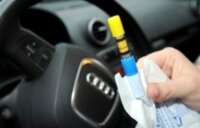
Breathalyzer
Some dates prove to be not only memorable … but not all as easily remembered even if they prove to be significant.
December 7th, 1941, for example, was a day which President Roosevelt declared would be “a day that will live in infamy”. October 14th, 1066, November 11th, 1918, and June 6th, 1944, are all instantly recognizable dates. It is said that people of certain age can remember where there were when they first heard that President Kennedy had been assassinated on November 22nd, 1967.
October 8th, 1967, however, is a date that will not “ring a bell” for most people … but it is a significant date – if only because it helped to almost half the number of deaths on British roads.
To be fair, there is a certain amount of dissimulation in that statement … but something did take place on that date which undoubtedly helped bring about that creditable result. That was the day when Parliament passed the Road Safety Act introducing, for the first time, a legally enforceable maximum “blood alcohol level” for drivers in the UK.
I say “enforceable” because of the invention of a “breathalyzer” – an electronic device which could be used as an instrument which could be used for preliminary screening those suspected of “driving under the influence” and determining if a formal blood test should be carried out. If the instrument indicated that there was a significant amount of ethanol in the breath being tested, then a blood test was carried out.
For the record: The effect of alcohol on drivers had been noted long before. In 1872 a law defined to driving coaches, wagons and steam cars in a state of intoxication as a violation of public order. In 1925 the driving of a “motor vehicle” was added to the list. Then, in 1932, a device was developed that could analyze the alcoholic level in blood. In 1935, the BMA, (the British Medical Association), published a study into “Traffic accidents related to alcohol” which led to an extensive campaign to implement an “evidence-based” method of analysis of blood alcohol and the House of Lords Committee recommending the introduction of this analysis to monitor drivers … but only on a voluntary basis. The first attempt to push a law through parliament to regulate the content of ethanol in the blood, (0.8 ppm – parts per million – as a maximum permissible limit), … oh, yes … and a maximum speed limit of 70 miles an hour.
Unlike the assassination of President Kennedy, I can’t say where I was and what I was doing at that particular time – but I do remember the controversy that it aroused. In particular, there was a considerable amount of concern about the fate of the village pub.
Britain has a large number of “country pubs”, (public houses, or bars, in villages). There was already considerable concern about the fate of the local village shop, the post office and other facilities which were under threat. It was thought that the introduction of the breathalyzer would mean that fewer people would drive out into the country for a drink … and lead to the demise of a “country fixture”.
Here in Kyrgyzstan the legal blood alcohol level for driving is zero.
The GAI, (the branch of the police that are responsible for enforcing the law relating to all aspects of traffic), do have breathalyzers available to them but they are very rarely used.
The standard technique is to get the driver to roll up a piece of paper into a cone and ask the driver to breathe into it. The officer then smells the cone and if he detects a whiff of alcohol then he takes the matter further … if not, he lets the driver go.
.
Drink Driving is an issue here – much as it is elsewhere in the world. The sentences for Driving Under the Influence were toughened a couple of years ago but a news report last year suggested that every tenth car accident is caused by a drunk driver. Also last year there were reports of a corrupt scheme being exposed whereby members of the GAI collected “on the spot fines” which were never recorded and then paid a “retainer” to their immediate superior.
Incidentally, as I understand it, according to Kyrgyz law the payment of traffic fines must be made at local banks rather than directly to the traffic police – but as that involves them taking the driver’s license and issuing a temporary document – with the original being reclaimed from the local police station once the fine has been paid – it is easy to understand why most drivers are happy to pay an “on-the-spot fine”.
A couple of weeks ago the Prime Minister was complaining about the inefficiency of the traffic police, but last week we saw exhortations for them to be more stringent in upholding the law … and there have been calls for the penalties for traffic offences to be further strengthened.
.
I have only ever seen a breathalyzer here once … it was some twelve or thirteen years ago. I was visiting friends in Issyk Kul and one of our number agreed to take us down to the local beach – but as there were far too many of us to fit in the car, he suggested running a relay – first one group and then return for the next group … and so on.
It was on his third trip that the local patrol stopped him … and I was one of his passengers. They called him over to their vehicle – not a good sign. They were chatting so long that two of got out of the car and wandered over to see what was going on, and he told us that they thought he had been drinking and wanted to impound the car. We tried to tell them that he hadn’t and that’s when they produced the breathalyzer …
I was amazed because I hadn’t seen one here before. I was even more amazed when they told me that he had failed the breath test … the crystals had changed colour.
For the record: A Breathalyzer Test detects alcohol on a person’s breath by using a chemical reaction. The Breathalyzer Test itself contains several chemicals and each is a different color. The colors change when they are exposed to alcohol. The chemical crystals start out as orange-yellow in color and change from yellow to green when it comes in contact with alcohol. An officer can determine the amount of alcohol detected by how intensely the color changes.
I looked at the tube and asked, “What colour were they before?” For some reason the police officers didn’t want to answer … there was the usual, “What language are you speaking? We only speak Russian” … even though we had been communicating perfectly well for the previous five minutes. The crystals were … yellow. A bright yellow … brighter than the original crystals … but yellow all the same. I tried to argue that the change in brightness was because the crystals had become wet with moisture in the breath and didn’t constitute a colour change.
If I had been the driver I would have said, “Impound the car … I am going to hospital and will have a blood sample taken and analyzed … and I will see you in court!” As it was, the driver told me and my friend to go back to the car and he carried on talking to the officers … he wasn’t keen on the idea of challenging the police so he paid the “on the spot fine” and went back to the car – and we drove off.
I am sorry – but I don’t believe he had been drinking … Of course, it is possible that, for example, he had had a beer over lunch but I had been with him all day (apart from his two trips ferrying people down to the beach) … and I hadn’t seen him take a drink. What is more, if he had really been driving under the influence … the police wouldn’t (or at least shouldn’t) have let him back behind the wheel.
.
There was one occasion when I was driving and got stopped by a GAI officer who was conducting a random inspection. He asked if I had been drinking and I said no.
“I think you’ve been drinking.”
“Well, you are wrong.”
“Did you drink last night?”
“One glass of wine with dinner.”
“A-HA!!!”
Uh Uh … at that point I realized I had made a mistake.
“Oh, come on,”
“Alcohol stays in the blood long after its been drunk.”
“Yes, but not that long – especially after just one glass of wine which was drunk with a meal that would absorb it.”
We stood by the side of the road for a while, arguing, and then he took me over to another officer – who happened to be in plain clothes, so I only had his word that he was an officer. I was told that this was his captain. He “introduced me as an “Englishman who has been drinking.” Of course I disputed that point straight away and the captain rolled up a piece of paper into a cone and told me to breathe into it. I complied with the request and he looked decidedly unimpressed … saying – pointing to the first officer, “Well, he thinks you’ve been drinking”.
“But I haven’t … so what happens, now?”
“You go for analysis”
“OK – lets go!”
I was told to get back in the car and the officer climbed into the passenger seat. Excuse me, I thought to myself, I am supposed to be Driving under the influence” but I am expected to get back behind the wheel and drive the officer to the hospital so that they can undertake an analysis. I made a mental note of that point just in case I needed to refer to it later on. Although I had no doubts as to results of the analysis … but I did wonder if they might be doctored in some way by the doctor, (pun intended).
On the way he asked me where I was from … so I told him, England. He asked what would happen if I was caught drunk driving in England. That’s when I made a second mistake by saying,
“It all depends …”
“What on?”
“For example, how much alcohol … ”
“A-ha! … not here … no alcohol at all!”
“Yes, I know … and I think that’s a lot better because it’s clear … no at all!”
Phew, I think I recovered from that mistake.
“Well, what would happen, would you loose your license?”
“Yes”
“… and pay a fine?”
Here it comes, I thought to myself …
“Yes”
“How much?
“I’m not sure but maybe a couple of hundred pounds … ”
“How much is that in Som?”
“About 15,000″
He went silent as he stared into space … presumably calculating how much he thought he could take me for …
When we arrived at the hospital, it was locked! He knocked at the door. No-one came. He knocked again … Harder. Then he started hammering the door with his fist. Finally we heard some footsteps and the door opened. He waltzed in announcing
“This is an Englishman … a Drunk Driver.”
“We’ll see about that … Your captain didn’t think I had been drinking”
“We’ve come for analysis.”
We were led into a large room where there was doctor – well, they said that she was a doctor and she wore a white coat – who told me sit on the examination cot. I started to roll up my sleeve and she said, “No”. She handed me a beaker with some liquid in it and a straw and told me to breathe through the straw into the liquid … which I did, (thinking, “this has to be a joke … note it for the court case”).
Apparently I hadn’t breathed out enough … I was told to do it again “Take a deep breathe and blow through the straw for two minutes!”
Two minutes!
I took a deep breathe and blew … counting one thousand and one, one thousand and two, one thousand and three … to count off the seconds. After about thirty seconds she said “Enough, You can stop.”
The beaker was put onto a table and we sat looking at it from three corners of the room … the doctor at her desk, the policeman sitting by the door – presumably so that I didn’t try to “do a runner” – and me sitting on the couch.
“What’s supposed to happen?” I asked. ”You’ll see”, was the only reply I got.
We sat looking at for about a minute … I counted one thousand and one, one thousand and two …
Eventually the doctor quietly said, “No, it’s normal.”
“What????”, said the policeman … and fell silent … staring at the beaker for another twenty five seconds … I counted one thousand and one, one thousand and two …
Eventually he said despondently, “OK, let’s go …”, presumably having decided he wasn’t going to get anything out of me. We got back to the car and he asked me to drop him off back at his post. I said, “You’ve got to be kidding”, sat down in the driver’s seat, started the engine and drove off.
.
To be fair, both of these events happened a long time ago … but judging from the stories I hear, (such as this one), “old habits die hard”.




 Bishkek