Honey, honey …
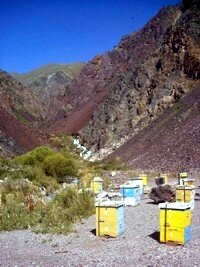
Bee Hives in a mountain valley
Here in Bishkek there are a number of kiosks and shops called Medovaya Lavka that sell just one locally produced product – Honey.
Honey is very popular and is harvested from both cultivated and wild bees and is thought to have curative properties.
As an aside: I read on the internet last week that “Honey is the only food that will not rot.” As it happens I knew that … and often comment on the strange habit that people have here of storing the honey in the fridge. I was a bit surprised, however, by the next sentence: “A jar of honey may remain edible for over 3000 years.“
It is produced in all regions of Kyrgyzstan and is a popular foodstuff and there is a lot of rivalry between the regions as to which produces the best honey. IMHO, (in my humble opinion), the arguments are irrelevant – they are all good … although I have to admit that they do vary in consistency and flavour depending on the location of the hives and the flowers in the district.
Many of the high mountain meadows, (jailoo), are rich in the variety of herbs pollinated by the bees and providing the raw material for amber nectar.
There are are other places that specialize in selling honey - just outside Balykchi, for example, on the main from Bishkek to Issyk Kul there is a complex where it is possible to purchase various types of honey produced from hives from all over the Issyk Kul region.
In the mountains it is possible to come across a wagon either surrounded by hives in the fields by the roadside, or with the wooden hives mounted in racks on trailers. The beekeepers have to pay to place their hives on particular plots and have to move them several times throughout the season.
(Incidentally, in his book “Hunted through Central Asia – On the run from Lenin’s Secret Police”, Paul Nazaroff, the anti Bolshevik from Tashkent who fled Uzbekistan after the failed counter revolution in 1917/1918, describes how, for a time during the Civil War, he worked as a bee keeper in the mountains near Bishkek.)
For those wanting to buy honey direct from the beekeeper, however, it is best to have a jar to put it in.
The first bees for commercial use were brought to the Prezhervalsky region (Karakol) from Verney (Almaty) as early as 1876, and were rapidly introduced throughout the country. A single hive can produce about anything between 25 and 32 kilograms of honey in a season.
Their importance is evidenced by the fact that they were included on the emblems of local authorities in both Pishpek and Prezhervalsk.
During the Soviet period, not only was there a very well organized state structure for honey production but many individual households also possessed the occasional hive. People were also allowed to sell honey for personal profits, (thus providing families with an potential additional source of income, which helped to add to its appeal as an agricultural activity), and the Kyrgyz Republic took third place in the USSR in terms of the number of bee keepers – and seventh place in the number of bee colonies. The beekeepers in the Republic produced enough honey to satisfy local demand and export up to 12500 tons a year, (for example to Europe and Japan). This helped to shape a system where large collections of hives, (maybe as many as 300), would be concentrated together under the control of a single beekeeper.
By 1990, however, the level of production had already started to fall – dipping to just under 7000 tons. The collapse of the Soviet Union, in 1991, led to a loss of markets and this dwindled considerably, and although there have been signs of an improvement in recent years, levels of production are still well below those of the Soviet period … something like 4000 tons being produced annually at the turn of the millenium – and the latest figures I have seen suggest just 1250 tons being produced in 2012.
Perhaps one of the biggest problems faced by beekeepers is satisfying the extensive product testing being necessary under regulations, (particularly in Europe), as for some time the nearest laboratories were in Germany, (although I understand that one has now opened in Tashkent and that there are plans to open one in Kyrgyzstan in the near future).
Then there is the question of marketing, and packaging. There is a Beekeepers Association, (the Kyrgyz Union of Beekeepers), and a surprisingly large number of suppliers advertising Kyrgyz Honey on the internet – at least I found it surprising.
Another problem faced by beekeepers is the increased competition between beekeepers and shepherds who want to use the jailoo as pastures for their livestock.
In 2009, beekeepers suffered from a different sort of problem when the Kyrgyz veterinary service placed a ban of exporting honey as a result of a number of cases of H1N1 influenza in the country. Fortunately, this hasn’t been repeated.
As an aside: Here’s a recipe for a hot lemon and honey drink that is often drunk as a cure for coughs and colds … – with, (as is common here), optional vodka.
Ingredients
- 1/2 cup honey
- 4 cups water
- 1 lemon, (zested and sliced)
- 1-2 cinnamon sticks
- Optional:
-
- Vodka, to taste
- other spices such as Ginger
Method
Pour the honey, into a medium sized pot and add the lemon zest, cinnamon and water, (and the vodka and other spices if you are going to include them), stirring to mix well. Bring to the boil, then cover it and allow to simmer for 30 to 45 minutes. Pour and serve with the lemon slices.





 Bishkek