Traditional Jewelry
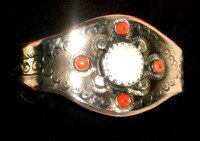
A bracelet
The second Sunday in October is another of the professional holidays that are a feature of the calendar here in Kyrgyzstan … it’s National Crafts Day.
One of the aspects of traditional Kyrgyz crafts was the manufacture of jewelry both in precious metals and stones (for example, corals and turquoise) . Unlike most of the traditional crafts it was basically a male dominated activity – even if the objects they created, (typically rings, earrings and bracelets), were designed for women, (although there are exceptions to both of these generalizations).
The skills were usually passed down from father to son through the generations.
It is one of the ancient genres of Kyrgyz craft and there are many examples of mines and works for the fashioning of silver, gold and other metals throughout the country. Many different techniques were employed – including forging, stamping, engraving, embossing and plating.
The jeweler tended to perform all the operations in the manufacturing process themselves. All the skills of blacksmith, and jeweler were combined in one person. A jeweler often worked also as a blacksmith and would make all their own implements.
They tended to work with pure metals – not mixing them with other base metals – although silver was often plated onto other metals.
Jewelry served a number of purposes:
- it was decorative
- it had magical connotations – silver in particular was thought to ward off the attentions of malicious spirits
- it was a status symbol:
- it could be represent a badge of office – for example a governor’s ring;
- rich people would wear more elaborate examples than poorer people
The type of jewelry worn by women tended to vary according their age, social status and the purpose of the decoration. The richer the family, the larger and more diverse the collection of jewelry she had available. Girls and young women wore more than older women.
Today, there is still a strong tradition of the design and manufacture of jewelry, especially using locally produced gold and silver.
Tumar – Amulets
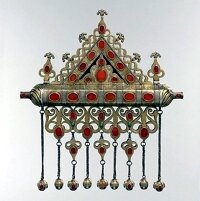
A Central Asian Tumar – part of the collection of the Metropolitan Museum of Art
In ancient times, the breast was considered a receptacle of the human soul, and should be protected with the greatest zeal and so amulets and talismans were hung over them, to be closer to heart – “the home of soul” – in order to protect the person from influence of malicious spirits.
Amulets are found in many different cultures … and they are a common feature amongst the peoples of Central Asia, where they are known as Tumar. The tumar served as a talisman. (In Arabic, apparently the word “talisman” means “a magic mark”.) They were thought to embody an energy which could bring good luck, riches, or happiness. This power was amplified, was stronger, if it was made from silver or gold.
Rings
Some scholars suggest that rings (shakek) were initially used in stretching a taut bowstring and were exclusively worn by men – either soldiers or hunters.
The ring, however, has a symbolic significance in many diverse cultures around the world. Of all the mystical concepts which have survived down to the present time, only the ring has not lost the force of its significance. (For example, wedding rings are still important symbols of fidelity.)
The ring is a circle, which in antiquity was a symbol of infinity, and of the Sun.
Many epics and legends tell about the force of rings and a magic ring is a common element in the fairy tales of many peoples.
The ring has long been a symbol of authority – they served as seals for the governors of ancient peoples, and were symbols of their authority.
Legend has it that stones were set into rings to remind people about Prometheus, who – according to Greek Mythology -brought fire from heavens as a gift for mankind. (When Hercules released the Titan, Prometheus began to wear a ring with a fragment of a rock chained to it for all eternity on the order of an angry Zeus.) Stones were considered to strengthened the magic power of a ring. They protected the owner from illnesses and brought them success and riches.
Bracelets
As with most jewelry, the bracelet, belerik, was also considered to have powers of averting evil influences and bad luck.
Originally bracelets were decorated with totems, figures resembling animals. Frequently, the ends of the open-ended bracelets were fashioned as the heads of snakes or frogs (which were a symbol of fertility), or, in the case of Uigurs and Dungans, the head of a dragon (a symbol of authority and wisdom), or the hoofs of a yak (a symbol of good luck).
Bracelets were often made in pairs and warn on both hands and sometimes, depending on the wearer’s wealth, several pairs may have been worn at the same time.
There were also foot bracelets. Such a “bracelet” was often placed on the leg of a newly born, long awaited for, child using fragments of silver ornaments given by large families.
Bracelets were frequently decorated with patterns, or inlaid with stones or mother of pearl, pearls and smalto (blue coloured glass), and they often had inscriptions engraved on them, (such as spells for the attraction of success).
Earrings
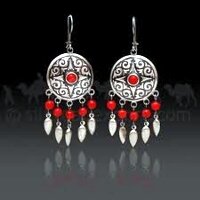
Earrings from Kyrgyzstan
The custom of wearing earrings is found in many diverse cultures; according to the Chandos portrait William Shakespeare sported one and it is said that Pirates used to wear Golden earrings in order to have the wherewithal in order to pay for their funeral when they died.
According to epic poem “Manas”, Kyrgyz men also wore earrings (Iymek, Kulak Syoikyo). There were considered to possess the power to avert evil influences and bad luck and thus they served a protective function.
They were worn at any age, but in particular were given to babies as a form of protection against malicious spirits. When a long awaited child was eventually born into a childless family, or a baby was born into a family where infant mortality was high, jewelry would be collected from seven mothers who had borne several children and fashioned into an earring which was given to the new born child, which it worn until they, themselves, married.
Buttons
Buttons served many purposes. As well as having a utilitarian function – as a fastener, they were also a form of decoration – enhancing the beauty of the clothes. As with other examples of traditional jewelry, they were considered to have to a mystical power which protected to the wearer from malicious spirits.
Naturally, the buttons of the rich person differed considerably from those of the simple shepherd in value, quality and detail.
As reasonably expensive items, they would not be cast off but were carefully stored and transferred from old, shabby, clothes to new ones.
Kyrgyz master craftsmen made two types of buttons: topchu, which were ornamented, flat circular discs, and tyuimo or chon topchu, which were three dimensional.
The tyuimo or chon topchu was often in the shape of a hemisphere made from silver, with the bottom part decorated with curls made from silver wire, which enclosed corals, enamel or glass and which was frequently engraved.
As with other forms of ornamentation, buttons were considered by the nomadic Kyrgyz as a charm offering protection against malicious spirits. Inside the tyuimo and chon topchu small stones or pellets would sometimes be placed so that they rattled as the person moved about. The sound was supposed to scare away evil spirits.
Metal buttons were usually made from silver, which in itself was imbued with a special protective character. One exception to this rule was the bronze button – which was a symbol for Umai Ene – the mother goddess. It would be sewn onto the clothes of a baby in order that she would protect the child.
Often, even small buttons would be covered in graceful, very finely engraved, patterns which carried a special symbolic or magical, significance.
Belts
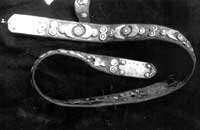
A belt
Belts have a, basic, utilitarian purpose – having fashioned himself clothes from animal skins, ancient man needed a device to girdle himself and fasten them around him.
Also, “girding your loins” also offers assistance when lifting heavy weights and helps to avoid over-straining, as is evidenced by weightlifters.
The belt also had a symbolic value as it was a symbol of authority, a mark of distinction and of rank.
Belts were also considered to have magical qualities. Made from leather, man began to use the hides from special sacrificial animals thus imparting a special magical force into the belt. As the belt basically forms a ring around the body it has the form of a circle, which gave it protective properties and it was considered to help ward off the influence of malicious spirits.
The buckles or clasps used to fasten the belt were usually large and figured, for example, in the shape of a solar disk, a rosette or a half moon etc. They were decorated with engraved patterns, infilled with niello or enamels.
Rich people would decorate their belts with silver discs, the poor with iron, plated with silver. Generally, however, Kyrgyz belts, (kemery), differed from the magnificently decorated ones preferred by the Uzbeks in their Spartan simplicity.
The use of coins
The jewellery of ancient Central Asia often made use of coins …
It was thought that they had magical characteristics in that they were round, (which is a mark of the Sun, which was considered to bring good luck and success in everyday affairs), and that they were often made of silver (which, according to the belief of ancient peoples, drove away malicious forces).





 Bishkek