A new Benjamin
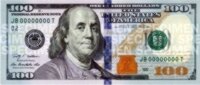
The new $100 bill
The US Federal Reserve has just issued new, “hi-tech” “Benjamin”, (one hundred dollar bank note).
It’s actually a bit late in making its appearance … the design was actually unveiled in April 2010 and had been scheduled to go into circulation in February 2011 … put printing errors caused the date to be pushed back … and some thirty million banknotes had to be destroyed Earlier this year, in April, it was announced that the note would finally be introduced into circulation on 8th October.
I wonder how long it will be before we get to see some of them here in Bishkek.
I don’t think it will be long … especially given the fact the local preference for crisp new banknotes … and the tendency to reject any notes that are old, worn or damaged, marked or dirty.
That’s actually quite a problem … we are quite often faced with a client who looks a us with armament when we scrutinize the bills that they give us to settle their bills. They don’ have any problems using the notes back home and can’t understand why we sometimes ask if they have another note. Often, especially when they don’t have other money, we have no choice but to accept their notes … even though that involves us paying an extra bank fee to change them into soms, and in some cases we are actually left with notes that the banks simply refuse to accept.
There are usually notices posted in the banks and many of the Obmeyen Valoota, (exchange offices), drawing attention to the features of new banknotes when they are issued and this time the new design incorporates number of new security measures in addition to the ones in the old notes, including:
- use of a special blend of paper – difficult to reproduce;
- with a “blue 3D security ribbon” woven into the paper – not simply printed on it;
- the number “100″ will shift from copper to green;
- a three-dimensional blue security ribbon with images that appear to move when the note is tilted;
- a copper inkwell with a holographic bell that changes color when tilted;
- “raised printing” to give Benjamin Franklin’s right shoulder a textured feel
- Complex colour and printing details – all designed to make it harder for counterfeiters to copy when creating forgeries
- serial numbers
- a watermark
- a embedded security thread which reacts to ultra violet light
For the record:I wrote a postcard about the security measures on the som banknotes back in March.
Even though it those special measures are built into the greenbacks … apparently, it costs just 12 cents to produce a banknote; presumably one of the economies of scale: it is estimated that there are some 90 million in circulation … and in 2009 alone, (apparently, according to one report, this was the peak year of production), some 1.8 billion notes were produced …
Incidentally: Of these, the Federal Reserve estimates that half of them are abroad, (I have seen figures ranging from 35% to two thirds), making the banknotes of the country’s largest exports.
International demand to hundred dollar bills is such that the rate of production has far outstripped that of other, smaller, denominations and according to one account, the Federal Reserve ships hundred dollar bills overseas on pallets, each one stacked with 640,000 bills. That means each pallet is worth about USD64 million.
The hundred dollar bill is the largest value banknote in circulation in the US … ever since the USD500, USD1000, USD5000 and USD10,000 notes were withdrawn in 1934. It is interesting to speculate if these larger denominations were still legal tender, if they would also be in such great demand.
As it happens, the largest Kyrgyz banknote, (5000 som) is also worth about USD100.
It is not clear, however, how long the banknotes remain in circulation … one source says that the average lifespan of a Benjamin is just over seven and a half years, whilst another says that on average they remain in circulation for more than 20 years – both reports cited official sources for their statistic … both different agencies of the US government.
Incidentally: the first USD100 banknote was issued in 1862 and featured an eagle … Benjamin Franklin only made his appearance on the notes in 1914.
.




 Bishkek