Aesculus hippocastanum
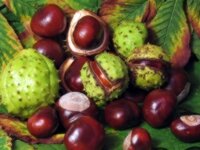
Conkers
The other day I was walking through Gorky Park on my way from my to the hotel, when I got a distinct feeling of dejá vu. For a split second, I felt as if I was back in the UK.
The weather cool and the skies were a little overcast – well, I suppose that is reminiscent of autumn Back in United Kingdom … but that wasn’t it.
No, the think that sent my mind back to my childhood was lying on the ground … conkers; the nuts produced by the tree Aesculus hippocastanum, otherwise known as the Horse Chestnut Tree. In Russina they are known as Kashtan.
I looked up and, sure enough, on the tree above me there were the telltale leaf clusters, each with 5 or 7 leaflets, and dangling fruit, each green and spiked – some ripe and had burst open exposing the brown nut with a whitish scar. The ones on the floor had fallen from such fruit.
Back in the UK they are used in the game of “Conkers”, where two players, each with a conker threaded onto a piece of string. They take turns striking each other’s conker until one of the conkers breaks: one player dangles their conker on the full length of the string so that the other player can swing their conker at it. The winning conker earns a “point” which is added to it’s previous score along with the points of the vanquished conker … so a “two-er” beating a “three-er” becomes a “six-er”.
I introduced the kids to the game a few years ago, after collecting a supply of conkers on my walk to the hotel. They found it fun … and the winning conker – a “ten-er” – still hangs in my office … but they are a bit too old for it now. Having said that, back in the UK it’s still played by grown men and there is even a couple of championship tournaments.
It’s odd to come across this tree here; they are not native to Kyrgyzstan – or Central Asia, generally. Indeed, although they are common back home in the UK, they are not native to those islands either. They come from the forests of the Balkans, in South Eastern Europe, but they are grown throughout the temperate world as an ornamental tree in parks and to line streets.
They are also popular, in miniature form, as Bonsai trees.
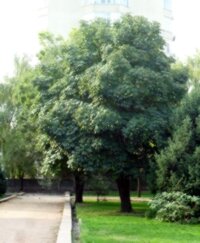
Aesculus hippocastanum tree in Gorky Park
There are a couple of specimens in Gorky park and they make an interesting and attractive contrast to the conifers that surround them.
The trees can grow to about 35 meters tall, with a domed crown of stout branches. The flowers they produce are usually white with a small red spot. The flowers appear in spring and make an attractive display of sprays, each standing about 10 to 30 centimeters tall, each with anywhere between 20 and 50 individual florets.
In English, they are called Horse Chestnuts and I had thought that this was because, when the leaves fall, they leave behind a scar in the shape of a horseshoe – complete with “nail” marks – but apparently it because the nuts seemed to cure horses of chest complaints … even though they are actually poisonous for horses – causing tremors and a lack of coordination.
Although, unlike proper chestnuts, they shouldn’t be eaten, they are generally harmless to the touch … however, I have seen suggestions that children with a nut allergies may have developed a rash after playing the game.
They have been used as the source of various chemicals:
- During the last century, they were used for the extraction of starch, which was then used to manufacture acetone that can be used for a number of purposes – and in particular was used in the manufacture of armaments;
- They can be used to produce a liquid that used to be used in whitening materials.
- They have been used as a source for medicinal compounds – although there are some concerns about the safety of its use … and the American Food and Drugs Administration classifies it as an “unsafe herb”.






 Bishkek