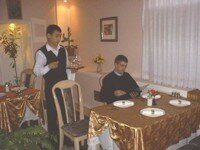
One of the most difficult questions we get asked by clients is about tipping. Should they give a tip? And, if so, how much?
Now, back in Britain, when I was growing up we never had a system of service charges imposed on the bill. In a restaurant, the price on the menu was what you paid. If you felt that you had received good service then you left a tip. Often, people would just round up the bill and not expect any change. Then a few places started to include a service charge – a practice adopted from the States or Europe – I am not sure which. Usually the service charge was 10%, but I have known a few places where it was 15% or even 20%.
Here, during the Soviet period, it was, apparently, not usual to ‘tip’ people like waiters and waitresses. The official attitude was that tipping was a “capitalist” practice and it was frowned upon … the salary was thought of as the reward for doing the job and tips were not necessary. Some people even took the suggestion as not only unnecessary – but even as an insult. Since the collapse of the Soviet Union, attitudes have changed and nearly everyone likes to receive a gratuity. More…
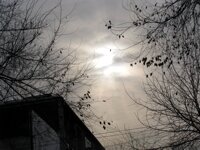
So, we were told, “the moon will appear to take a bite out of the sun … ” in today’s Partial Eclipse of the sun.
The amount of the sun which is hidden by the moon during a partial eclipse depends on how far you are “inside the penumbral shadow”. Although many Europen capitals would be able to see about half of the sun’s disc obscured by the moon, those living in the higher Northern latitudes of Europe would be the best placed for observing the phenomena, with something like 85% passing behind the moon as seen in Scandinavia. Here in Kyrgyzstan, on the other hand, it looked as if it would be a mere 25%.
That’s still quite impressive and so I prepared to brave the freezing cold. Iit was -8 degrees Celsius outside, according to the Weather Channel who also told us that with a Westerly wind blowing at 4 mph, it felt like -12 … believe me, it felt colder! More…
I got a strange comment on my Facebook profile the other a little while ago. Someone had noticed that I had clicked the “like” button on the Archers community page and responded with the following comment:
Tum-te-tum-te-tum-te-tumm…. tum-te-tum-te-tumm-tumm 
At least two of the seventy odd “friends” with whom I am connected on Facebook would have got the reference straight away, as they have also clicked that particular button, but I am sure that a large number of the others must have been confused by it. Especially those here in Kyrgyzstan.
More…
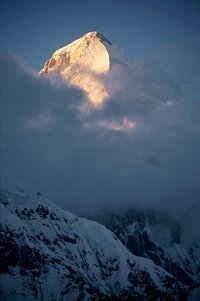
One of the newswires that I subscribe to had a link today to an interesting article in the Guardian newspaper about the growing pressure of work on mountain rescue services in the UK.
It caught my attention because Kyrgyzstan is a mountainous country and I wondered about the situation here in Kyrgyzstan. In fact I often see references to the fact that Kyrgyzstan is over 90% mountainous – the actual figure seems to vary upon the source being quoted. This sometimes causes some confusion for some visitors who don’t stray far from the main road – who ask: “Where are the mountains?”
The general definition of a mountain seems to be: “a large landform that rises above the surrounding land”. One dictionary actually uses the phrase, “higher than and steeper than a hill”, which raises a lot of questions in my mind, especially: “what is a hill?” The idea behind this four letter word seems so simple and commonplace that we tend to take it for granted but when we look up the word in the dictionary we find that it refers to “a landform that rises above the surrounding land.” The distinction between a mountain and a hill is simply that one is larger than the other. So it all boils down to a question of size. More…
The first amendment to the American Constitution was introduced along with other measures which formed what is known as “the Bill of Rights” in order to provide guarantees for civil liberties which were thought to be inadequately provided for in the original document. This particular amendment was directed towards the freedom of religion, the freedom of speech and the freedom of the press:
“Congress shall make no law respecting an establishment of religion, or prohibiting the free exercise thereof; or abridging the freedom of speech, or of the press; or the right of the people peaceably to assemble, and to petition the Government for a redress of grievances.”
It’s not, however, a “blank cheque” and doesn’t give the press “carte blanche” to say, print or display whatever if wants without limitation. There are a number of limitations which are often invoked, in particular with regard to security or decency, (propriety).
It represents a difficult area in terms of law and philosophy about what constitutes “fair comment”. This is a problematic issue that I have recently encountered. More…
So, 2011 has finally arrived … and, as usual, I slept through it – well almost. Having fallen asleep, as usual, watching the TV, I was woken up at 12:15, (or should that be 24:15?, or even 00:15?), by the fireworks. Apparently, the ban on fireworks is only valid in Osh. Here in Bishkek the salute, (that’s what they call a firework display here), went off in all its glory, as usual. It lasted for another half an hour, lighting up the sky in a multitude of colours, especially greens and reds, accompanied by loud bangs. As I rubbed the sleep from my eyes, and trying to console a distraught Garfield, (that’s the unimaginatively named Ginger cat sharing my bed with me), I couldn’t help wondering if the authorities in Osh didn’t have a point … all those explosives could easily have been mistaken for yet more examples of riotous incidents and terrorist outrages. More…
December 31st, 2010 Author ian Sections: ianbek
I continued to add Postcards in 2010, and the frequency increased as a result of the events of The Easter Revolution – 7th April, 2010. I started sending out a weekly Postcard (which are marked (*)). The following postcards were added during the year: More…
New Year is almost upon us and it is time to sit back and think about what has happened and making resolutions and plans for the coming year.
There are already lots of reviews of the year in the various newspapers and on TV and Radio. This year Kyrgyzstan seems to feature in all of them …
To be honest, it’s probably too early to really review the year … there is always the risk that we are too close to the events, (especially those of us who, like me, have been caught up in the middle of things), it’s very easy to look back and read into things with hindsight, using the information that we learned later on. I know that as I went through the postcards from 2005 for the website, I was a little surprised at some of the things I wrote at the time in the light of what I now know.
I suppose, however, that one of the advantages of New Year is that it gives us a time to focus on what has happened, to think about, plan, make resolutions and set targets for the coming year and so now is an appropriate time to look back and review the year that is coming to a close. More…
When I was a schoolboy, (and later when I was a schoolteacher), one of the standard projects that classes were set was to plan a holiday. The task involved a number of different skills, establishing a budget, and costing various alternatives; setting priorities as to the type of holiday, (for example, activities like trekking or sunbathing); selecting a destination, a hotel or package; creating timetables for the itinerary, (not forgetting to plan the trip to and from the airport) and so on. Sometimes the pupils would draw inspiration from television travel programmes or accounts of other people’s holidays. The task would involve scour the newspapers for adverts, and writing off for brochures, and visits to local travel agents looking for brochures, (they must have known what was going on and probably cursed the teachers for their imaginative initiatives) from which descriptions would be copied and pictures cut out for the posters and final report. The library would be raided for guide books.
These days, of course, things are a lot easier in terms of getting ideas and information. The traditional sources of information are still there, but with the internet people can scan many more ideas, download the brochures, pictures and even video of their destination. Many destinations and tour companies produce special CDs and DVDs as souvenirs which double as promotional materials. For anyone actually planning a trip there is lots of advice on destinations, activities, procedures and so forth available on specialist websites and through the channels of social media. More…
Whilst I was in Naryn this month I took the trouble to go through some of the video cassettes and CDs that we have up there. More…