Mountain Rescue
One of the newswires that I subscribe to had a link today to an interesting article in the Guardian newspaper about the growing pressure of work on mountain rescue services in the UK.
It caught my attention because Kyrgyzstan is a mountainous country and I wondered about the situation here in Kyrgyzstan. In fact I often see references to the fact that Kyrgyzstan is over 90% mountainous – the actual figure seems to vary upon the source being quoted. This sometimes causes some confusion for some visitors who don’t stray far from the main road – who ask: “Where are the mountains?”
The general definition of a mountain seems to be: “a large landform that rises above the surrounding land”. One dictionary actually uses the phrase, “higher than and steeper than a hill”, which raises a lot of questions in my mind, especially: “what is a hill?” The idea behind this four letter word seems so simple and commonplace that we tend to take it for granted but when we look up the word in the dictionary we find that it refers to “a landform that rises above the surrounding land.” The distinction between a mountain and a hill is simply that one is larger than the other. So it all boils down to a question of size.
It is not simpy a question, however, of the length or breadth of the landform, nor the area of land that it covers, but one of altitude. I remember, for example, being taught when I was a schoolboy back in Malvern, that the Worcestershire Beacon, (the highest hill in the Malvern Hills), was actually a Mountain because it was more than 1000 feet high. Its height of 1395 feet – or 425m – seems pretty small to me nowadays as Bishkek is well above that, situated at about 800m – or about 2600 feet – above sea level, (it depends where you are in the city when you measure it. My GPS system tells me the office is at 724.4m).
The plot of the 1995 film, “The Englishman Who Went Up a Hill But Came Down a Mountain”, starring Hugh Grant, centers around an English cartographer must tell a Welsh village that their mountain, (“the first mountain in Wales”), is only a hill, because his measurements indicate that it is actually just under the 1000 foot threshold. The offended community sets out to change that and construct a mound on the summit to raise it above the limit in order to retain its official status as a mountain.
Nowadays, the threshold seems to have moved … a mountain is generally considered to rise something like 600m above the surrounding terrain – so the Worcestershire Beacon wouldn’t count any more.
Here, the word “mountain” is used to refer to land which is higher than 1500m above sea level and so, when the country is described as “mountainous”, this simply means that the vast majority of the country lies at altitudes of more than 1500m above sea level.
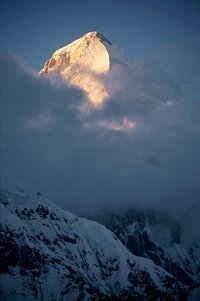
But what about the question of “steepness”? This conjures up the image of the sides of a mountain rising up to a “peak”, rather like a pyramid. Perhaps the archetypal mountain in this respect is Mont Blanc in France – but Khan Tengri on the borders of Kyrgyzstan, Kazakhstan and China – and, incidentally, claimed by all three countries as their own – is another. The Kyrgyz Range of mountains to the south of Bishkek certainly resembles this with their line of craggy peaks, as do the Terskey and Kungey Ala Too ranges which encircle Lake Issyk Kul. What, however, of Peak Lenin on the border of Kyrgyzstan and Tajikistan? It doesn’t have such a pronounced peak as such.
It is said that mountains cover something like 20% of the earth’s surface and occur in 75% of the world’s countries, accommodate approximately 10% of the world’s population and are the source of over 50% – some sources suggest as much as 80% – of the world’s supply of fresh water.
They offer a wide variety of ecosystems – indeed, one definition of mountains is that they must rise sufficiently high as to provide for two distinct ecosystems … hence the 600m limit, which is basically what is needed to do this.
.
Back in Britain, it seems that the number of “callouts” experienced by mountain rescue teams has increased year on year, and this year’s weather conditions have put additional strain on members of the team. According to the leader of the Langdale/Ambleside team:
the team was a “long way from breaking point” but had to plan for the future. “We have to anticipate it growing year on year. If the callouts carry on increasing, at some point the system we operate is not going to work.”
It seems as if there has been an increase in the number of casual climbers and walkers that have fallen into difficulty and needed assistance – “members of the shorts and flip-flops” brigade, as the report puts it, although, thankfully, “fewer people had been rescued suffering from hypothermia because many were wearing good-quality fleeces and waterproof coats”. One of the reasons for the increase is thought to be the growing expectation amongst members of the public that “they will be whisked off a mountain in minutes if they get into trouble”, possibly as a result of the media reports and documentaries about the “rescue heroes”.
In fact, rescues are not always as dramatic or comfortable and, unfortunately, are not always successful. What’s more, members of the rescue services are volunteers and put themselves at risk by going to the assistance of distressed travelers. I’m not sure if they are ever presented with a bill for the service, but I suppose they ought to be, and I think they would be surprised at how big it would be if they were.
In most parts of the world, and certainly in the UK, the rescue services are manned by volunteers. The American Coastguard and Britain’s Royal Air Force operate an “Air Sea Search and Rescue Service”, but the Britain’s Lifeboat service is manned and operated almost entirely by volunteers and the situation in mountain regions tends to rely upon ordinary citizens volunteering their services.
Here in Kyrgyzstan there is no central rescue service, although plans to establish one were set in motion as long ago as 2004. There used to be what everyone seems to agree was an efficient service run in Soviet times, but which has ceased to function since the dissolution of the Union. That service was financed by trade unions, and all climbers were required to register when they arrived at mountain camps. They were only allowed to begin the climb after their equipment had been checked and they had been given training. If the group did not return to base camp by a certain time, a team was automatically sent out to find them. The system collapsed, however, in 1991 along with the Soviet Union, and the responsibility for saving climbers was divided between the travel agencies who organized the climbs and the government’s Ministry for Ecology and Emergency situations, (MEES), which did not have a dedicated mountain rescue team.
Nowadays, the Ministry of Emergency Situations, (M.Ch.S, the Em-chay-es), operates rescue helicopters, and there are at least two private services. One offers satellite transmitters with a “panic button” which can be pressed to alert the staff at their headquarters who would then alert the appropriate authorities and dispatch assistance.
The American National Guard has recently run training courses for Kyrgyz rescue teams in Montana and Alaska and a Slovakian project has also prepared materials and training for mountain rescuers.
To be honest, I don’t know if the Rescue Services in Kyrgyzstan have experienced a similar increase in the number of callouts in recent years. There are often stories in the press about climbers running into difficulty, needing rescue or simply “going missing”. Occasionally there are reports of climbers who have perished in some accident on the mountains. On average, three to four climbers have disappeared every year since the collapse of the Soviet era mountain rescue system. A few years ago a body was found in one of the valleys not far from Bishkek of a climber who had obviously gone missing a few years before – but no-one seemed to know anything about who he was and the body could not be identified.
It’s not just climbers either. A couple of years ago a group of hunters were caught up in a helicopter crash in the mountains in the Naryn oblast, near to the Chinese border. One of the hunters used his satellite phone to contact relatives in Canada who, in turn, alerted the Kyrgyz authorities. A relief helicopter was dispatched but, somewhat overloaded, it too crashed to the ground. Eventually a group of Border Guards from the post at Torugart, led by a visiting American “advisor”, found the group and repatriated them to Naryn.
If the climbers and walkers in Britain would be surprised at the cost of rescue services in the UK, then they would be astounded at the cost here in Kyrgyzstan. They certainly would have to pay for the services, here. It’s for that reason that foreign governments advise their nationals to ensure that they take out sufficient travel insurance … as the British Foreign and Commonwealth Office put it: “If you can’t afford the insurance, you can’t afford to go.”
Technically speaking, insurance is a requirement here in Kyrgyzstan, but in reality it is rarely ever checked. For example, it is never checked when a visa is issued – although many countries actually refuse to issue a visa without a copy of the insurance policy, or certificate, being provided.
.
Now, although most of our tours would not require the assistance of the various mountain rescue services, (most of our tours are “motor tours”, “cultural tours” or tours along the Great Silk Road and we don’t undertake mountaineering expeditions and the like, and our treks are accompanied by experienced staff), we are very conscious of safety issues in the mountains.
The mountains are, indeed, a dangerous place. The risks in such environments are manifold and numerous: steep slopes with slippery and/or uneven surfaces; risks of avalanche or landslip, or falling rocks; encounters with wildlife … just to mention a few. What’s more, by their very geography, mountainous regions tend to be remote and difficult terrain to traverse. It can take a long time to summon assistance – and for it to eventually arrive. In one case, in 2004, it took five days for the Ministry of Emergency Situations to learn of an incident which cost the life of one Russian climber. It would help, of course, if there climbers, skiers, snowboarders and the like were at least required to register before entering on an expedition, but at the moment that is not the case.
They should not be thought of as “nothing special” or, worse, treated with contempt or disdain.





 Bishkek
Brilliant article, most informative, thanks Ian. Next time my son comes to KR for a climbing holiday he will book through Celestial mountains! For promotion, how about-’adopt a mountain’ Vladimir Putin now has one so why not International visitors ‘owning’ a few hundred metres? You could issue certificates as ‘Friends of Celestial Mountains’ to the valiant tourists. Just a thought.