El Kutu – Wings of the people – Fathers of the Nation
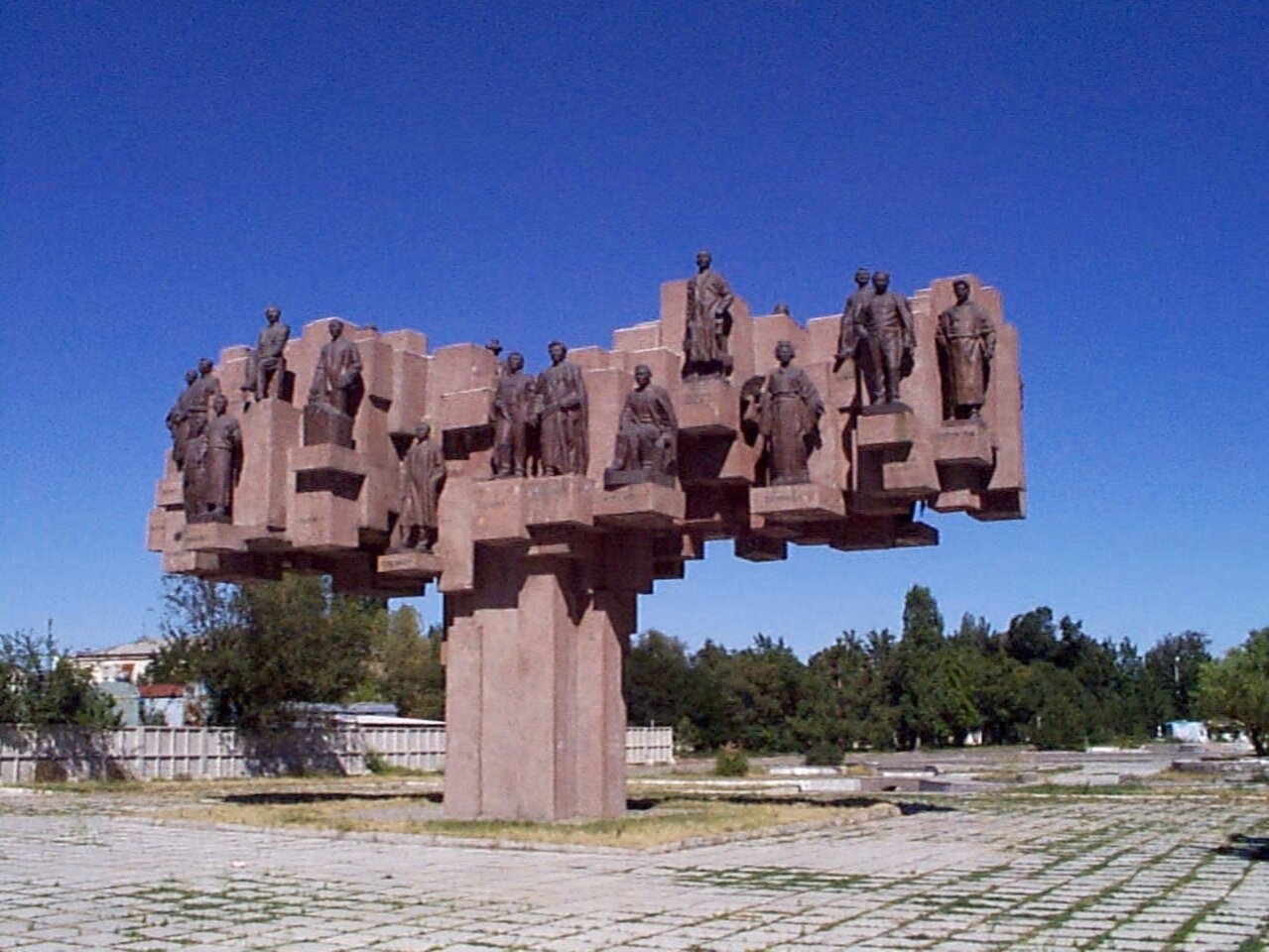
El Kutu in 1996
The second half of the 1990s saw a number of of monuments which portrayed important people in the history of Kyrgyzstan - although it also saw the unveiling of a monument dedicated to the two hundredth anniversary of Pushkin.
There were, for example, monuments erected to the writer Tokombaev (1996), the Avenue of Statesmen (1996), the Ballerina Bibisara Beishenalieva (1997), the poet Osmonov (1997), the poet Umetaliev (1999), Shabdan Baatyr (1999), … and, of course, that statue of Pushkin, (1999).
For the record, it also saw the unveiling of the memorial to the veterans of the Afghan war, in Ataturk Park (1996) and the ill fated Erkindik – the Kyrgyz Statue of Liberty, (1999), which used to stand in the main Ala Too Square.
At the start of this period in the middle of the decade, (1995), there appeared the complex, El Kutu - a Granite plinth, stretching some 17 meters and shaped like a Capital T, on which there were twenty nine bronze statues … effigies of prominent people in Kyrgyzstan.
At the time, I had just arrived in Kyrgyzstan and was told that the monument was called Fathers of the Nation … and I still see it called this from time to time. This, however, always caused me some confusion … as, out at Chon Tash there is the Ata Beyit cemetery and memorial complex which apparently means Fathers of the Nation. As I understand it, however, the phrase El Kutu means Wings of the People. This makes a little more sense … because among the characters represented there are statesmen and politicians … but they are more leading figures of science and culture.

a “strange monument” by Danielzolli on Flickr
Unfortunately, the figure have now all disappeared and only the plinth with the inscriptions remain. Rather than being placed in a prominent situation in the city center, it is tucked away at the side of the Philharmonia, at the intersection of Pushkin and Turusbekov Streets. As a result it is often overlooked … although sometimes some spots it and at least one visitor to the city was sufficiently intrigued to photograph and write briefly about the “strange monument” that he had encountered.
It was apparently a gift to the city from the sculptor Sadykov, who already had several other examples of his monumental work throughout the city. He had been thinking of such a structure for some time. The plinth is meant to symbolize the mountainous landscape and the figures representing the spirit of the Kyrgyz people and the hope for their development.
Among the characters portrayed are/were poets,m artists, performers, scientists and scholars, social figures, akyns (traditional minstrels or bards), manaschi, and famous historical characters … such as:
- the ancient philosopher Djusup Balasugin;
- thje ancient linguist Mahmud Kashgari;
- the improvisor poet (akyn) Dzeni Dzok;
- Kurmandjan Datka, the Queen of the Alai;
- the Komuzist Niyaazali Borosh uulu;
- to komuzist Alai Ogonbaev;
- the komuzist Karamoldo Orozov;
- the Manaschi Sayakbai Karalaev;
- the writer Tenirkul Umetiliev;
- the writer Alai Tokombaev;
- the writer Chingiz Aitmatov;
- the ballerina Bibisara Beishenalieva;
- the singer Kaiyrgul Sartbaeva;
- the scientist Musa Adyshev;
- Askar Akaev – First President of Independent Kyrgyzstan.




 Bishkek