Aaly Tokombaev
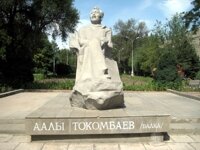
Aaly Tokombaev
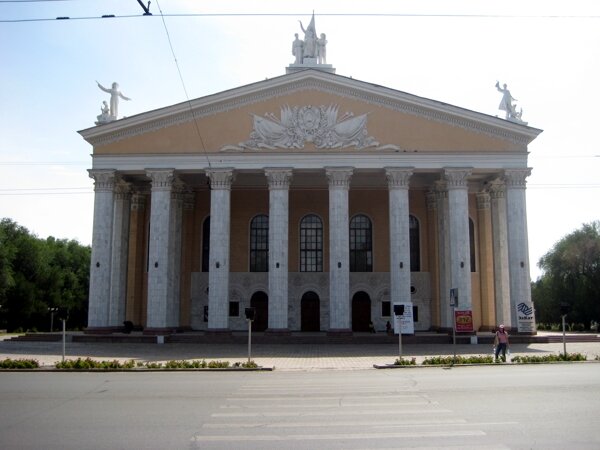
There is a statue on Sovietskaya, opposite the Theater and Opera and Ballet and by the side of the Museum of Fine Arts. It depicts a man, Aaly Tokombaev, sitting in an armchair. Tokombaev is a poet and one of the pioneers of Kyrgyz literature.
He was born into a poor family on 7th November, 1904, in the Chon Kayindy in the Semirechinskaya region of the Russian Empire, (which is the Kemin District of the Chui oblast).
As with many of his generation, the uprising of 1916 caused upheaval in his life. Along with many others, his family fled from the conflict by crossing over the border into China … when, the following year, they were on their return, they died leaving the young teenager an orphan.
He was admitted to a boarding school in Tashkent and from there went to study at the Central Asia State University – now the National University of Uzbekistan – graduating in 1927. In 1927, he also joined the Communist Party and after graduating he began working on the Kyzyl Kyrgyzstan newspaper, (Red Kyrgyzstan).
His first published poem appeared in the first issue of the Kyrgyz language newspaper Erkin Too. Then, in 1927, his first collection, Lenin Tuuraluu, (About Lenin – about the greatness of Lenin, the Communist Party and the “new life of freedom of the Kyrgyz – which was republished in 1936), was published and this was followed by further collections throughout the 1930s, including: Emgek Gyly (Flowers of Labour – in 1932); Attack, Abalky Yrlar (First Verse, or Early Poems – in 1934).
His career progressed rapidly and he soon became editor of the Kyrgyz section of Tsnetrizdata (Central data) in Moscow, which and in 1931 became the editor in chief of the State Publishing House of the Kyrgyz SSR. He continued to work in various capacities in various Kyrgyz periodicals and served several times at the helm of the Union of Writers of Kyrgyzstan between 1934 and 1949.
In the 1930s he turned to writing prose as well as poetry. He wrote a prodigious number of novels over the years, under the pseudonyms Chalkar and Lepine, including: The Dnieper flows into the Sea (1939); Wounded Heart (1940) and The Mystery of Melody in his early years.
During the Second War he wrote a series of patriotic works: Countryman Manas (a collection of poems published in 1941); On the twenty-eighth; The Oath; Pride; The owners of the Forest; After the War from the pen of Tokombaev out of the book of Life; Lyrics; Under Komuz melodies and We were Soldiers and Gratitude, (a collection of poems – 1944).
After the war, he published Eyewitness, a poem which explored the profound changes in the psychology of the Kyrgyz over the years.
In 1967 he was awarded the Toktogul Prize for his verse novel, Before the Dawn, which tells the story of the Kyrgyz liberation struggle against the Tsarist empire. originally published in 1947 but revised for the publication of the 1962 publication of the Russian edition.
Although he wrote primarily in Kyrgyz, he also also published in Russian and translated woks of such poets as: Pushkin, Goethe, Schiller, Lermontov, Mayakovsky, Marshak, Nizami, Abaya, and Jambul. Several of his writings have been translated in Russian … and also into a number of other languages of the former USSR: Ukrainian, Kazakh, Tajik, Uzbek and Lithuanian.
He continued publishing into the 1970s, with Sunrise; Ashybay; My Republic and The world of my life … among others.
He joined the Academy of Sciences in 1954, also served as a Deputy of the Supreme Soviet of the Kyrgyz SSR between 1963 and 1980 and received various other awards.
He died in Frunze, (now Bishkek), on 19th June, 1988 at the age of 83.
His house in Bishkek has been converted into a memorial museum dedicated to him, his life and his work.




 Bishkek