Shabdan Baatyr
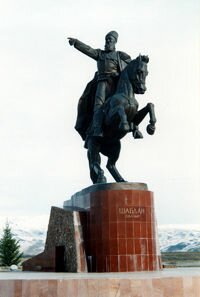
The statue of Shabdan Baatyr in Kemin
Shabdan Baatyr was born as Shabdan Dzhantaev on 29th October, 1839, into the Sary Bagush tribe in the Kemin region.
From an early age his father began preparing him to take over his role as manap, a community leader. He rose to be a local chieftain and ruled the Chon Kemin valley as his local fiefdom. The locals still hold him in great regard and a large statue of him on horseback has been erected in Kemin (on the left hand side of the road as you travel from Bishkek to Lake Issyk Kul).
Shabdan was born into the “aristocracy of the steppes”. From his childhood he was brought up with the morals inherent to the steppe-nomads of that time: devotion to people; diligence; honour; military courage, and a respect for the natural surroundings in which they lived.
At the age of 11, in 1850, he was captured and held as a hostage by the Khan of Kokand. In his youth he took part in a number of raids on neighbouring tribes. Respected as a soldier he rose in the ranks to the modern equivalent of Lieutenant Colonel, despite the fact that he had no formal education. He was highly decorated.
The Khan of Kokand even appointed him as the “bek” of the city of Azreti-Sultan, but he wasn’t happy with the situation.
- He is credited with liberating the Kurmandjan Datka (the “Tsarina of the Alai”) in 1876 when she was held captive by the Russian Imperial army. Kurmanjan Datka’s supporters, the mountain Kyrgyz, were very concerned by this event, and rebellion was in the air. At some considerable risk to his own safety, Shabdan Baatyr arrived before General Skobelev, (the Imperial representative in Turkistan), and negotiated her release. (There are several versions of this story – including one that he intended to woo her as part of his plan to unite the Kyrgyz – even though she was much older than him).
- When over a hundred Kyrgyz and Kazakhs were sentenced to death for rising in protest against the policy of resettling Russians brought from the West in Central Asia, a letter to General Skobelev from Shabdan Batyr won a guarantee of their release.
- In July 1862 when the rebels led by Tailyk Batyr attacked a group of Russian soldiers enroute to Naryn, it was Shabdan Batyr along with his dzhigits who saved them from captivity.
- In 1876 the Shabdan’s intervention saved the Russian Alay Military Expedition when they were surrounded by a group of Kyrgyz rebels – and he reconciled the two parties…
It is said that at his funeral, many of the local dignitaries swore never to offend the memory of the great man by their own petty squabbles – even in death he cast a shadow of peace over the nation.
There had been many attempts to try and unite the various Kyrgyz tribes and Shabdan’s efforts were to play a significant role. He explained to the karakuls (old men), djigits (young men), and bais (beys -headmen) that their prime responsibility were to establish and preserve peace in their lands. He told them that it was only by strengthening friendships with other peoples, (especially the Russians), would it be possible for them to build a strong state in the future and to achieve prosperity.
His concern for social issues is demonstrated by the fact that, despite his own lack of formal education, he did much to develop the education system for his countrymen. In 1909 he opened and completely funded a private medrassa (a Muslim religious school) in Kemin inviting a number of well known and respected teachers from all over Central Asia to teach there. He also sent Kyrgyz children to study at the Russian Grammar School in Almaty (Verney). He also sent a letter to the Tsar, Nicholas II, asking him to create Muslim assemblies, to open madrassas and schools where children would have the opportunity to study in their native language.
Throughout his life he helped the poor by providing shelter; food; distributing money, valuables, and cattle to ordinary people. He taught a nomadic people skills in agriculture, gardening, bee keeping, crafts, and house building.
He “retired” in 1884, but remained an important and influential figure throughout Kyrgyzstan (and Turkestan generally).
He died on 6th April, 1912, at the age of 72, mourned by thousands – according to the official records he died “a pauper”, having given away most of his wealth to the needy Kyrgyz.




 Bishkek