Sayakbai Karalaev

Karalaev on the 500 som banknote
Sayakbai Karalaev – (1894-1971) – was one of the great Manashi of the twentieth century according to the Kazakh author Muhtar Auezov who called him the “Homer of the 20th Century”. (Another source suggests that it was Chinghiz Aitmatov that awarded him this title).
As a manaschi he had to master half a million lines of epic poetry. His versatile performances veered between tragedies, to lyricism, to dramatic. At times crying, at others laughing, and at others sighing. At first he was greatly influenced by Chouke Omur, a well-known manaschi from Issyk Kul, but about 1925 started to develop his own style. Between 1932 and 1947 he wrote down the entire Manas epos – ‘Manas’, ‘Semetey’ and Seitek’ – totalling over half a million lines of poetry. He performed in Finland and in Moscow as well as in Kyrgyzstan, and received several awards.
He was born on 7th September, 1894, into a poor family in a small village, Akele, on the shores of Lake Issyk Kul. His mother was out collecting wild berries in the mountains, stepped on a snake and gave birth to him prematurely. Before the October Revolution he worked as a shepherd, and in 1918 he joined the Red Army as a volunteer – serving until 1922. On his return he was elected as Chairman of the village council and was involved in organizing the local collective farm. From 1935 he was engaged by the Kyrgyz Philharmonic Society as a professional “manaschi”.
It is likely that he was familiar with the epic from his childhood – learning the stories from his grandmother. There is an account that he began performing whilst serving in the Red Army and in 1924 he began studying under the Chon Manaschi Choyuke Omurov. However, according to his own account, he grew up as an ordinary “village lad”, without showing any interest in Manas – and showed only modest talents as a composer.
In the late 1960’s Karalaev was interviewed by a young, 23 year old, student – Bolot Shamshiev, (who went on to become a great film producer). As a typical Soviet student, who grew up with the philosophy of Historical Materialism, Shamshiev must have found it difficult to credit what he was hearing … yet, as he says in a newspaper article published in 2004 – “I couldn’t not believe him. He was a fair person, was frank with me, did not use cunning and did not dissemble”. So what was it that was so strange about the story he heard?
In response to a question about how he could remember half a million lines of poetry – he told a story of how he became a manaschi.
He told how, one year, he went to Kochkor to take part in a song festival during the Holy month of Ramadan. He did well in the competition, winning 19 Imperial Roubles. As he put it, this was BIG money for that time – a ram cost 1 rouble – so he had earned enough to buy 19. At current prices (2004) – the average price for a ram is: KGS6000-7000 or about USD150.
He set off home, and when he got to Orto Tokoi, he made camp he decided that to rest for the night by the edge of a wood, at the place which is now a reservoir. He dismounted from his horse, took off the saddle and after fixed the reins under a large boulder, settled down to sleep. He woke up in the night feeling hungry. Looking around, he noticed that the horse was no longer tethered to a boulder … but standing near a snow-white yurt, and light was radiating from the inside through the entrance.
Without thinking, he got up, approached the yurt and looked inside where he saw a beautiful woman and on the floor a dastarkan spread out and covered with food. He felt a sense that the woman was really Kanykei – the wife of Manas. She smiled, and gestured for him to enter. She smiled and handed him a large “kese” (cup) of koumiss.
There was then a deafening road from outside and a howling gale blew up. Full of fear, he jumped up and went outside. There, in front of him stood horseman on their mounts – huge giants, with their “heads resting in the sky”. Hot flames emerged from the horses’ nostrils. In the centre of the group was old warrior –eyes sparkling in the light of the fire. Later, he was convinced that it was the hero, Manas, himself – but at that time he was too scared to know any better.
On of the horseman, an old warrior with a long grey beard that stretched down to his belt, called to him, telling him to get down onto his knees. He said that he didn’t really need any encouragement to fall to his knees, because the ground beneath him seemed to shake, and it was impossible to stand upright anyway. He fell even further, and lay prone, on the ground. The horseman got down and filled a wooden bowl with sand – and held it to Karabaev’s mouth, urging him to eat it – but he clenched his teeth together, and turning his head away, firmly resisted the “forced feeding”. He felt his head seized and turned to face the warrior who looked into his eyes and said:
“You should swallow what I offer you. Then, you will glorify Manas. Open your mouth and do not be afraid.”
Karalaev opened his mouth and the warrior poured the sand into it. He said that he wanted to swallow the lot, down in one, but it burnt his throat and he failed. Some of the sand was caught in his throat, he had difficulty in breathing and went into spasms. This seemed to annoy the warrior but there nothing Karalaev could do about it. The warrior took a staff and placed it at the young man’s throat – and he was convinced that he has “met his end”. Using the staff, the warrior pushed more and more sand down the throat – so that it felt to Karalaev that it would burst. Reconciled to death, he lost consciousness – but with a sensation that the sand was, in fact, something sweet.
When he came round again the Warrior spoke to him and said: ”Tomorrow, when you leave Orto-Tokoi, you will meet a herder with two rams – one white and the other black. They are your sacrificial rams. Do not stint, but give the owner of the rams all that you earned in Kochkor and send him home. There kill these two animals and feed the Alkalsals (old men), and ask them for a blessing for the name and service to the spirit of the great and invincible Manas. Then, note that for half a year you will lose your voice. Do not be afraid, subsequently your voice becomes better – loud, sonorous and tireless”.
And then … he disappeared.
Karalaev woke up the next morning, looked around, and thought it had all been a dream. His horse was still tethered to it’s boulder, there was no trace of the yurt, the beautiful woman, the horsemen or their steeds. Having washed in the stream, he left on his way.
As he we went on his way he met a peasant, driving two rams – one black and one white. Stupefied, and not knowing what came over him, Karalaev took all his money and gave it to the peasant in exchange for these animals … who hurried away, probably thinking the young man was mad.
Karalaev took the animals and prepared a feast for the old men of his village, just as the warrior has told him to do. Although they happily ate the feast and gave the blessing that was requested – it was apparent to the youth that not everyone believed the story of his dream encounter with the legendary hero.
The next morning, he discovered that he could not speak. No-one seemed to be able to make sense of what was happening. They began to point at whisper behind his back, the village boys threw stones at him. He left home and went into the mountains living as a hermit – a, sort of, hunter-gatherer experience.
Six months passed.
One morning he woke with a start, his body shaking all over, as if he was in an epileptic fit. His powers of speech had returned – but seemed to be totally out of control – words rolled forth in an unending stream … and he sang … about Manas.
He rushed home, where his father was so shaken, he took a horsewhip (a “kamchi”) and beat the youth on the back until he stopped singing.
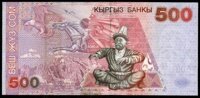
Manaschi on the reverse of the 500 som banknote
And that, so he says, is how he became a Manaschi.
It may seem like a wild story – but Shamshiev found it difficult to dismiss. Apparently there are other examples of similar mystical dream experiences – including being forced to eat sand – which presaged a career as an akyn of professional mourner.
Karalaev began recording his version of the Manas epic in 1935 – the tak took 12 years, ending only in 1947. It is the most complete version to be recorded … and covers all three components, Manas, Semetie and Seitek. It is particlularly noted for its depiction of the battle scenes – although Orozbakov’s version has more of them.
He died in 1971 in Frunze – now Bishkek.
His portrait appears on the 500 som banknote. There is also a red granite bust of him as part of the Manas Sculptoral Complex outside the Philharmonia building on Prospect Chui in Bishkek. It is one of a collection of busts which commemorate famous manaschi of the 20th century. He is the only only of those depicted here who was ever filmed and photographed whilst performing.




 Bishkek