Alexander Sergeyevich and the Day of Russian Language
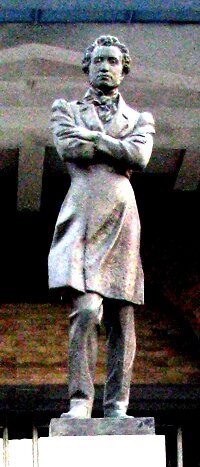
Alexander Sergeyevich Pushkin
A few years ago I was talking to someone about literature, (books, poems and plays), and whereas I was being asked about Shakespeare and who was my favourite author … I also got asked if I had ever read anything by Alexander Sergeyevich. I was confused and had admit my ignorance – “Who?”, I asked.
I was quickly put in my place with the exclamation, “Pushkin, of course!”
It’s a sign of his status that he is known simply by his first name and otchestva, (his father’s name). In fact, he is considered to be the greatest Russian poet and the founder of modern Russian literature.
As well as poems he wrote “verse novel”, dramas, prose (such as short stories, critical assays and even correspondence) as well as fairy tales.
Now, to be honest, I am not really an aficionado of poetry … and so I had to admit that although I had heard of works like Evgeniy Onegin and Boris Gudenov the closest I had come was watching a performance of Evgeny Onegin at the Opera and Ballet Theater – and didn’t have the nerve to say that I found it quite difficult.
In fact, Pushkin’s verse remains largely unknown to English readers, mainly as a result of the difficulty of translation … in order to translate the one hundred pages of Evgeniy Onegin into English, Vladimir Nabokov produced a two volume version.
Mush of his work has inspired others – musical versions such as Tchaikovsky’s opera which caused me so much trouble and his verse play Mozart and Salieri was the inspiration for Peter Schaffer’s Amadeus.
Pushkin has played a significant role in the development of the language influencing many writers and even coining words and phrases where he found gaps in the Russian lexicon.
Alexander Segeyevich was born on 6th June 1799, into an aristocratic family in Moscow – although it is said the family were actually poor. His father could trace his ancestry back to the Russian nobility of 12th century and his mother to noble houses of Germany and Scandinavia.
One of his maternal great grandfather’s however, had been a black African page, (although it’s not clear exactly where from – for example, from Ethiopia of Cameroon), who had been brought to Russia as a slave and raised in the court of Peter the Great. He received an education in France as a Military Engineer and rose in the ranks to become responsible for the construction of seaports and canals in Russia.
He published his first poem, “To a friend of the poet“, at the age of 15 and by the time he left school he was already well regarded in literary circles.
He became involved in social reform, emerging as a a champion for literary radicals – which got him into trouble with the authorities which got him sent away from the capital (twice) and hindered further publication for a while.
Proud of his honour, he apparently fought a total of 29 duels defending it during his life – and one of them was to result in his death, (from a wound to the spleen from a shot by his opponent – he died two days afterwards.)
Another sign of his significance is that his birthday has been chosen as the Day of the Russian Language, which aims “to preserve, support and development of the Russian language as the national heritage of the peoples of the Russian Federation means of international communication, and an integral part of the cultural and spiritual heritage of world civilization.”
Russian is apparently one of the five most used languages in the world, (along with English, Spanish, Chinese and Hindi), with more than 10 million speakers, and, with about two thirds of those speaking it as a second language, can be considered one of the world’s international languages. All the astronauts visiting the International Space Station are required to know Russian.
Russian is, of course, the second language of Kyrgyzstan – with the status of an “official language” … used in many official proceedings and publications … although some see that status as being under threat by the insistence of the prominence of, and measures adopted to support the development of the State Language – Kyrgyz.
Now, although Pushkin traveled considerably throughout the then Tsarist Empire, he never made it as far as Kyrgyzstan … which at that time was still a far off land under foreign suzerainty. Despite that, he is still held in high regard.
Here in Bishkek, a statue to the Great Man was erected to commemorate the 200th anniversary of his birth on Kievskaya, outside the building of the Slavic University. The Russian Embassy and many of the cultural groups will be marking the day in a number of events.
So … Happy Birthday Alexander Sergeyevich!






 Bishkek