Djusup Balasagyn
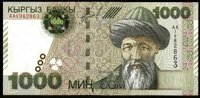
1000 som banknote depicting a portrait of Djusup Balasagyn
Djusup Balasagyn, (alternatively known as Jusup or Yusuf, Balasaghun), was a writer and thinker born in the ancient city of Balasagyn, the winter capital of the Karakhanid empire, (where the Burana Tower stands, near the site of the present day Tokmok), possibly around 1016, although according to some chronologies it is more likely to have been around 1019.
We don’t know that much about him apart from the snippets that he wrote about his life in his work Kutagdu Bilig, (which is sometimes translated as ‘The theory of knowledge’, or ‘The Knowledge that Brings Happiness’ – an English translation by Walter May has been published under the title ‘Beneficent Knowledge’), which he wrote when he was about 50 years old.
This work suggests that he was a highly educated person, skilled in poetic forms, with a wide knowledge of astronomy, mathematics and medicine. It forms a sort of moral code – one of the central themes is the value and supremacy of laws.
From a young age, he supposed to have shown his many talents, and after receiving a basic education in his home town he was then sent to the best schools of that era – in Farah, Kashgar and Bukhara. He mastered Arabic and Persian to his native Turkic language – and showed himself a master at philosophy, poetry, politics and science.
The Kutagdu Bilig was apparently written for, Tavghach Bughra Khan, the Prince of Kashgar, and as such fits in to a genre of “advice to princes” which was common at the time, although it goes much further in that offers advice to ordinary people and not just to princes.
It is written sometime around 1070 in couplets, (two rhyming lines, the first containing six syllables and the second five), in the Uighur language, and this was one of the interesting features which marked it out: that, although it contains many phrases and borrowed words from both Arabic and Persian, it wasn’t written in either of these two languages – the lingua franca of the period. It is usually considered to belong to the body of Turkic literature, Uighur being a Turkic language – it is sometimes referred to by scholars as Middle Turkic.
Some scholars suspect that the prologue, which is much more overtly Islamic than the rest of the text, may not written by him Yūsuf, particularly the first part, which is in prose, unlike the rest of the text. There are virtually no explicit references to Islamic texts, Hadith or other Islamic contexts, except in the prologue. Despite this, some scholarsseem to think that it represents an attempt to unify Islamic practices with those of the KaraKhanid society in which he lived.
Indeed, the text reflects the beliefs, feelings, and practices of both the author and the society in which he lived with regard to quite a few topics, and depicts interesting facets of various aspects of life in the Karakhanid empire.
It centers around the relations of four main characters: the King, Vizier, a sage and a dervish and contains writings on topics such as: the seven planets and the constellations; how what we say can be both good and also bring harm; the qualities needed in a ruler, a politician such as the visier and different professions – even a cook; how to conduct oneself when dealing with nobles, commoners, merchants and other groups of people; how to choose a wife and raise children;
The work gained a renowned place for its author in the history of Central Asian Literature – and a place at court in Kashgar; after presenting the completed work to the prince he was awarded the title Khāss Hājib, an honorific title similar to “Privy Chamberlain” or “Chancellor”.
Although it was apparently well known through the Timurid era, only three manuscripts have survived, and they are each known after the city in which they were discovered; Herat, (Vienna), which was written in the Uighur script, Cairo, (written in Arabic), and Namagan, (discovered as recently as 1943). The three copies seem to agree in on the whole, although there is some variations in minor points. The work first came to Western attention in 1796, when the Heart copy was “discovered” by an Austrian scholar in Istanbul. It was translated and studied by classical scholars – and translated into Russian. It has since been translated into Kyrgyz, and English.
Djusup died in 1085 at the age of 66 in the city of Kashgar, and was buried there, where there is now a mausoleum erected on the grave site.
The Kyrgyz have adopted Djusup Balasagyn as one of their own – largely, perhaps, because his birthplace is located in the territory of the modern republic – but it is not clear if he was himself Kyrgyz. The Kyrgyz State National University is named in his honour, and in May 2003 a statue of him was unveiled in front of the main building (on Frunze Street) in Bishkek and a portrait of him appears on the 1000 som banknote.






 Bishkek