Erkindik – Bishkek’s Statue of Liberty
On June 17th, 1885, the French ship Isère sailed into New York harbour with an unusual cargo. Packed in crates were the parts of a present from the people of France to those of the United States of America, something that was to become a symbol of the United States: The Statue of Liberty.
The statue, (and the miniature copy of it on an island in the middle of the river Seine in Paris), depicts a robed female figure, (Libertas, the Roman goddess of freedom), bearing a torch and a tabula ansata, (a tablet evoking the law), upon which is inscribed the date of the American Declaration of Independence, and a broken chain lies at her feet.
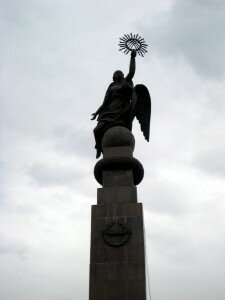
Bishkek also has it’s Statue of Liberty – called Erkindik. Strictly speaking, Erkindik is the Kyrgyz word for Freedom.
Just twelve meters high, the four ton copper statue in Bishkek’s Ala Too Square is somewhat dwarfed by it’s American namesake, which rises forty three meters from the heel to the tip of its flaming torch and weighs in at over two hundred tons.
However, the Bishkek statue still manages to convey a sense of elegance and symbolism.
On a high granite pedestal, ringed by a wreath, there stands a large copper ball representing the world and all the peoples of the world “dreaming of freedom and peace”. Atop of the globe there is a depiction of a winged female figure – representing a collective image of the Kyrgyz statehood, freedom and independence. In her hand is is one of the heraldic symbols which represents the Kyrgyz people – a Tunduk, (the frame of the chimney hole in a Kyrgyz yurt – a traditional symbol of hearth and home combining both functional and symbolic – even sacred – characteristics), surrounded by twenty one flames. (The Kyrgyz flag also features a Tunduk but it is ringed by forty flames representing the traditional forty Kyrgyz tribes.) The composition resembles a sun and recalls the ancient tradion of sun worship featured in many petroglyphs found throughout the country, but especially at Saimaluu Tash.
On the plinth below the statue is a depiction of a laural wreat accompanied by the inscription: “Erkindik” – Freedom.
Erkindik is the work of the Kyrgyz sculptor Turgunbai Sydykov and the architect Pisarsky. There are several other examples of Sydykov’s monumental work to be found throughout the capital and a museum dedicated to his creative work on Togolok Moldo street.
This Kyrgyz Statue of Liberty currently stands in the Ala-Too Square, outside the Historical Museum and is flanked by the State flagpole to its right. Further to the West are the Friendship Monument and Government House, more commonly known as The White House.
It hasn’t always stood here, however. Originally commissioned to celebrate the anniversary of the independence of Kyrgyzstan following the collapse of the Soviet Union, it was originally installed at the foot of what is now Prospect Erkindik. Ironically, The Kyrgyz Statue of Freedom replaced one of of Felix Derzhinsky, the one time head of the secret police, the NKVD – and the boulevard had been called Prospect Derzhinsky. It was moved to its present site in the summer of 2004, replacing the statue of Vladimir Illych Lenin.
Neither statue, Derzhinsky nor Lenin, has been lost to posterity, however. Derzhinsky, albeit unmarked and unnamed, now stands at the rear of the National Library, and Lenin was relocated to overlook the old Central Square at the back of the Historical Museum.
.




 Bishkek
I came across this piece of news on the AkiPress wire service today, (http://kg.akipress.org/news:398671/):
In Bishkek they are going to dismantle the Statue of Liberty (“Erkindik”).
It is set on the most important square in Kyrgyzstan – Ata-Too. It is assumed that on Monday, July 25, will the government decree on the dismantling of the statue.
Instead, in its place will be a monument to Manas Baatyr. Presumably, these activities are associated with the celebration of the 20th anniversary of the independence of Kyrgyzstan, which will be celebrated on August 31.
I’ll keep you posted if it happens!
For an update – see Say Goodbye to Liberty – http://ianbek.kg/?p=5155