Kashgari – Ancient Linguist
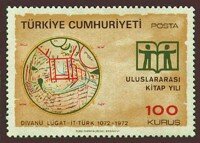
The Kashgari Map on a Turkish postage stamp
Mahmud Barskani was born in 1038 in the village of Barskan – modern day Barskoon – which was a trading center on the Silk Road. His father, Husayn, was the equivalent of “mayor” and by all accounts, his mother, Bubi Rabiya Basri, was regarded as a highly intelligent woman.
However, there is some debate about his origins. The Chinese claim he was a “native” of Wapur village in Xinjiang and some Turkish scholars say that he was born in Kashgar. Was his nationality Kyrgyz?, or Uighur?
He is also known as Mahmud al-Kashgari – or more simply as Kashgari.
Apparently he spent some time studying in Shule as Kashgar was known at that time, before setting out on his travels around the then known world.
Apart from the fact that the city of Kashgar may have been named after him, (or did his name Kashgari come from the city?), he is best known for his work, “Di vanu lugati”, a comparative dictionary of the various Turkic languages and dialects. It was written in Baghdad between 1072 and 1074 and was intended for use by the Caliphs of Baghdad, (the new, Arabic allies of the Turks). It contains some 290 proverbs, (many of which are apparently still very much in use in Turkish today) and examples of pre-Islamic Turkic poetry.
Some of the proverbs mentioned in this book may seem strangely familiar. Among them are (with a modern interpretation or equivalent):
- “Mountains do not come nearer to mountains, but men to men” (=”Men meet, mountains never”)
- The sword does not cut its own sheath” (=”Dogs do not eat dogs”),
- “Five fingers are not the same” (=“There is no equality in the world”);
- “He who marries early enlarges his family; he who gets up early goes a long way”;
- “Children pour water on the street, their parents slip and fall in it” (=”Parents are responsible for their children’s behavior”);
- “When the grandfather eats unripe grapes, his grandchild’s teeth are set on edge” (=”Children pay for the sins of their parents”),
- “The stupid guest entertains the host”
- “One crow does not make winter” (= “One misfortune should not make one lose hope”);
- “Better to be the head of a calf than the foot of an ox” (= “Better to be the first in a village than second in a big city”, or “Better to be a big fish in a little pond than a small fish in a big pond”).
- “You cannot put out fire with flames”
- “When there are road marks, one does not miss his destination”; (= “When there is knowledge, speech does not cause one to stray”)
- “Kiss the stone that you cannot bite” (=”Kiss the hand that you cannot bite”).
- “Two camels fight and the fly in between dies” (=”The horse kicks out and the mule kicks out; between the two the donkey dies”, or “When the great quarrel, the small pay the penalty”)
The book was “discovered in Turkey in 1914 and consists of about 9000 words. He gives interesting insights such as the fact that the local Kyrgyz swore oaths “on an iron sword”.
He included the first known Turkish map in his book – in colour. He had traveled widely and this map of the then known Turkic world and had Issyk Kul and Barskoon in the centre. The scale is reduced as you move from the centre towards the edge of the map. The colors are described in the original as gray for rivers, green for seas, light yellow for deserts, red for mountains, and yellow for cities and towns. It is oriented with East at the top.
The map can be found in the “Millet Genel Kütüphanesi” (the General National Library), in Istanbul, and it was featured on Turkish postage stamp in 1972.
His tomb is at Upal, a small village about 50 kilometers southwest of Kashgar. It lies about 3 kilometers off the main road to Pakistan and is a plainer version of the Abakh Hoja tomb in Kashgar – with plain white walls. It has been repaired and renovated by the Xingjian authorities. The complex also serves as a repository for various texts donated by Islamic scholars.




 Bishkek