Archaeology
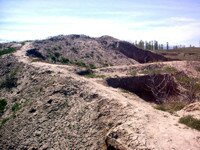
Suyab - outside Tokmok ... One of Kyrgyzstan's active archaeological sites
In Russia, today, (15th August), is the professional holiday of Archaeologists. When I saw that I thought I would go looking for the Kyrgyz equivalent … and, to my surprise, I couldn’t find one.
That struck me as a little odd because, although archaeological excavations can be of value to any period of history, they are of particular importance in terms of Kyrgyzstan where so little physical evidence remains and the nomadic Kyrgyz, having no written language until the twentieth century, left no written records of events or their lives.
On the other hand, perhaps it’s not all that surprising because, (despite an appeal of the president of The World Archaeological Congress, – WAC, a non-governmental, not-for-profit organization which promotes world archaeology - to UNESCO to establish a World Archaeology Day), there is no internationally recognized day to commemorate and raise awareness of issues relating to archaeology.
So, that’s one up in the enlightenment stakes for Russia!
For the record: In 2011, WAC organized a Day of Archaeology and asked people working in or studying the subject to submit an account of their day in text, pictures and video on a special website. In 2011 there were over 400 such reports, in 2012 almost 350 and a similar figure this year. Unfortunately, as far as I can tell – there were no reports from Kyrgyzstan.
Although for the last two years, the date chosen was 29th July, this year it was 26th July … it seems I missed it … but I will keep an eye open for it for next year … let’s hope that there will be some news from Kyrgyzstan then … there is, after all, plenty of work going on.
Man has inhabited the Central Asian mountains that make up modern Kyrgyzstan since ancient times. Although very few buildings remain, there are claimed to be over 5000 sites of archaeological interest. Many of them are protected by the State as sites of special Historical and Cultural significance.
Silk Road Cities
The classic sites include the Burana Tower, Tash Rabat caravanserai, the architectural complex at Uzgen, The Manas Gumbez (mausoleum), the mausoleum of Shah Fasil at Safed Bulan, Koshoi Korgon, the 3000 year old city of Osh, and the petroglyphs of Saimaluu Tash.
There are others, however, including the excavations at Krasnaya Rechka, Ak Beshim, the prehistoric settlement at Tosor on Lake Issyk Kul. Stone age implements have been found just to the south of Balykchi, dated at over 100,000 years old.
In particular there are many examples of barrows (burial mounds) scattered throughout the countryside. At one site, just outside Balykchi, there are over 250 and nearby another 70).
Of particular importance in recent years has been the discovery of huge statue of the Buddha at Krasnaya Rechka – known in the days of the Great Silk Road as the city of Nevkat.
A subject of particular interest, recently, has been excavations around Lake Issyk Kul. Apart from a number of sunken cities which have been explored, (it is claimed that At least five ancient settlements are supposed to be hidden under the crystal-clean water of Issyk-Kul.), there have also been a number of shipwrecks which have revealed a wide variety of artifacts from a range of different periods. Amongst the finds made in 2004 were – a Greek amphora dating from over 2500 years ago (the time of Alexander the Great … implying that the Greeks may well have made it to this region); a small ceramic pot perfectly preserved under water – an ancient perfume bottle; and a fragment from a ceramic vessel dating from about the 7th or 8th centuries, decorated with a six-pointed star (a Star of David?) with two tight spirals – their directions symbolizing good and evil, life and death.
Sunken cities and citadels can be found under the waters of Lake Issyk Kul but there are others as well. The ruins of the ancient city of Sheldjy, for example, lie under the waters of the Kirov reservoir. A recent find in these ruins of a silver Dirham, originally minted in Barskoon, (on the southern shore of Lake Issyk Kul) is evidence of the extent of the Karakhanid Empire which ruled this region over a thousand years ago. In fact the metal workers of Sheldjy used to provide silver for use across the whole of Central Asia for over a thousand years, right up until the 16th century.
Not long ago, National Geographic supported an expedition which they featured on their website and with live updates webcast on the internet.
Other coins have been found in Uzgen which date from before the Mongol invasion.
The monastery at Svetly Mys, (claimed to be the burial place of the evangelist, Saint Matthew) has also been receiving attention, although concrete evidence of evangelist, himself, has yet to emerge … although I understand that there is to be another expedition this year.
Discoveries are still being made. Some as the result of properly organized ‘digs’, or excavations, but occasionally new artefacts turn up as a matter of chance. In the summer of 2003, for example, a pot was found which contained a collection of coins – some of which had been adapted as ornamental jewelry.
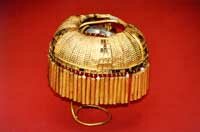
Golden diadem - part of the Shamsy Hoarde
The Shamsy Horde
Another example of a chance find was that of the “Golden Mask of Shamsy”. One day in 1962 a tractor driver was ploughing a filed when he came across something unusual. He got down from the tractor and examined his find. The police were summoned and an inventory taken.
Experts came out from the Historical Museum in Bishkek and over the next few years a number of expeditions explored the neighbourhood – but nothing more was ever found. The find was an ancient treasure trove consisting of jewellery, (gold on copper medallions that might well have adorned a horse’s harness); a beautiful, finely crafted, medallion containing a miniature portrait; a golden cup; bracelets and earrings; a headdress (measuring just 17 cms in diameter) and a golden funeral mask.
All of the items date from the 4th or 5th Centuries. Most of the jewellery, like the headdress, is incredibly small – suggesting that either this was designed for a child – or the people of that period were much smaller than those of today. It used to be said that the mask had been sent on loan to St Petersburg – never to return, but in fact it is still in the custody of the Historical Museum in Bishkek … but not on general display for the lack of a suitable hall in which it could be housed.
The Grave of Genghis Khan
One find that has so far eluded archaeologists is the grave of Genghis Khan, (although it is thought that one of his wives was buried beside a mountain path in the Talas oblast). There is a legend that he decreed that when he died his burial place should be kept a secret. So a party of 40 attendants took his body to a secret location, buried him (along with a treasure of untold riches), and were then killed by their 40 guards, who in turn committed suicide – thus ensuring the Khan’s wishes were fulfilled. The site has never been found, and many Kyrgyz believe that it was somewhere around Lake Issyk Kul. The theory was taken seriously enough for the Soviet government to stage an expedition to search for the grave in the 1970’s. There has, however, been much interest in a recent discovery of a mass grave in Mongolia, that some archaeologists think might be it – which will come as a surprise and disappointment to the Kyrgyz “believers”, if it can be proved.
Finds relating to more recent times are also being made … again, many of them occur by accident.
A Horde of Coins:
In 2004, it was reported that a man repairing his home, in Kara Balta, discovered almost two hundred silver coins minted from 1922-1927 and more than three hundred coins made from copper and nickel from the 1920s – 1930s. The youngest coin was a 20-kopeck coin dated 1935. The majority of coins were in mint condition.
It is possible that the coins were hidden as a result of the Soviet money reform of 1922-1924 which stopped post-revolutionary inflation and made it possible to put gold and silver coins into circulation. (Precious metals were used for minting coins in order to inculcate in people trust in the new money – as well as guaranteeing the reliability of the Soviet rouble). This was the time of the new economic policy (NEP), which again permitted private trade and entrepreneurship. At the end of the 1920s the situation had changed once more. Private entrepreneurship had been completely abolished and mass repressions started against well-to-do peasants. Coins minted from precious metals ceased, and in 1927 silver coins were no longer being issued. In 1931 copper and nickel coins replaced those containing 50 per cent of silver. Simultaneously, a card system for the distribution of industrial products and food was introduced in the country. The currency regulations were also revised. Citizens were obliged to give the state all money and jewellery, among them silver coins which had been recently in circulation. Keeping and selling even two coins was severely punished and currency dealing in the USSR was treated as an extremely serious offence. Even at the beginning of the 1970s numismatists were punished severely for keeping collections with coins made from precious metals.
The Lost Stamp:
Another interesting find surfaced in a souvenir shop – a bronze stamp was found in the flood plain of the Alamedin River 8-10 kilometres south of Bishkek. When the stamp was cleaned, it was found to bear the inscription: “Alamedin rayon Committee of the AUCP(b)”. In the centre of the stamp the same text was repeated in Latin, (the Kyrgyz alphabet was based on Latin letters from 1928 to 1941 – so the stamp must have been produced within this period). The stamp of such an important organisation was kept with special care. A very limited number of people had access to it and when an old stamp was replaced with a new one, it was normally destroyed. The loss of a stamp was severely punished at that time. The loss of the stamp would have been reflected in the documents of that time and it is hoped that researches in the Central State Archive will shed some light on this unusual discovery.
The Earliest Coin?:
Expeditions to Lake Issyk Kul have discovered many interesting ancient artefacts. In 2006, archaeologists managed to retrieve from the bottom of the lake such items as: Bronze Age daggers, hatchets, arrowheads, sickles, pitchers and pieces of ceramic. The most interesting and unique find proved to be a “stump of a gold ingot” which was made in an octagon and weighed almost 70 grams. It is thought by some scholars to be one of the earliest known examples of metallic money – perhaps the earliest.




 Bishkek