Saimaluu Tash
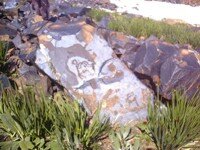
Hidden at over 3000 meters in the Ferghana range, about 100 km northwest of Djalal Abad, near the Kurgat Pass is the remote, small plateau of Saimaluu Tash. The name means “Patterned stone” and refers to the fact that here is a gallery of thousands of stone paintings – petroglyphs which are littered around the landscape.
Saimaluu Tash means “embroidered stones” in Kyrgyz – which aptly describes the scene.
There are estimated to be around 11000 drawings scattered over two moraine slopes – three kilometres long. The first has the vast majority of the stones – about 9500. In the middle is a small pond, which is considered holy – and is known to have been used as a site for meditations by local shamans.
Some of the drawings date from about 2000 BC – some sources suggest 3000BC. It is thought that they represent votive offerings brought by locals from the valleys to be nearer the heavens. There are images of animals, carts, agricultural activities such as ploughing, traditional ritual dances, all without any background. The number of solar images suggest that sun-worship was the common religion in the region.
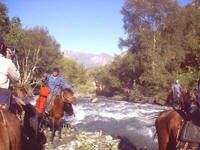
The stones were revealed to the outside world when, in 1902, the Russians decided to build a road from the town of Djalal Abad in the Ferghana Valley to their outpost at Naryn. The result was the present Kazarman road – which is spectacular but not open all year. One of the cartographers, Nikolai Hludov, became fascinated by stories he heard from the local shepherds about “painted stones” in the mountains, and organized a small expedition to investigate. He reported the findings to the Archaeology Society in Tashkent and an expedition to excavate the site was organized. Similar discoveries in France and political issues meant, however, that the site remained relatively unexplored until the 1950’s.
The site is sometimes called the Stonehenge of Central Asia – and that should help to encapsulate the importance and capture the spirit of the historical artefacts that can be found here. Unlike Stonehenge, however, (which has a main road passing only a couple of hundred meters from the standing stones), there is no easy way of reaching the site. The main route is from the village of Kalmak Kirchin – some 60 km from Djalal Abad, along a rough track (sturdy 4WD only) up to a small “honey farm” high in the mountains. From here, the rest of the way, (10 kilometres), is on foot.
There is a newly published book (2002) – “Petroglyphs of Central Asia” which has a record of the archaeological expedition to Saimalu Tash and a number of other important sites.





 Bishkek