Petroglyphs
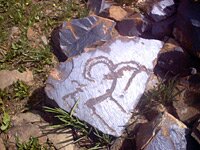
Petroglyphs – the word comes from the Greek (petra = “stone” and glyphe = “to draw”) and is used to denote pictures drawn or etched onto stones. These drawings, left for us on high rocks and in deep caves can provide evidence of the way of life and the environment of times gone by when there was no system of writing.
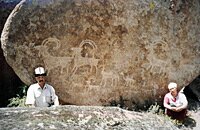
Rock drawings appear to have been made in two ancient artistic styles. The first technique was silhouette or shadow, typical of many ancient pictures. Blows were made with a metallic or stone instrument to take out the entire surface of the rock nearly 2 mm deep inside the silhouette. Some pictures were beaten by blunt tools which removed only a thin sun burnt rock layer, and this is typical of later periods. Another technique used tools with sharp edges and frequent blows with these produced a deep line engraved in the rock.
It is probably incorrect to think that ancient people only depicted the animals that they hunted. Many scholars think that the rock drawings depict mythological images and that the consciousness of ancient painters was restricted by their knowledge of the surrounding nature and society.
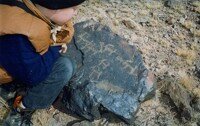
Petroglyphs are recognized as an important historical and cultural heritage. Efforts are underway to protect and preserve them – unfortunately, not all of them are particularly successful. One of the more accessible major sites of petroglyphs is at Cholpon Ata – where there are over 40 acres littered with fine examples. Unfortunately, some have been disfigured by the graffiti of more recent “artists”, but perhaps more worrying are reports that conservation work carried out in 2002 has resulted in the loss of many fine examples. Some 70 large stones were treated as part of a project – but in the opinion of some specialists, the restoration work carried out was done hurriedly, without observing conservation rules, and resulted in the disastrous loss. The lichen on the surface of the stones was removed and this will accelerate the destruction of their upper layer. Conservation rules stipulate that experiments should be conducted over many years on stones not bearing petroglyphs, but on this occasion some of the stones with the most interesting pictures were treated without preliminary tests. Some time later the pictures grew dull. More work is being undertaken to remove the film covering the stones with solvents.
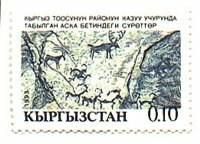 Discoveries are still being made. In 2004, it was reported that a new field of Petroglyphs was discovered which date back to a period between the 3rd and 1st centuries BC. Having heard stories from local shepherds about a place in the mountains which was visited by sick people at Suuk Dobo, (= “cold hill”), in the Osh oblast, a team of scientists decided to explore. After a journey which takes four hours on horseback they found a stony tract, some 3500 meters above sea level, with a gallery of previously unknown petroglyphs on boulders and small stones. They discovered and catalogued some 1500 drawings, which seem to show a development from drawing animals such as the Argali (Marco Polo sheep), horses, camels, reindeer, bulls, wolves, dogs, wild boars and birds – whilst others depict hunting scenes, and some scenes depicting fire worship, as well as some unknown graphic signs. (It is suggested that, to modern eyes, one looks like an airplane and another resembles a railway track).
There are many examples of petroglyphs found throughout Kyrgyzstan and these are just some of them:
Ak-Chunkur Cave Paintings: In Kyrgyz, “Ak-Chunkur” means “White Cave” and the name probably reflects the fact that it is found in limestone hills in the Sary Jaz (“Golden Valley”) of the Tien Shan mountains. The paintings date from the stone age and there are images of men, animals and some abstract symbols.
Aravan: Aravan is a predominantly ethnic-Uzbek district center 23 km west of Osh and home to petroglyphs (carved stones) called ‘The Celestial Horses of Davan’. The petroglyphs, who date from the first century BC, are carved on a near-vertical rock face next to a cemetery and represent solar symbols and the legendary Ferghana horses which were much sought after by Chinese emperor Wu-Di in the second century BC. The site was archaeologically researched from the 1930s to the 1980s, and excavations at the foot of the rock produced evidence of animal sacrifice sites. Today, the horse carvings and nearby spring are still a local pilgrimage site and there is a small mosque. As a matter of fact, there are far more modern-day graffiti than ancient petroglyphs on the rock since a local superstition considers it as a luck bringer to have your name eternalized on the rocks. This is actually another good example of the influence of pre-Islamic animist practices that prevail in Central Asian Islam. There is said to be caves with more petroglyphs close to the sanatorium of Aravan, so bring a “maglite” or torch if you plan to look for those.
Burana Tower: in the grounds of the Tower complex is the “Museum under the stars” which includes a number of petroglyphs and Balbals collected together from sites throughout the Chui region. Although no longer in their original surroundings their collection and presentation here has preserved some good examples which may otherwise have disappeared as the region was populated and developed.
Cholpon Ata: – in a field above the town – many dating from about 500 BC – they were probably made by the Saks and so predate the arrival of the Kyrgyz in this area. There are drawings of animals (ibex, wolves and deer) and hunters and some appear to have been arranged in patterns. There are also collections of petroglyphs at Kara-oi, Omok and Chok Tal on the Northern shore of Lake Issyk Kul.
Ornok – Just to the East of the village is the new road that leads over the mountains to Almaty. A filed of Petroglyphs dating from between the 6th to the 1st century BC can be found between the village and the hills.
Osh – The Suleiman-Too petroglyphs. In the centre of Osh is the outcrop known as Suleiman’s Throne. Long considered a sacred place, it has a number of examples of petroglyphs – and as it is located within the city itself provides easy access to the relics. There are a wide variety of geometric symbols, lines and symbols. Although depictions of animals are not very common here, there are examples of ibex, horses and birds. As Saimaluu Tash, there are a number of solar images. There are also paintings on the walls of the labyrinth within the mountain.
Saimaluu Tash: Not easy to reach and requiring a special journey, hidden at over 3000 meters in the Ferghana range near the Kurgat Pass is the remote, small plateau of Saimaluu-Tash. The name means “Patterned stone” and refers to the fact that here is a gallery of thousands of stone paintings – petroglyphs which are lettered around the landscape. Some of the drawings date from about 2000 BC. It is thought that they represent votive offerings brought by locals from the valleys to be nearer the heavens. There are images of animals, carts, agricultural activities such as ploughing, traditional ritual dances, all without any background. The number of solar images suggest that sun-worship was the common religion in the region.
The Talas valley: Several sites exist, such as: Tene-Tash, Kurgan-Tash, Kulan, Urmaral, and Kiukiuresu gorges. One group of petroglyphs can be found where the Tene-Tash and Chonor rivers flow into the Talas River there are drawings and silhouettes of wild and domestic animals depicted on huge granite rocks. A second group is found on rocks located along the right bank of the Kurgan-Tash River, a tributary of the Kenkol, and includes nearly 200 dot-technique drawings. The earliest drawings date back to the Bronze Age (2nd millennium BC) and depict animals in the form of two triangles. Most rock drawings can be seen along the Urmaral river, especially in its upper reaches. The most interesting group of drawings is on the so-called “Shining Rock,” a huge rock 60 meters long and 8-10 meters high which blocks almost half of Kaman-Suu gorge, protecting it from cold northern winds. Here there are drawings of a deer-camel and a female deer with two conic humps, a horse, a man and strange symbols and characters. The most popular animals seem to have been bulls and goats – symbols of eternal strength and stamina. Despite the fact that animal drawings are found everywhere in the Talas Valley, testifying to the presence of people, there are very few drawings depicting man.
The Chumysh Petroglyphs : Not far from Bishkek, (about 20km) – these are across the Chu river and actually in Kazakhstan – so there are visa problems if you want to see them – which date from the Bronze age and are scattered all over the crags and boulders of the upper slopes of the Chumysh hills. Most are small, and not easy to find.
In addition there are a number of interesting rock paintings/inscriptions:
Issyk Ata – not far from Bishkek, in the Issyk Ata valley, is a Tibetan inscription, regrettably marred by some modern graffiti.
Tamga Tash on lake Issyk Kul – 5 km from Tamga, (you probably need a 4WD as the road is poor – and you then need to cross the river on foot) – is a Tibetan inscription on a large split rock
In 2002, a new book was published in Bishkek, (supported by UNESCO): “Petroglyphs of Central Asia”, describing the archaeological excavations of several sites in Kyrgyzstan, Kazakhstan, Tajikistan and Uzbekistan. The text gives an interesting account of the many explorations and there a number of photographs and drawings of figures.
2003 saw the publication of a small book by two University students, printed in Russian and English, “Looking at Petroglyphs in the Western Tien Shan”. It has a map, descriptions and pictures in the Talas, Sary Chelek and Chatkal regions of Kyrgyzstan and neighbouring parts of Kazakhstan and Uzbekistan.






 Bishkek