Sunken Cities
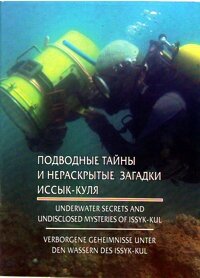
Underwater Secrets ...
Recently, I received an email from a former client, who happens to be a Professor of History. We have exchanged emails on a number of topics but this time she was particularly interested in the “sunken cities of Lake Issyk Kul”.
Lake Issyk Kul, as well as being the center of Kyrgyzstan’s tourism industry and one of the world’s largest mountain lakes, is steeped in History … and legend.
Many of the legends associated with Issyk Kul, (such as that of Cholpon Ata and the dragon of Skazka valley – and especially those concerning its origins), talk about a great deluge.
It’s possible that, as with the Biblical story of Noah’s flood, there may well be some element of fact behind the stories.
The water level of Lake Issyk Kul is known to rise and fall with the passage of time, but archaeological evidence suggests that there have been two periods when the surface level rose significantly: one sometime around the Sak period in the first century BC, representing a nomadic culture; and the second, a more agricultural culture from the medieval period, sometime around the turn of the fourteenth and fifteenth centuries.
It’s not certain that back in the 4th century BC, whether Alexander the Great actually made it to Kyrgyzstan as there’s no actual evidence, although there are legends that connect him with Lake Issyk Kul. He certainly made it to Samarkand and founded several cities in the region including Alexandria Eschate, (Alexandria the Furthest), which is thought to have been on the site of modern day Khujand, in Tajikistan which is located in the South Western part of the Ferghana Valley. According to legend, having conquered the Persian Empire, he exiled a number of noble hostages to a remote new settlement called Barshan, in order to prevent them raising a rebellion against him, when he left to start a campaign against the Indian subcontinent. Part of the settlement was supposed later have been submerged under water although part of it remained on plateau above the shoreline. Darshan is often associated with modern day Barskoon. Along the shore near the settlement many objects have been found, domestic household goods, agricultural implements and weapons which date from roughly this period.
There is a similar story relating to Tamerlane, (Timur the Lame), who lived in the fifteenth century. He is supposed to have had a “little dwelling” on the shores of the lake where he would sometimes take a rest, and to which he is supposed to have sent captives and dignitaries who had fallen into disgrace. There are many stories associating Tamerlane with different places around the lake, especially the modern village of Baetovo where some underwater archaeological discoveries, (burnt brick walls and and various artifacts), have been found which date from the Timurid period.
Historians have known for some time about “sunken cities” lying beneath the waters of the lake. Apparently there are more than ten such towns, (one source suggest twelve dating from the Sak period, alone) and numerous, (hundreds), of kurgans (burial places).
Muslim scholars from the Middle Ages mention examples: Abu Said ibn Mahmud Gardizi recounts the story the story of Alexander the Great whilst Ahmed ibn ArabShah and Mirza Khaidar, tell stories of the fortresses of Tamerlane being flooded by the lake.
A Russian merchant, Isaev, followed caravan paths near Issyk-Kul in 1824-1830. In 1857 he wrote a message to a Russian officer mentioning underwater ruins in Issyk-Kul on the right side of the Tup River where it flows into the lake: “Buildings seen in the water were made of stone. They say there was a great city there before the flood and no lake”.
In that same year, Pyotr Semyonov, (Tienshansky), came across bricks cast ashore by waves between the estuaries of the Tup and Dzhergalan rivers.
In 1869 Kyrgyz guides showed General Kolpakovski, the Military Governor of Semirechye, (Seven Rivers), some underwater ruins near the eastern shore not far from the Koi-Sary Tract and near to the northern shore, (near the current village of Kursk), and presented him with large bronze cups which had been found underwater.
When Kolpakovski was given two bronze bowls which had been “raised” from the bottom of the lake. It was obvious that they were quite old, (one of them having Arabic decoration and seemed to come from Karakhanid Khanate – probably from the eleventh or twelfth centuries). Intrigued, he set in process some systematic investigation and he instituted the first recorded systematic researches in 1871.
Then, in 1959, the Soviets began some further exploration with divers using of Aqualungs. These were led by researchers from the History Institute of the Academy of Sciences, but after a short period of time these were suspended. The divers found several baked bricks, fragments of ceramic dishes, a piece of a ceramic pipe (which suggests a high level of local civilization), bronze arrowheads, iron knives, and the bones of both people and animals.
Excavations were resumed, together with experts from Russia, in 1985. They investigated the partly flooded Sary-Bulun settlement in the eastern part of the lake, near the town of Tyup. This is believed to be the site of the Usun capital – the city of Chengdu (“red valley”) from the first century BC. Amongst the finds recovered were artifacts made from ceramics, stoneware, broze and horn, including
When I first came here, almost seventeen years ago, I was told that as the waters of the lake receded it is thought that the village will soon emerge from the depths … however, it hasn’t.
In recent years there has been a flurry of further activity which have been reported in the local press, for example in 2003 bronze objects were found near the village of Kara-Oi, on the northern shores of the lake, including bronze bowls and part of a horse bridle.
Offshore, opposite the villages of Korumdy and Temirovka and near the Grigoryevskaya harbour, archaeologists found fragments of ancient pots dating back to the Bronze Age. Unfortunately, only a few of such articles are preserved because most of them were apparently taken by local residents and tourists as souvenirs. They also found knives with handles topped with large figures of horses or sheep. The horses looked very realistic: with large heads, long tails, and well-developed leg muscles – typical of steppe horses.
Near Barskoon there have been a wide variety of finds: bronze daggers, sacrificial bowls, decorated figures of animals, pendants, gold rings, and other jewelry, sickles and other tools, ceramic pots and jugs, and a medieval silver goblet.
One of the most interesting finds from the bottom of Issyk-Kul is a sacrificial table of almost square shape. It has four legs shaped like a woman’s body, 22 cm high. These figures are well preserved: slant eyes, wide nose, oval chin, and a short and strong neck and scholars think these figures can suggest how ancient residents of the Issyk-Kul region looked.
Another find was a large hemispheric sacrificial pot with two horizontal handles and a relief tamga (the seal of the master) resembling a crescent with the points directed downwards. Such pots were widespread in this region in the 2nd half of the 1st millennium and more than 10 such pots have been found at Issyk-Kul – but this one was the largest. It is thought that such pots were used only on holidays and special occasions. The large size of these pots testifies to big feasts of ancient cattle breeders in honour of their gods.
Some of the bowls recovered from the lake present us with an enigma. Some of them are extremely well preserved, but it is not clear how the handles would have been brazed or “welded” onto them given the technology available to the craftsmen at the time.
The scholar, Professor Ploskikh published a book about these sunken cities entitled “The Atlantis of Central Asia – the Secret of the Great Silk Road” and more recently, “Underwater Secrets and Undisclosed Mysteries of Issyk Kul“. In them, he outlines some of the references to them that can be found in historical sources.
Some of the objects that have been recovered during excavations are on display at the Museum of the Kyrgyz-Russian Slavic University.
For the record: Although sunken cities and citadels can be found under the waters of Lake Issyk Kul, there are others as well. The ruins of the ancient city of Sheldjy, for example, lie under the waters of the Kirov reservoir. A recent find in these ruins of a silver Dirham, originally minted in Barskoon is cited as evidence of the extent of the Karakhanid Empire which ruled this region over a thousand years ago. (In fact, the metal workers of Sheldjy used to provide silver for use across the whole of Central Asia for over a thousand years, right up until the 16th century.)




 Bishkek