Uzgen
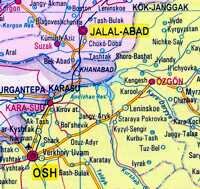
Uzgen - between Osh and Djalal Abad
Uzgen (Ozgen) – lies on the main Bishkek-Osh road, some 55 kilometres north-east of Osh and 50km south east of Djalal Abad.
There are many claims made about the city; that:
- it has a history of over 2000 years
- it has been the site of a number of citadels built at various times since the 1st century BC. It is sometimes identified with the Toen on Yu mentioned in 2nd century BC Chinese Chronicles.
- that it was the site of a camp for some of Alexander the Great’s troops
- that it is one of only two cities in Kyrgyzstan to have existed continuously from its foundation in ancient times to the present
It was an important centre on the trade routes between the Ferghana and Semirechye (Seven Rivers region). Uzgen became a highly developed town in the Karakhanid epoch and developed into a large trading and handicrafts centre. At that time there were a large number of mints producing coins and about 900 coins have been identified as being minted in Uzgen around the turn of the millennium.
Tenth century accounts depict the city as populous and busy, with a citadel, shackhristan bazaars – with gardens and canals laid out around the city. There was a city wall around the entire settlement with four gates. There were no bridges across the river – and it was necessary to ford the waters.
In the 11th and 12th centuries Uzgen was one of the capitals of the Karakhanid State (at that time it was called Mavarannahr). However, from the 13th century it gradually lost its economic significance.
The ancient city of Uzgen was located on a high bank of the Kara-Darya river and consisted of three shakhristans, of which only hills and ruined walls remain. However, an 11th century minaret survives and three Mausoleums dating from the 11th and 12th centuries – and are acclaimed as one of the unique architectural sites of medieval Central Asia. The complex has been recently restored and is featured on the back of the 50 som note.
The Uzgen Minaret is a tower consisting of three parts:
- the lower part is an octahedron – 5 m high;
- the middle part is in the form of a tapering cylinder; and
- the upper part is a lantern built in 1923-1924, with a cupola and arched windows. The Minaret is 27.5 m high.
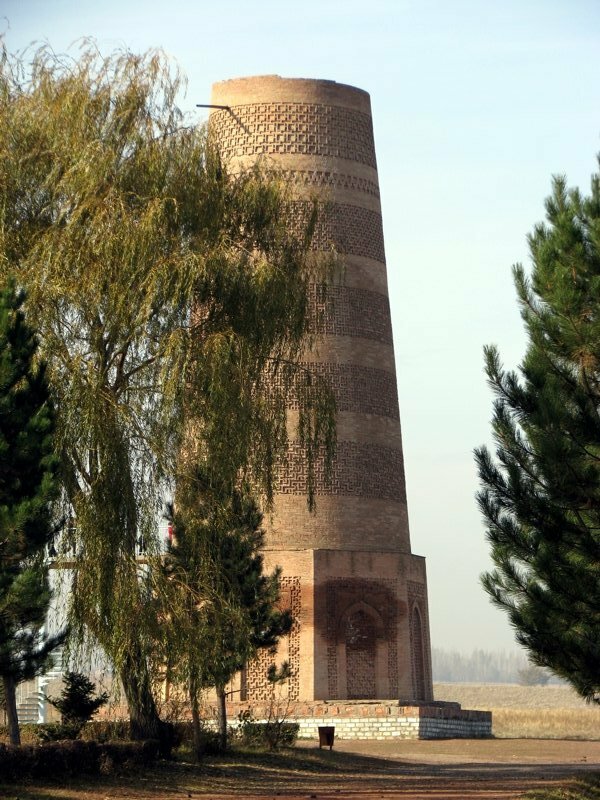
The diameter of the lower part is 8.5m, tapering to just 6.2m for the upper part. The Minaret was made of brick. One of the faces of the base has a lancet arched door leading to the spiral staircase, lit by two narrow windows. The cylindrical part is decorated with 11 ornamented belts – the narrow ones decorated with embossed patterns. Because the ornamentation are artistically and technically more diverse than those of the Burana Tower in the Chui oblast it is thought that the Uzgen minaret was built later than it’s northern relative.
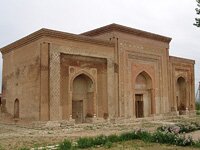
The three mausoleums
Near the minaret are three mausoleums built in a line. These Mausoleums are called : Northern, Middle and Southern Mausoleum.
The Middle Mausoleum was the first to be built, in the early 11th century (1012 – 1013). According to some sources, it was built in honour of Karakhanid Nasr ibn Ali. It takes the form of a square, measuring 11.3 m by 11.4 m – the interior measures 8.5 m by 8.5 m – and is 13 m high. The Mausoleum is built of fired brick and it is richly decorated with figured brick work and carved ornaments in alabaster plaster. It is possible to count about 12 ornamental geometrical and vegetation motifs. There are columns in the corners and it has four doorways, three of which are actual doorways. The western facade is in the form of a portal with a door in a deep niche. The niche is topped with a lancet arch supported by columns. The niche is 3.8 m wide and about 7 m high, and is framed with decorative strips.
The Northern Mausoleum, was built in 1152/3. This date for the construction was determined in the 1920’s - from an analysis of the inscriptions found on the mausoleum. According to some sources, it is thought to have been built as the burial place of Klich-Burhan-Khan, with his father and mother, but according to the other data it is the burial of Ilchi-Mazi-Sultan. On the other hand – an inscription tells that the Mausoleum was built in honour of Jalal-ad-dinual-Husein. It is square in shape – measuring 10.2 m by 12.2 m, (the interior is 7.5 m by 7.5 m) and is built of brick. Inside there are two columns supporting the cornice on both sides of the portal, decorated with a rhombic pattern of brickwork. In addition to the decorative brickwork and alabaster carvings, there are also by terracotta tiles with various forms ornamentation and carved Arabic inscriptions.
The Southern Mausoleum, was built in 1186-1187, (the date being fixed from an analysis of the inscriptions), but it is not known to whom it is dedicated. It is much smaller than its neighbours – although it is also square in shape with the interior measuring 6.4 m by 6.4 m. The portal of Southern Mausoleum looks like that on the Northern Mausoleum, but the decor is different. Here different sizes of terracotta tiles were used – with inscriptions implemented in “kufi” and “nash” handwriting with arabesque “islimi”, ornaments of stars and crosses filled with winding rods of grapes.
A little to the North East are the petroglyphs of Kara Dzhar.
The city has a predominantly Uzbek population and this region was the scene in 1990 of ethnic conflict between elements in the local Kyrgyz and Uzbek communities in which there was a large loss of life.
The economy of modern day Uzgen is basically agricultural. Rice is grown in the surrounding area and tobacco, apples and sunflowers (for the oil) are also basic crops. There is a brewery in the town, which is very highly rated locally.







 Bishkek