Koshoi Korgon
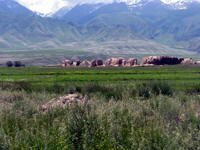
Not far from the town of At Bashi, about three kilometers from the main road, lie the remains of an ancient settlement, known as Koshoi Korgon.
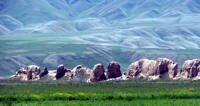
Although set back at some distance from the modern road, the ruins can be seen by travelers on their way either to or from, Torugart or Tash Rabat. However, they are much more impressive seen close up and, if there is sufficient time, it might well be worth making a short detour.
Set on the floor of a wide valley, it is somewhat dwarfed by the nearby hill which rises a few kilometers to the North, but it had a commanding position from which it could control much of the traffic between China to the South and Naryn to the North.
It is thought that it was once a fortress of the Karakhanid empire – around the turn of the first millenium – and apparentl the ruins were in relatively good condition up until the time of the Second World War. The walls now show signs of wear and erosion and have been fenced off so, unfortunately, it is not possible to get really close to them.
The 5 meter high walls, (in places, they reach a height of 8 meters), are made of pahsa (pugged clay) and stretch for more than 1000 meters. They were part of the ruins of a small, rectangular citadel dating from sometime between the 10th and 12th centuries and once would have been fortified with towers.
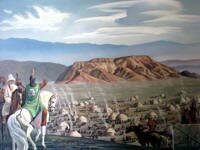
Legend has it that this is where Manas, the legendary Kyrgyz hero, is supposed to have buried his friend Koshoy. (A “korgon” is an ancient burial mound.)
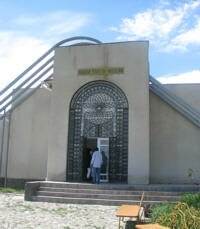
Some archaeological work was carried out in 2004, and plans were made to develop a tourist center with a hotel, museum shops and a “model” village to show how people used to live in the region. At the moment, however, only a small, privately run museum has been established. The ground floor contains some general displays which are accompanied by short descriptions in Kyrgyz, Russian and English … which makes it unusual in that it is one of the few museums in the republic to have captions in English. Up a flight of stairs there is a small gallery with the frame of a yurt and displays of leatherwork and other crafts.





 Bishkek