“Museum Fatigue”
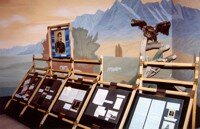
The Prezhevalsk Museum in Karakol
A few years ago a tourist on a Silk Road Tour commented that he felt a case of “Museum Fatigue” coming on.
It seems that virtually everywhere the group had been in China, they had visited a museum. The scenery was wonderful, the people friendly, the food fantastic … but they had spent hours walking round museums … where, (as someone once noted), ”they had all the heads and arms from the statues that are in all the other museums”.
Here in Kyrgyzstan the programme had three visits: a small privately owned craft museum in Kochkor where the group were given a demonstration of crafts – especially the typical nomadic felt carpets, shyrdaks and Ala Kiyiz; a visit to the State Historical Museum here in Bishkek – famous for it massive iconography of Lenin and the Soviet Union as well as displays about Kyrgyzstan and the Museum of Fine Arts. They had also paid a short visit to the Burana Tower, which has a small museum attached to it, en route.
There was a lot more on the programme as they heading off to Uzbekistan to visit the ancient Silk Road cities of Bukhara, Khiva and Samarkand – which is sometimes called a “museum city”.
He said that he would have preferred some time for more activities such as walking or horse riding – especially here in Kyrgyzstan where the landscape was ideal for such activities.
I said that I sympathized, but it was probably a feature of having booked a “Historical Tour” and, in our own defence, the programme had been determined by the tour operator. I promised, however, to talk to the operator and see if we could suggest some alternatives for future tours.
As it happens, as someone once said, “Museums are one of the top tier tourism draws in the country”. I am not sure that is true for Kyrgyzstan, (although there are quite a few of them); the mountain landscape with its natural environment and the traditional nomadic culture probably play a bigger role.
Although we don’t have anything on the scale of The British Museum in London, the Louvre in Paris, the Smithosonian in Washington, the Kunsthistorisches Museum in Vienna or MOMA in New York, but some of the museums in Kyrgyzstan do have features that make them a attraction in themselves.
The Historical Museum, for example is famous for its grandiose Soviet iconography; including huge statues of Lenin and painted ceilings depicting a demonic President Reagan. There are plans afoot to remove these exhibits and replace them with others more in keeping with the history of the land and the Kyrgyz people. It is planned that these exhibits will not be disposed of, (after all Soviet Kyrgyzstan is still part of Kyrgyz History), but to dismantle them and re-erect them somewhere else.
“How well a particular museum does, of course, depends on what is unique about it, what people can see there that they can’t see anywhere else.”
Actually, the museum already has much more to offer … but it takes time to get past the draw of the main displays to discover some of the other gems.
For example: – there is the Gold Fund which is hidden away, subject to a supplementary fee, and not open every day, (however, a few weeks ago we were asked to arrange a visit for a group on another day and managed to do so).
Then there are the temporary exhibits – usually small thematic displays on the ground floor which, I am sorry to say, a lot of tourists miss out on as they head straight up the central staircase.
A visit can last from less than an hour for a lightning quick whirl round, to a whole day lingering and taking things in. A lot depends, of course, on things like how much time is available on the itinerary; the interests of the group – if they are specifically interested in, for example, the Soviet legacy or if they have a wider interest; and if they take a guided tour, (which is advisable because all the signs are in Russian or Kyrgyz – not English or other global language), or simply elect to stroll around on their own, soaking up the atmosphere and lingering over exhibits which catch their attention.
The other museum that tourists usually visit is the Fine Arts museum – which is really more like an Art Gallery. As it happens, Bishkek has a variety of museums, (including a new one, not on that list – at the Russian Orthodox Church), most of them small and very specialized … and overlooked (or ignored) by visitors – possibly because they are specialized and possibly they’ve never heard of them.
In fact, to be honest, many locals don’t much about them – although they may have heard something about them. On several occasions I have been visiting one of the museums and discovered that I am not only the only visitor … I may have been the only visitor that day, (and in one case, I was the first visitor that week). On the other hand, on another occasion, I happened to arrive at about the same time as a class from a local school who were on a field trip and was able to follow the group around, listening to what the teacher and the museum guide had to say to them.
Where they are following a tour itinerary, then it is understandable that they a set timetable with deadlines and are limited to, basically, the highlights. Sometimes, the deadlines of the itinerary will even dictate which museums can be visited – for example, a trip from the ancient Silk Road cities of Uzbekistan through the Ferghana valley, via Osh and then over the Irkeshtam pass to Kashkar in China, means that only possibilities are the State museum on Suleyman Too and the Silk Road museum in Osh.
Occasionally we are asked to arrange a special diversion in order to visit a particular site of interest to members in the group – such as the Prezhervalsk museum in Karakol or the small museum in Kochkor which concentrates on traditional nomadic crafts.
For those, however, who have more time, (such as independent tourists – traveling under their own steam), then it might be worth seeing what museums there are in the city and visiting some of them according to their particular interests.
It’s also worth stopping off and visiting some of the museums in the regions – there are quite good general ones in Cholpon Ata, Karakol, Kochkor and Naryn, and more specific ones in the Burana Tower, Karakol – the Prezhevalsk Museum, Koshoi Korgon and Talas – the Manas Ordo.




 Bishkek