The Silk Road – a well trodden route
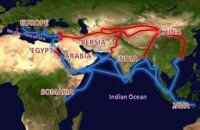
The Silk Road
There are some doubts about whether Marco Polo actually made his famous journey arising out of inconsistencies in his account, the lack of corroborative detail in official records for Kublai Khan’s court and the fact that there is no original manuscript – only a wide range of fragments and translations which contain different episodes and details and the earliest of which seems to date from some fifty years after he “dictated” his story to his “ghost-writer”, Rustichello, in a Genoese prison.
Despite this, he is often regarded as the European to first open up China and The Silk Road to the West. He probably deserves the reputation in that his account provided much valuable information about China and Central Asia and was widely read. Indeed it appears to have been required reading for many travelers to the region right up until the nineteenth century.
By his own account however, he was not the first European to visit the region. His father and Uncle took him along when they returned to China. The Mongol emperor, Kublai Khan, had urged them to return to Europe as his ambassador to the Pope – and requested that they bring back Holy Water from Jerusalem and some priests to explain details about their religion.
Indeed, there had already been several attempts to send missionaries to China and the Mongol court and there was a legend of “Prester John”- a supposedly Christian ruler living in the Far East.
Perhaps the first Europeans to venture in Central Asia accompanied Alexander the Great, when he led his Macedonian armies from Greece on a rampage of conquest into Persia and Central Asia, before turning South to India. There are doubts if he made it as far as Kyrgyzstan although there are legends that connect him with Osh, and Lake Issyk Kul.
There are accounts of a Roman embassy being sent to China as early as 166 BC apparently arriving by sea. There is another account, described by Ptolemy, of a journey undertaken by the merchant Maes Titianos which reached as far as the “Stone Tower” – variously identified with Tashkent, (Uzbekistan), Osh (Kyrgyzstan) and Tashkurgan (China).
There is evidence of a small Nestorian Community being established in as early as 635 AD, and in medieval times several missionaries and envoys were dispatched by the Royal houses of Europe and the Papal See. In addition, there is evidence of a small Italian community living in Yangzhou in the 1350s – and accounts of prisoners from Europe being transported back by the Mongols.
If so, then they wouldn’t have been the first. Following the battle of Carrhae, in 36 AD, (where the Roman Legions reputedly had their first encounter with silk banners), it is thought that many of the prisoners taken were then deported to the Eastern regions of the Persian Empire. There is an interesting account of another battle fought by Chinese troops besieging a fortified town, Zhezhe, thought to have been located in the Talas valley. Apparently, some of the defenders astounded their oriental opponents by their tactics … they formed up in the famous Roman tortoise battle formation – with large rectangular shields raised above their heads, (resembling fish scales) and presenting an impenetrable wall on all sides against spears and arrows. The walls of the town were further protected by a double row of stakes – another typically Roman practice.
Amongst other early Europeans (i.e. before Marco Polo) to venture East were:
Andrew of Longjumeau, a Dominican friar who served as a papal envoy to the Mongol court and made two trips – the first 1245-7 only as far as Iran but the second, in 1249-51, much further into the Mongol interior.
John of Plano Carpine was a Benedictine monk sent as an envoy by Pope Innocent IV to the Mongol court … along with Simon of San Quentin. John’s account of what he saw is a mine of information of the Mongol court and the civilizations through which they passed – and was widely known throughout Europe.
William of Roebuck another Franciscan monk, from Flanders, who traveled as a missionary, apparently dispatched by King Louis IX of France. Although his account of his journey was apparently known to Roger Bacon, it was not widely read until translated in the 16th Century.
John of Montecorvino – who built the first Christian Church in Peking, where he served as Archbishop until his death in 1328.
The traffic was not all “one way” – there were many examples of travellers who made the journey west, as well.
King Mu (Mu Wang), (who is reputed to have been the first “Silk Road Traveller”), travelling as far as what is now Iran, in 959BC. The account of his journey, “Mu tianzi zhuan”, was written much later, (during the 5th-4th centuries BC), and is the first known travel book on the Silk Road. No copy of it remains in existence – but it is referred to in a number of later accounts.
Chang Ch’ien, (138-116 BC), a Chinese general and envoy who is generally credited with opening the Silk Road. He made two epic journeys from the Chinese capital into Central Asia. His first trip, (138-125 BC), was a diplomatic mission from the Han Emperor Wudi to recruit allies to form an alliance against the Xiongnu peoples who were marauding his empire from the North. He left with a party of 100 men – but only 2 of them were to return. It wasn’t an easy journey. Captured and held captive for ten years, he was married to a Xiongnu bride and fathered a son. He escaped, and continued his journey. Travelling into the Ferghana (where he encountered the legendary Celestial Horses) and then to Bactria, only to discover that the potential allies he was seeking were more interested in trade than making war – the great Chinese empire was just too far away. On his return journey he was captured again – and escaped again …
His missions were a failure in that he failed to find allies for the Chinese court – but he brought back with him something, perhaps, much more valuable – information about the geography, peoples and culture of the lands to West – - information about some 36 separate kingdoms – and led to the formalization of trade, especially the silk trade, between China and Persia.
Kan Ying was the first Chinese envoy to Ta-Ts’in (the Roman Orient). Sent by general Ban Chao from Kashgaria in 97 AD, he travelled through the Pamir Mountains, and eventually reached the Persian Gulf. He is the first known Chinese person to have visited the Middle East.
Fa-hsien, a Chinese monk who travelled through the Western regions between 399 and 413, eventually reaching India. At the age of 65, he set out to bring back to his homeland examples of the Buddhist scriptures. He journeyed most of the way on foot and was the first known traveller passing through the Taklamakan desert from Woo-e to Khotan. He returned to China via the sea route – which was almost as dangerous as the land route – and he had to protect his precious manuscripts from being thrown overboard during violent storms.
He was followed by several others including …
Hsuan Tsang, who reached as far as Tashkent, Samarkand and Bactria before turning South to India between 629 and 644. who reached as far as Tashkent, Samarkand and Bactria before turning South to India between 629 and 644. Like Fa-hsien, he also went in search of definitive Buddhist texts, and spent the rest of his life translating them. His route took him over the Bedel Pass from Ak Suu in present day China, skirting Lake Issyk Kul before visiting Tokmok and then through the Talas valley. The crossing over the Bedel Pass was a traumatic experience … heavy snows had delayed his departure from Ak Suu, a portent of worse to come, in a 40 mile stretch, (about 65km), he lost a third of his companions and animals. He had to take time out to recuperate from the ordeals at Barskoon on the shores of Lake Issyk Kul. The account of his travels includes a vivid description of his reception by the local Khan at what is now Tokmok and some detailed descriptions of Samarkand as it appeared in his day. His journey covered over 10000 miles (16000km) over difficult terrain and lasted 17 years.
Du Hwai, was a Chinese soldier who fought at the Battle of Talas in 751, was captured and imprisoned for ten long years before travelling to Tashkent, Samarkand, and then into northern Iran to Iraq, and finally reaching Syria. On the Perisan Gulf, he boarded a foreign ship, returning to Canton via the Indian Ocean and South China Sea. He recorded his experiences in a book which gives us details about the Battle of Talas and his prison life in Central Asia.
Tamim ibn Bahr – who seems to have been sent as an envoy sent to the Uighur capital of Karabalasugin which in modern-day Mongolia – probably because of the upheavals in TransOxiana. He left a written account of his travels.
Yeh-tu Ch’u-ts’ai, who served as an advisor to Genghis Khan. A poet as well as a scholar, he accompanied the great Khan and his army through Central Asia in 1219, through Talas, to Samarkhand and Bukhara.
K’iu-Chang Ch’un, a Taoist monk ordered to attend the court of Genghis Khan and travelled via the Tien Shan Mountains through modern Kyrgyzstan to Samarkand and then down through Iran and Afghanistan. Chang Ch’un was already quite elderly at this time – but his young companion, Li chi Ch’ang, kept a detailed diary which gives an account of their journey and was published as early as 1228.
Rabban Bar Sauma was a Nestorian missionary, who travelled West, and eventually met with many important dignitaries. At Talas, in North Western Kyrgyzstan, he met with Kjaidu Khan, cousin of the great Kublai Khan. In Europe he visited the Vatican, and met with the English king Edward I in Bordeaux, France. (His travelling companion, Markos, was elected as Patriarch during their journey.) Bar Suama’s account of his journey were preserved in an abridged version and serve as the only one from that era where we have an Eastern perspective on European civilization of the time.




 Bishkek