Prezhervalskiy Museum, Karakol
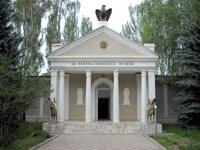
The Prezhervalsk Museum
April 29th, 1957, saw the opening of the Prezhervalskiy Museum on the headland between the Karakol and Kara Suu Rivers, at the eastern end of Lake Issyk Kul – some 12 km from the regional center of Karakol.
Nikolai Mikhailovich Prezhervalsk had died at the Military hospital on the same site on 20th October, 1888. A monument to the explorer had been erected 1893, although the official dedication only took place on 26th June the following year.
Although the monument was erected within five years of the explorers death, it took sixty four years years for the Museum to be founded. Mind you, the delay wasn’t necessarily down to a lack of trying.
In 1913, a special day to commemorate his life and work on the 25th anniversary of his death. The Imperial Russian Geographical Society commissioned Prezhervalsk’s friend and disciple Pyotr Kuzmich Kozlov to attend as their representative.
Having arrived at the graveside, in a ceremony attended by virtually the whole town, Kozlov laid a silver wreath that he brought with him from St. Petersburg on the grave. Other wreaths were laid by representatives of the Turkestan Governor General, the Military Governor of the Semirechiye oblast and the Prezhervalsk district, educational institutions and other dignitaries.
There were a number of speeches. In his speech, Kozlov informed the gathered crowd that he had received atelegram from the explorers brother, General Evgeniy Mikhailovich, in which he was donating 1000 roubles to the town to be used for charitable purposes.
His speech was followed by one delivered by Vlasov, the “town leader”, in which he praised the Major General and said that the people had taken him to their hearts. He emphasized how proud they were of the grave and the monument, and then announced that the town intended to establish a Memorial Museum.
A subscription fund was established and fund raising efforts were set in motion straight away and 500 roubles were raised in a matter of hours. This was added to the 1000 donated by the General, making a total of 1500 roubles buy the end of the day – no small sum for those days. Apparently, there is no record of what happened to the money – but it wasn’t used to establish a museum.
Finally, in 1957, a Government Resolution established a Memorial complex which included the grave, monument and provision for a new Museum, which opened on 29th April.
It begin gathering exhibits and within the first three years had accumulated from a variety of sources, (including from the Russian Geographical Society), almost 400 including publications of the explorer’s works, photocopies and pictures. More exhibits were added over the years, paintings, stuffed animals and birds, rare books, a gun that had once belonged to the explorer himself and other of his personal belongings given by his relatives, including:
- a leather purse,
- an inscribed malachite stone,
- a visit card holder,
- a notebook with a pencil and ruler,
- a small knife,
- a monogrammed box,
- a sealing wax stamp,
- pictures by Prezhervalsk and Kozlov,
- a pipe and
- a Mongolian ash tray.
The 400 square meters of the exhibition space now contains almost 2000 exhibits, divided into ten separate sections devoted to Prezhervalsk’s life and work, and also to his associates, (such as Kozlov, and Roborovskiy), and the wildlife of Kyrgyzstan.
The Museum and complex is listed among the list of sites granted state protection as being of historical and cultural importance.




 Bishkek