Museums
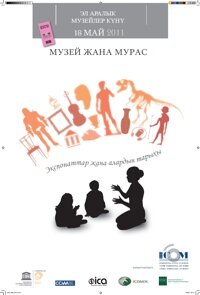
Last week I went to a meeting in the Hyatt. The hotel is opposite the Museum of Fine Arts and when I left I crossed the road to get a taxi from outside the museum. As usual, the Museum displayed a large banner above the entrance. This one was different, however, as it wasn’t announcing an exhibition as such but was to mark International Museums Day on May 18th.
This is an annual event organized worldwide by the International Council of Museums, (ICOM), ever since 1977 with a view to raise awareness on how important museums are in the development of society.
On their site, ICOM have copies of the posters commemorating the day in a variety of languages to download, including versions in English, Russian and even Kyrgyz … which shouldn’t be all that surprising because they have a National Committee based in Kyrgyzstan.
Museums are a fairly recent innovation in Kyrgyzstan and most tend to be relatively small – far from the general impression of cavernous halls filled with with dry and dusty specimens inspired by visits to the British Museum, the Louvre, Smithsonian or some of the world’s other major museums.
Museums are concerned with much more than just simple displays – this is just one aspect of their work. They collect, document and preserve collections of artefacts and specimens of historical, cultural, artistic and scientific importance, as well as making them available to the public – for example, (but not only), in displays.
The first public collection in Kyrgyzstan was the Uyezdniye library in Tokmok as early as 1870. Other libraries were to follow, for example the People’s Library in Prezhervalsk, (now Karakol), in 1902 and in Osh in 1917..
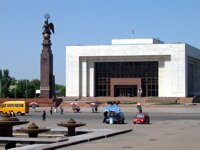
The first museum as such to be established in the country was the Frunze Museum in Bishkek – which was dedicated to the memory of Michail Frunze, the Red Army General who led the conquest of Central Asia for the Bolsheviks in the Civil War, and which opened its doors in 1925.
It was followed by the Historical Museum, which opened in 1927 and the Museum of Fine Arts in 1934.
Kyrgyzstan may not be able to match Finland in the the number of museums per head of population, but the number of such institutions is growing. In 1981 there were only thirteen operating in the republic – but by start of the new millennium this had risen to thirty-six state run museums and a number of private ones.
In Soviet times there were also a “factory” museum in each big industrial undertaking and many schools had their own museums, such as the ones in Talas and Koporu Bazaar.
Most visitors to Bishkek pay a visit to the Historical Museum, to see the massive monumental art and examples of Soviet iconography. A visit to Karakol is incomplete without calling into the Prezhervalsk Museum and recalling the journeys of this Russian explorer which yielded so much information about the Asian continent. In Osh, the State Museum in the caves of the Suleyman Too mountain, in the heart of the city, offers one of the most unusual settings for a museum.
The main museums can be divided into a number of categories:
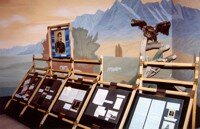
Historical – as well as the State Historical Museum in Bishkek, there are special museums dedicated to recording historical development of the regions, local traditions, folklore and crafts: in Ak Sai; Burana; Chaek; Cholpon Ata; Gulcha; Karakol; Kazarman; Kochkor; Kyzil Kia; Mady; Naryn; Nookat; Suzak; Tokmok;
There are a number of historical sites preserved as Museums, such as Burana; the Shah-Fazil Mausoleum at Safed Bulan; Tash Rabat and the Uzgen architectural complex.
There is a museum dedicated to Victims of the Stalinist Repressions – “Ata – Beyit” – which is in the village of Chon-Tash, near Bishkek.
Memorial musems – dedicated to particular personalities, for example: Aytiev; Chokmorov; Chuikov; Frunze; Kaynazarova; Kojumkol; Manilova; Osmonov; Prezhevalsky; Shopokov; Tokombaev; Toktogul.
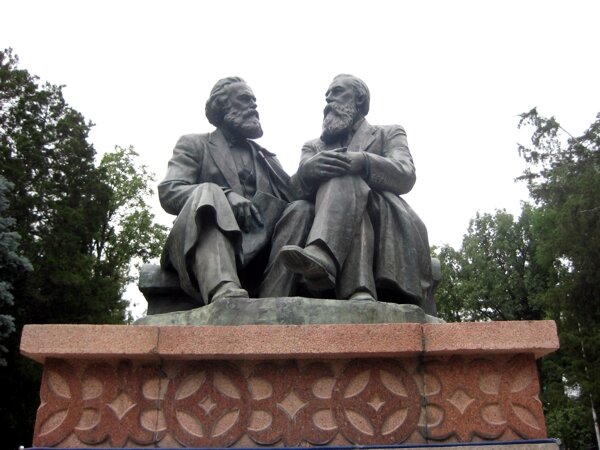
Artistic – As well as the Museum of Fine Arts in Bishkek, there is the Open Air Museum of Sculpture in Oak Park, (Bishkek) and a number of towns have special galleries – for example in Naryn.
Literary museums – such as the one dedicated to Satylganov Toktogul in Bishkek and in Toktogul and to Chinghiz Aitmatov in Sheker.
Specialist museums – There are a number of specialist museums such as:
- The Zoological museum attached to the biological faculty of the Kyrgyz State University;
- Archaeological museums, for example, attached to the historical faculty of the Kyrgyz State University and the Humanities Faculty of the Kyrgyz-Slavonic University;
- The Museum of the National Bank in Bishkek, (but we seem to have a lot of trouble actually getting into this one);
- The Geological museum – attached to the State agency for Geology;
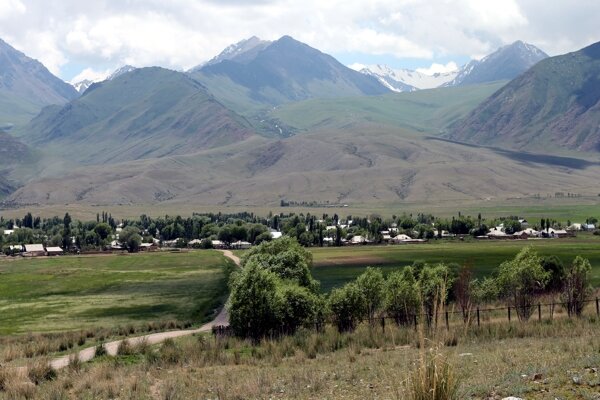
One of the features of many museums in Kyrgyzstan is that they are al-fresco – “Open air” museums in which the exhibits are displayed in natural surroundings or parkland. Not every visitor to the republic is able to complete the journey to the remote “stone garden” of Saimaluu Tash to see the ancient petroglyphs there, but the collections at Burana and Cholpon Ata are much more accessible.
Although many operate on limited budgets, and most of the sign are in either Russian or Kyrgyz, all of Kyrgyzstan’s museums have their highlights. It might be the exhibits depicting the wildlife, or the examples of traditional handicrafts, or some of the personal belongings of some important character, (such as the Kojumkol’s trousers – big enough for three people to fill – all at the same time), or a snow leopard in the act of downing its prey.
_______________________________________
I’ll try to write some postcards about some of the individual museums in the future.
_______________________________________
Each year ICOM allocates a theme for participating museums to … this year the theme is Museums and Memory.
Previous themes have included:
- 2010 – “Museums for social harmony”
- 2009 – “Museums and tourism”
- 2008 – “Museums as agents of social change and development”
- 2007 – “Museums and Universal Heritage”
- 2006 – “Museums and young people”
- 2005 – “Museums bridging cultures”
- 2004 – “Museums and Intangible Heritage”
- 2003 – “Museums and Friends”
- 2002 – “Museums and Globalisation”
- 2001 – “Museums: building community”
- 2000 – “Museums for Peace and Harmony in Society”
- 1999 – “Pleasures of discovery”
- 1998-1997 – “The fight against illicit traffic of cultural property”
- 1996 – “Collecting today for tomorrow”
- 1995 – “Response and responsibility”
- 1994 – “Behind the Scenes in Museums”
- 1993 – “Museums and Indigenous Peoples”
- 1992 – “Museums and Environment”
.



 Bishkek