The Historical Museum
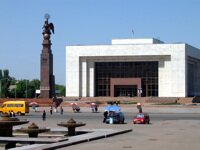
The Historical Museum
The Historical Museum is located in the large marble “cube” in the main Ala Too square in Bishkek – behind the statue of Manas.
The Museum was founded in December 1925 in the building which was supposed to be the boyhood home of Mikhail Frunze – now preserved in the Frunze Museum – and accepted its first visitors in March 1927.
It moved to occupy the building now known as Dom Druzhba – Freindship House – just to the East of the main square in 1967 – and then, in 1984, this newly, specially constructed building in which it is now located.
In fact it has been known by several names since it’s creation:
- 1925-1933: The Central Museum of Kirgizia
- 1933-1943: The State Museum for the Study of Local Lore
- 1943-1954: The Museum of National Culture
- since 1954: The State Historical Museum
Until after Independence it was known as the Lenin Museum – named in honour of the revolutionary leader … who was the subject of many of the exhibits. It originally held thousands of documents – either originals or copies – which illustrated his life, revolutionary activities, theories and the work of the Communist Party.
In the 1920s and 30s the collection was extended by acquisitions depicting the ethnic and natural sciences of the regions, archaeological exhibits. In 1947 a department of Soviet Construction was created which concentrated on the revolutionary origins and development of the Soviet Union.
There are about 100,000 exhibits in the museum, which include:
-
stone age relics
- with petroglyphs from Saimaluu Tash,
- with Turkic runic inscriptions;
- a collection of stone balbals outside on the Eastern side of the building;
- Bronze age armour and everyday household objects;
- jewellery dating from the 1st to the 5th centuries;
- ceramics, glass and metal finds from archaeological excavations;
- ancient coins;
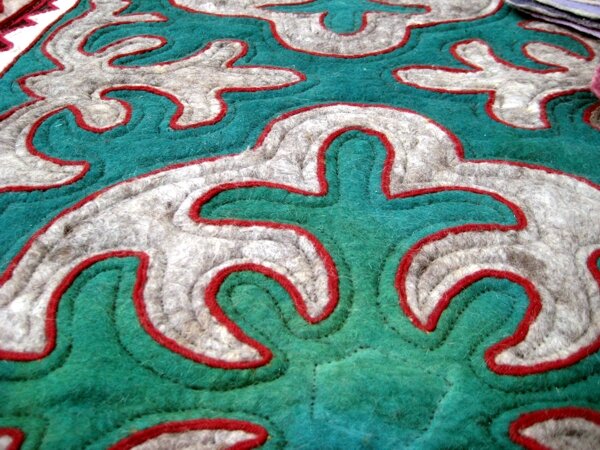
- ethnological collections representing the culture of Central Asian peoples from the late 19th and early 20th centuries, including objects made from: wool; felt; chiy; leather and wood … and examples of embroidery and weaving.
- examples of national costumes;
- weapons;
- personal papers and belongings of many outstanding people of the Republic; and
- gifts to the Kyrgyz Republic from many foreign countries and heads of state.
The first floor has some shops, a display and area for temporary exhibitions.
The second and third floors were, until fairly recently, shrines to Lenin and the history of the Soviet Union, especially in Kyrgyzstan. Where it was not possible to have original documents – photocopies were mounted and displayed with great reverence. Although some aspects of the displays remain – for example the huge monumental reliefs such as the one of Lenin leading the revolutionary masses with an inscription in Russian and Kyrgyz which reads “Proletariate of the World Unite!” – the displays are being revised and revamped.
According to one source, the second floor alone has some 3000 images of Lenin (!)
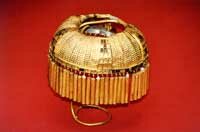
Golden headdress from the Gold Fund
In the bowels of the museum there is a small room which houses the museum’s “Gold Fund”. It is possible to visit the Gold Fund on Tuesday’s and Thursdays and there is an extra fee. There are examples of archaeological finds including the famous Shamsy horde.
Signs are generally in Russian and Kyrgyz – but there a few in English. Although it is easy and interesting to simply wander through the museum, a guided tour should enable visitors to understand far more.
Location/Address: Ala Too Square
Tel. 626097; 626085
Open : Everyday daily except Monday – 09:00 – 17:00
Standing Exhibitions at the Historical Museum:
Gifts to the President of Kyrgyzstan - since the 1950′s gifts given to the Preseident and other officials by dignitaries from around the world have been passed on to the Historical Museum. The collection includes painting, medals and works of wood, glass and Porcelain.
Photo Exhibition: The Great Victory will not be forgotten – Photos, letters, weapons from World War II (1941-45).
“April People’s Revolution – 2010” – commemorating the Events of April 2010.
Gold of Ancient Kyrgyzstan, (Tuesday, Thursday and Friday only. On other days of the week access to the collection needs to be agreed in advance.) The exhibition includes the best examples of jewelry of the Saka civilization, the era of the Great Migration and medieval Kyrgyzstan. The earliest specimens of Saxon barrows, (8th to the 3rd century BC), were found during excavations in Ketmen-Tube Valley, the Issyk-Kul basin and in the inner Tien Shan.





 Bishkek