The Burana Tower
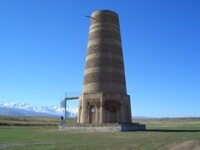
The Burana Tower
Situated 10 km to the South of Tokmok – stands the Burana tower. It’s a favourite spot for day trips from Bishkek and we often visit it on tours on the way between Bishkek and Issyk Kul or Naryn. To be honest, it’s quite a while since I have been there myself, (over a year), but it is an interesting site and well worth a visit.
The history of the tower is shrouded in mystery – at least, legend and history give us different versions:
The legend tells of a powerful khan who had a beautiful daughter, Monara, whom he loved very much and wanted to protect against the affections of local djigits – young men.
One day he summoned all the fortune tellers and clairvoyants in the region and demanded that they tell the girl’s future. All of them foretold a happy life for the girl – bar one. This aksakal declared, “I can only the truth even though you may execute me for it. Your daughter’s fate is a sad one. She hardly reaches her sixteenth birthday when a poisonous black spider bites her and she dies immediately.”
The Khan was angry – but he could not ignore the prediction. So he built a tall tower and the fortune teller was incarcerated in a small room at the bottom – and his daughter was placed in isolation in a another at the top of the tower.
The girl grew up in the tower, looking out over the valley through the four windows in the cupola which looked out to the compass points – North, South, East and West. Servants brought her food and drink, delivering it in a basket after by climbing a ladder placed against the outside of the tower. They were inspected from head to toe to make sure that their clothes, the food, nor the plates, hid a spider.
On the day of her sixteenth birthday, the Khan was so happy that the old man’s prediction had proved false. He wanted to decided to congratulate the girl on her “special day” and went to her room carrying a bunch of vines. Congratulating her with a kiss, he presented her with the fruit, which she accepted and then, inexplicably, collapsed and died. Dumbfounded the Khan inspected his gift … and there was a black spider.
The Khan was grief stricken and sobbed so loudly that the tower shook and the top part fell down, creating the ruin that we see today.
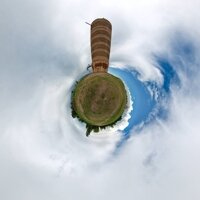
"Planet Kyrgyzstan" version of the Burana Tower
In fact the tower is all that remains of the ancient city of Balasugan set at the foot of the Shamshy valley. Established in the 10th century on the site of an older settlement, the city was the birthplace of the poet Jusup Balasugyn (1015-?) who wrote an epic poem called Katadgu Bilim (=”The knowledge which brings happiness”), which has been translated into several languages – including a recent translation into English by Walter May.
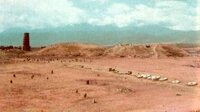
An old panoramic shot of the site
With Kashgar, Balasagyn was one of the capitals of the Eastern Khanate when the Karakhanid state split up. (The capital of the Western Khanate was Samarkand). It was spared from destruction by Genghis Khan’s Mongols, and renamed Gobalik (=”good city”) in the 13th century, but it lost its importance and had disappeared by the 15th century.
There were major archaeological surveys of the site in the 1920s, 1950s and 1970s. The archaeologists discovered that the town had a complicated layout covering some 25-30 square kilometers. There were ruins of a central fortress, some handicraft shops, bazaars, four religious buildings, domestic dwellings, a bathhouse, a plot of arable land and a water main (pipes delivering water from a nearby canyon). Two rings of walls surrounded the town.
Although the Kharakhanids, (who built the city) practiced Islam, they were tolerant of other religions and there are some examples of early Christian (Nestorian) inscriptions.
The entire complex today covers some 36 hectares. It includes the tower itself, reconstructions of mausoleums found on the site, a mound that is all that remains of the palace/citadel, a collection of balbals (grave markers used by nomadic Turkic peoples who used to roam Central Asia) and petroglyphs (paintings on stones) and a small Museum. An embankment on which were built the town walls, made of wattle and daub, would have surrounded the town.
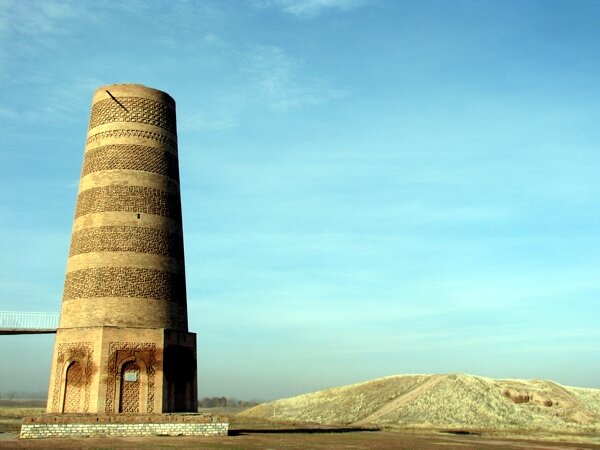
The tower is believed to be a minaret – and if so it is the oldest in Central Asia. The name Burana itself is probably a corruption of the Turkic word Murana (= minaret). A similar, smaller construction is preserved at Uzgen, near the Uzbek border, complete with the domed crown and doorways from which the muezzin would call the faithful to prayer.

An old photograph showing the cannibalised tower
Originally 45 m tall only the bottom 25 m remain – the top was lost in an earthquake in the 15th century. The tower has an octagonal base and on this was constructed a conical tower. On the outside of the tower is pattern of relief work in brick. The diameter at the bottom of the tower is 9.3 meters and the top is 6m across. The remains were “canabalised” by local people who took the bricks from the base for their building – photographs of the tower before reconstruction in the 1970s can be seen in the small museum and show this clearly.
Inside is a narrow spiral staircase that is said to be original, leading to the top. Access would have been by removable stairs, or through the roof of the mosque – now there is a metal staircase leading to the door nearly 7 m above ground on the southern side.
Personally, I suffer a little from claustrophobia and so find the staircase a little daunting. It’s very narrow and if you meet someone coming the other way it can be a bit difficult passing in the confined space. Oddly enough, going up is a lot easier than coming down – or , at least, that’s how I found it. On the other hand, it’s worth the discomfort in that it is possible to get a good view of the Chu valley and Tokmok from the top. Also, it is possible to make out the lines of the walls of the settlement in the fields surrounding the tower. To be honest, however, there is another catch … although the top has a low wall, there is no railing – so anyone who is afraid of heights shouldn’t venture too close to the edge.
At the foot of the tower are some reconstructions of the foundations of several ancient mausoleums made out of burnt brick. These foundations were uncovered in the 1970s. The different shapes and sizes indicate the different status and numbers of occupants.
Nearby is a small hill, measuring 100 meters square and 10 meters high. It apparently hides a palace complex (or a temple – the archaeologists aren’t sure), which existed in the 10th century – that is before the town itself came into being.
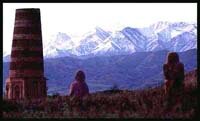
Balbals, Tower and Mountains
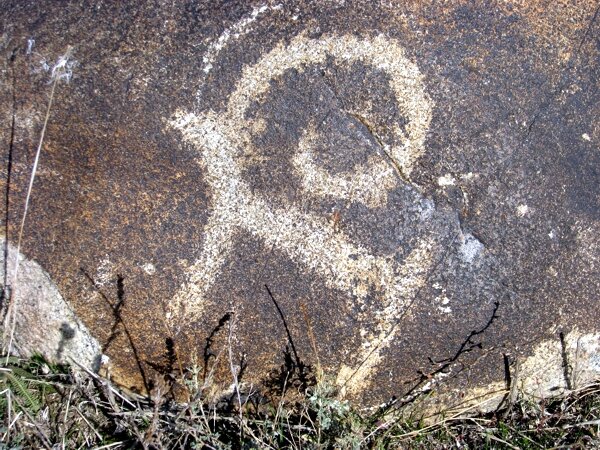
A little further away is a collection of 80 balbals (small statues of the dead thought to have been nomadic grave markers) dating from the 6th century, petroglyphs (depicting mammals, hunt scenes and stone implements), millstones and threshing stones, dating from the 2nd century BC, brought and placed here from all around the Chu valley, Lake Issyk Kul and further afield in the Tien Shan. There are other collections around the Chu valley and in Southern Kazakhstan. The Kyrgyz-Turkish Manas University has helped to publish a booklet, “Sculptured stone figures of Burana” – which is available from the museum.
The small museum, established in 1976, has some artifacts recovered from the site, (jars, coins, a board game …), but it is claimed that the best articles were removed a long time ago to Moscow or St. Petersburg. In the Shamshy valley, itself, a wide range of Scythian artifacts have been found, including a heavy golden burial mask” – which currently is stored in the Historical Museum in Bishkek.
The two rooms are crammed with crockery of different sizes – varying from small cups to vessels that hold more than 100 liters; ceramic and bronze lamps; coins from different ages; examples of different sorts of handicrafts from down the ages;; instruments for grinding corn; pieces of water pipes from the town’s water, irrigation and sewerage systems.
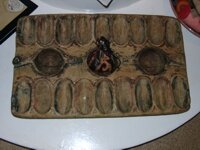
Toghuz Torgooz board
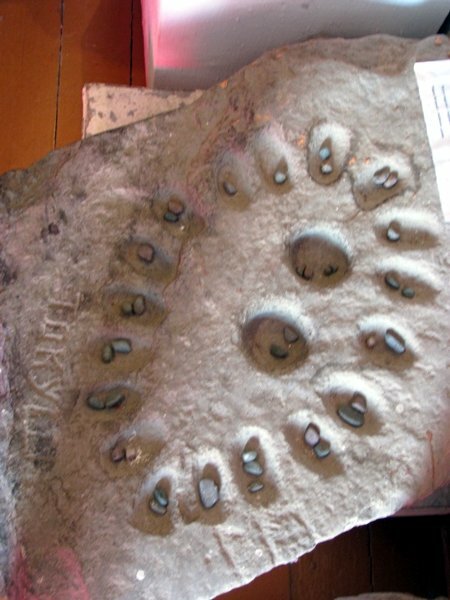
There is even an example of an old stone board for playing Toghuz Korgool - a board game for two players. Although it is an ancient game, (involving counting and strategy), and is found in many parts of the world, even as far afield as Africa - where it is known by such names as Awari and Awo and Gebeta in Ethiopia, (where it is thought to have originated). In Arabic it is known as Mancala which has come to be a generic name for a wide family of similar games. Here, it is sometimes referred to as “Kyrgyz Chess”, indeed, in the former Soviet Union it even became a form of National Sport. In 2001, one of the Top Ten Kyrgyz Sportsmen was a player of the game. Each player has nine “pockets” along one side of the board – each containing nine beads, or stones. (Toghuz means nine in Kyrgyz and several other Turkic languages). Each player takes turns moving beans from one pocket to those on the right.
From the Tower, it is possible to head into the mountains to a picturesque valley; for example, to the Kegeti or Shamshy gorges.
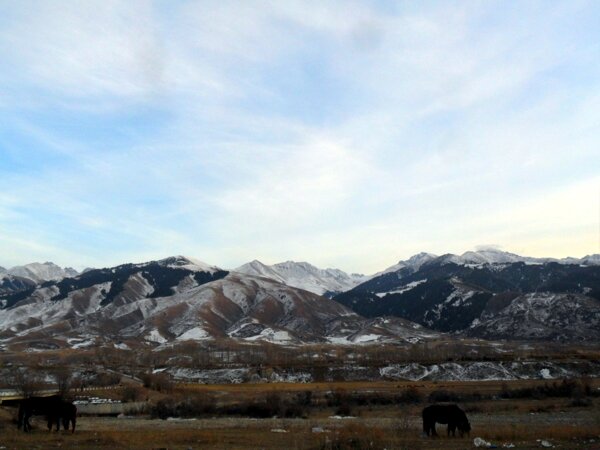
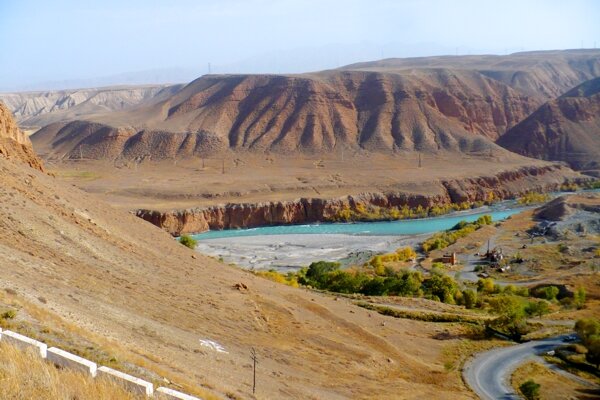
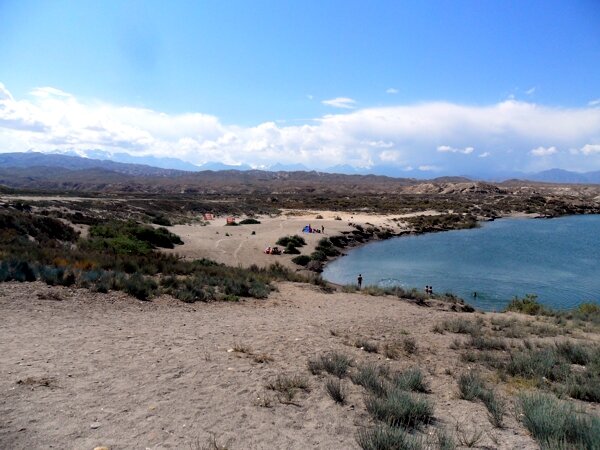
Here are some photographs, taken from a recent excursion to the tower:









 Bishkek